Dr. Joseph Warren’s 1775 Boston Massacre Oration


On the night of March 5, 1770, a conflict occurred between eight British soldiers and their captain and a crowd of citizens angered that British regiments occupied their town. The crowd threw snowballs, oyster shells and wielded clubs to taunt the soldiers near the Custom House. The confrontation resulted in the soldiers firing into the crowd, killing five and wounding others. Dr. Joseph Warren was one of the doctors called to treat the wounded and perform autopsies on the dead. The Patriots vowed not to forget “the bloody massacre” that would later become known as The Boston Massacre. Each year after, on March 5, they held an oration to remind the town of the event.

Paul Revere’s engraving of the Boston Massacre copied from an earlier version by Henry Pelham. Gilder-Lehrman Institute of American History.

In 1775, March 5 fell on the Sabbath. Therefore, “at a Meeting of the Freeholders & other Inhabitants of the Town of Boston…The Comittee appointed by the Town…to apply to a proper Gentleman to deliver an Oration…had made Choice of Joseph Warren Esq. to deliver an Oration on the 6th. of March instant, who had accordingly accepted of said Service.” It was voted that the oration be delivered “at the Old South Meeting House half past 11 O’Clock A.M.”
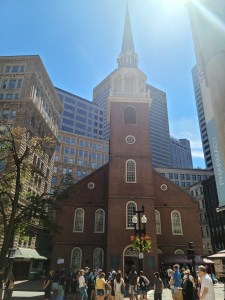
Old South Meeting House circa 2022

Boston buzzed with excitement. The oration was considered a town meeting—illegal under the Massachusetts Government Act. Unlike previous occasions of the commemoration, British troops were abundant in Boston (they had been removed to Castle William after the massacre). The British soldiers were going to resent an oration whose purpose was, in the words of Samuel Adams, “to commemorate a massacre perpetuated by soldiers and to show the danger of standing armies.” Dr. Joseph Warren had delivered the oration in 1772. Samuel Adams wanted Warren’s experience in the pulpit. He knew that Warren would not be intimidated.

In his diary for September 6, 1775, from England, former Massachusetts Governor Thomas Hutchinson mentioned a call from a Colonel James. “He tells an odd story of the intention of the Officers the 5 [six] March that 300 were in the Meeting to hear Dr Warrens oration— that if he had said anything against the King &c an Officer was prepared who stood near, with an Egg to have thrown in his face and that was to have been a signal to draw swords & they would have massacred Hancock Adams & hundreds more & he added he wished they had.” Hutchinson commented, “I am glad they did not for I think it would have been an everlasting disgrace to attack a body of people without arms to defend themselves.”

A crowd of 5,000 gathered at Old South Meeting House including those British officers. Samuel Adams “had long expected they would take that Occasion to beat up a Breeze” and invited them to sit in the pews directly in front of the pulpit so they “might have no pretence to behave ill.” This put the soldiers uncomfortably close to the many leading patriots in attendance. The officers were not only sitting in the pews, some were seated on the steps leading up to the pulpit, and some were sitting on the pulpit itself.

The pulpit today at Old South Meeting House circa 2017.

After spending the morning treating patients, Dr. Warren arrived around eleven o’clock. Rivington’s New York Gazette reported, “A single horse chair stopped at the apothecary’s opposite the meeting, from which descended the orator [Warren]…and entering the shop, was followed by a servant with a bundle, in which were the Ciceronian toga…Having robed himself, he proceeded across the street to the meeting.” A toga was worn by a citizen of Rome and distinguished him from a soldier or a slave. As a student at Harvard, Warren had performed the popular play Cato with his classmates. By wearing a toga, Warren was sending a strong message: citizens would not be intimidated by tyrannical threats.

Since the meetinghouse was jammed with people, he was taken around to the back of the building, where he climbed a ladder to access the pulpit through the rear window. The pulpit was covered in black cloth provided by John Hancock. A soldier grunted. One barked, “Scoundrel.” Warren ignored the British officers who meant to coerce him, looked out over the audience and began to speak. “My ever honored fellow citizens, it is not without the most humiliating conviction of my want of ability that I now appear before you: but the sense I have of the obligation I am under to obey the calls of my country at all times, together with an animating recollection of your indulgence exhibited upon so many occasions, has induced me once more, undeserving as I am, to throw myself upon that candor which looks with kindness on the feeblest efforts of an honest mind.”

He contended that personal freedom is the natural right of every man. “And no man or body of man, can without being guilty of flagrant injustice, claim a right to dispose of the person or acquisitions of any other man, or body of men, unless it can be proved that such a right has arisen from some compact between the parties in which it has been explicitly and freely granted.”

He spoke of their forefathers having nobly resolved never to wear the yoke of despotism, but tyranny, when once established, entailed its curses on a nation. Yet, there was a time when America and Great Britain became so united in affection both countries flourished due to mutual prosperity. He proclaimed, “The hearts of Britons and Americans, which lately felt the generous glow of mutual confidence and love, now burn with jealousy and rage. The many injuries offered to the town, I pass over in silence. I cannot now mark out the path which led to that unequaled scene of horror, the sad remembrance of which, takes the full possession of my soul. The sanguinary theatre again opens itself to view. The baleful images of terror crowd around me, and discontented ghosts, with hollow groans, appear to solemnize the anniversary of the fifth of March. Approach we then the melancholy walk of death.”

When Warren spoke of the events of March 5, 1770, he focused on the agony and despair of the families who had lost loved ones that night. “Come widowed mourner, here satiate thy grief; behold the murdered husband gasping on the ground, and to complete the pompous show of wretchedness, bring in each hand thy infant children to bewail their father’s fate. Take heed, ye orphan babes, lest, whilst your streaming eyes are fixed upon the ghastly corpse, your feet glide on the stones bespattered with your father’s brain.”

Warren’s voice rose to an emotional crescendo. “Our country is in danger, but not to be despaired of. Our enemies are numerous and powerful; but we have many friends, determine to be free, and heaven and earth will aid the resolution. On you depend the fortunes of America. You are to decide the important question, on which rest the happiness and liberty of millions yet unborn. Act worthy of yourselves. An independence from Great Britain is not our aim. No, our wish is that Britain and the colonies may, like the oak and the ivy, grow and increase in strength together. The interest and safety of Britain, as well as the colonies, require that the wise measures, recommended by the honourable Continental Congress, be steadily pursued. But if these pacific measures are ineffectual, and it appears that the only way to safety, is through fields of blood, I know you will not turn your faces from your foes, but will, undauntedly, press forward, until tyranny is trodden under foot, and you have fixed your adored goddess Liberty on the American throne.”

He finished by stating, “With having redeemed your country, and secured the blessing to future generations, who, fired by your example, shall emulate your virtues, and learn from you the heavenly art of making millions happy; with heart felt joy, which transports all your own, you cry, the glorious work is done. Then drop the mantle to some young Elisha, and take your seats with kindred spirits in your native skies.”

The audience stood to a thundering applause. What happened next was recorded in the diary of Lieutenant John Barker of the King’s Own Regiment. “…when after he [Warren] had finished a most seditious inflammatory harangue, John Hancock stood up and made a short speech in the same strain, at the end of which some of the Officers cried out, fie! fie! Which being mistaken for the cry of fire an alarm immediately ensued, which fill’d the people with consternation that they were getting out as fast as they cou’d by the doors and windows. It was imagined that there wou’d have been a riot, which if there had wou’d in all probability have proved fatal to Hancock, Adams, Warren, and the rest of those Villains as they were all up in the pulpit together, and the meeting was crowded with Officers and Seaman in such a manner that they cou’d not have escaped; however it luckily did not turn out so, it wou’d indeed have been a pity for them to have made their exit that way, as I hope we shall have the pleasure before long of seeing them do it by the hands of the Hangman.”

The British responded to Warren’s Boston Massacre Oration with ridicule. On March 15, 1775, British officers and Loyalists gathered on King Street and then proceeded to the nearby British Coffee House where they conducted a mock town meeting. Loyalist physician Thomas Bolton, read a satirical lampoon of Warren’s oration. In addition to his assault on Warren, Bolton reviled other prominent Patriots including John Adams, John Hancock, John Rowe, Charles Lee, William Molineux, Samuel Cooper, Josiah Quincy, and Dr. Thomas Young. Bolton accused that William Molineux, who died in 1774, “through the Strength of his own Villiany, and the Laudanum of Doctor Warren, he quitted this planet and went to a Secondary one, in search of Liberty.”

Despite the Loyalist reaction, “the Thanks of the Town [Boston] be & hereby are given to Joseph Warren Esq. for the Elegant & Spirited Oration delivered by him at their Request.”


References:

Photos of Old South Meeting House by Salina B Baker.

Barker, John. The British in Boston Being the Diary of Lieutenant John Barker of the King’s Own Regiment from November 15, 1774 to May 31, 1776.Cambridge: Harvard University Press, 1924. https://www.google.com/books/edition/The_British_in_Boston/fY0rAQAAIAA

City of Boston. A Report of the Record Commissioners of the City of Boston Containing the Boston Town Records, 1770-1777.  Boston: Rockwell and Churchill, City Printers, 1887. https://archive.org/details/recordsrelatingt18bost

Cushing, Harry Alonzo. The Writings of Samuel Adams, Volume III,1773-1777. The Project Gutenberg eBook of The Writings of Samuel Adams – Volume 3, 2015. https://www.gutenberg.org/cache/epub/2093/pg2093-images.html

Di Spigna, Christian. Founding Martyr: The Life and Times of Dr. Joseph Warren, the American Revolution’s Lost Hero. New York: Crown, 2018.

MHS Collections Online. An Oration delivered March 15th 1775 from the Coffee House by Doctor Thomas Bolton. https://www.masshist.org/database/viewer.php?item_id=3034&img_step=1&pid=34&mode=dual

UNIVERSITY OF MICHIGAN LIBRARY, M|LIBRARY Digital Collections. An oration; delivered March sixth, 1775. At the request of the inhabitants of the town of Boston; to commemorate the bloody tragedy of the fifth of March, 1770. / By Dr. Joseph Warren. ; [Two lines of quotations in Latin] https://quod.lib.umich.edu/cgi/t/text/text-idx?c=evans;cc=evans;rgn=div1;view=text;idno=N11558.0001.001;node=N11558.0001.001:4
 

A Noble Train of Artillery: The Knox Expedition

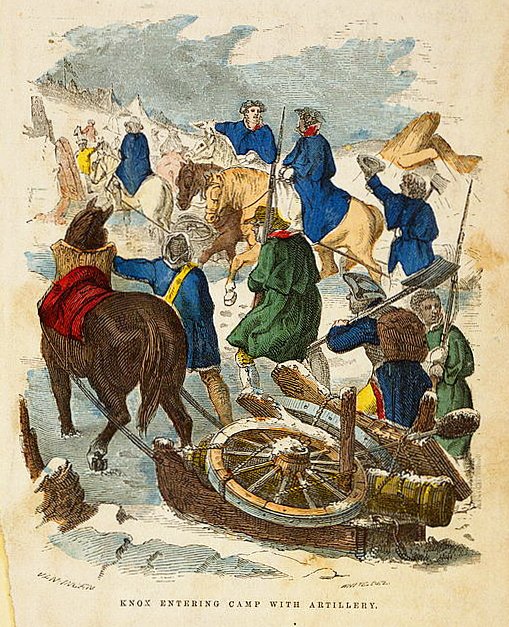
“We shall cut no small figure in going through the Country with our Cannon, Mortars, etc., drawn by eighty yoke of oxen.”   ~~Henry Knox in a letter to his wife, Lucy. December 1775

General George Washington arrived in Cambridge, Massachusetts on July 2, 1775. The Continental Congress had led him to believe that he would find 20,000 battle-tested provincial soldiers. What he found was not a proper army. In his opinion, it was a mob of “puritanical savages.” Further, on his arrival, he was assured that the army had 308 barrels of gunpowder. It was actually only 90 barrels. A lack of heavy weaponry, made offensive operations virtually impossible.

What was Washington, who  was intent on ending the Siege of Boston in one decisive stroke, to do?

Enter a twenty-five-year-old former book seller with militia and battle experience, an interest in artillery, and a talent for building fortifications: Henry Knox.

HenryKnox
Henry Knox by Charles Willson Peale

Henry impressed Washington with his energy, ingenuity, determination, and knowledge. Which man brought up the cache of artillery at Ft. Ticonderoga in upstate New York is unknown, but Henry volunteered to travel the 300 miles to Ticonderoga and bring the artillery back to Cambridge. Several gunners from Boston’s town regiment under the command of Lieutenant Adino Paddock’s old Grenadiers agreed to serve under Knox. David Mason, the man next in command under the aging artillery colonel Richard Gridley, agreed to serve as a lieutenant colonel of artillery of the regiment if Knox was appointed colonel.

On November 8, 1775, Washington wrote to Congress, “The council of officers are unanimously of the opinion, that the command of the artillery should no longer continue in Colonel Gridley, and knowing of no person better qualified to supply his place, or whose appointment will give more general satisfaction, have taken the liberty of recommending Henry Knox.”

Washington issued Knox orders on Thursday, November 16, to take stock of supplies in the artillery corps and to inventory its needs, then to proceed first to the New York Provincial Congress and then to Albany to procure and send supplies to Cambridge. He backed Knox financially, and wrote to General Philip Schuyler asking him to assist Knox in the endeavor.

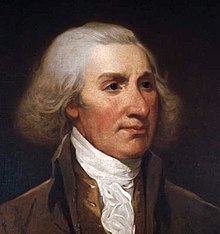
General Philip Schuyler

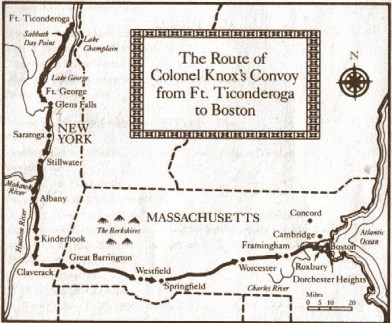
Leaving on horseback and accompanied by his nineteen-year-old brother, William, and an expeditionary force, Knox reached Ticonderoga on December 5, 1775. The plan was to transport over 60 tons of artillery by scows from the northern tip of Lake George thirty-two miles to Ft. George on the southern tip of the lake.

Henry prayed for warm weather, and until that point, the weather had remained mild, but the wind picked up and forced Knox’s freezing men to row into an icy gale. One of the scows fetched up on a rock and filled with water. As long as the scows gunnels remained above the water line, the boat could be floated. With heroic effort, they finally succeeded in getting all the cannon to the southern end of the lake just as it began to freeze over.

Knox Route from Ft Ticonderago to Boston-8x6

On December 17, Henry wrote to Washington, “I have had made forty two exceedingly strong sleds & have provided eighty yoke of oxen to drag them as far as Springfield where I shall get fresh cattle to carry them to camp. . . . I hope in 16 or 17 days to be able to present your Excellency a noble train of artillery.”

Henry began earnest negotiations with local Stillwater (Albany-area) native George Palmer for the expected oxen and sleds. Per Henry’s journal, Palmer walked off in a huff after General Schuyler complained he was charging too much for his services. Thus, Knox relented to using mostly horses to pull the laden sleds.

While William Knox remained at Ft. George to procure the needed sleds, Henry went ahead to the Hudson River, where he and his men took steps to strengthen the river ice in anticipation of the artillery’s arrival and crossing.

Once the horses and sleds (and some head of oxen) were secured, the Noble Train of Artillery left Ft. George and moved along a difficult and exceedingly slow route following the Hudson River, with the crews forced to cross the frozen Hudson four times before reaching Albany.  On January 5, from Albany, Henry wrote Washington: “The want of snow detained us some days, and now a cruel thaw hinders [us] from crossing [the] Hudson River, which we are obliged to do four times from Ft. George to this town.”  

When the train was able to move on, Henry was forced to break up his caravan into smaller groups of sleds due to logistics. On crossing the Hudson east to Massachusetts, cannon broke through the ice and crashed into the water. With the help of locals, they recovered the cannon. On January 9, the last of the cannons had crossed the Hudson.

Crossing and re-crossing the Hudson had proved difficult, but the hills and mountains of western and central Massachusetts were just as challenging. On the down slopes, the huge heavy sleds threatened to run ahead of the teams that were pulling them. They were plagued by lack of snow. Another “cruel” thaw left them stranded in Westfield.

In Westfield, Henry entertained the locals, many who had never seen cannon, by firing a mortar that became known as “Old Sow.” It was here that Henry learned that John Adams and George Washington had named him to succeed Colonel Richard Gridley as colonel of the Regiment of Artillery.

In the last week of January, 1776, the first of the noble train arrived in Framingham, Massachusetts. Henry Knox was back in Cambridge by January 24.

Knox’s journey provided the Continental Army with a windfall of artillery that was used at Dorchester Heights and ultimately led General William Howe to evacuate his British troops from Boston, taking thousands of loyalists civilians with them, and effectively ending the Siege of Boston.

Colonel Henry Knox was promoted to brigadier general in 1777 and major general in 1782. He remained loyal to Washington throughout the war.

General Henry Knox by Gilbert Stuart about 1805

Resources:

McCullough, David. 1776. 2005: Simon & Schuster, New York, NY.

Philbrick, Nathaniel. Bunker Hill A City, A Siege, A Revolution. 2013: Penguin Books, New York, NY.

Puls, Mark. Henry Knox Visionary General of the American Revolution. 2010: Palgrave Macmillan, New York, NY.

http://www.massmoments.org/moment.cfm?mid=29

Portrait of Major General Philip Schuyler from the John Trumbull miniature by Jacob H. Lazarus (1822-91) in 1881. The painting is on display at the Schuyler Mansion State Historic Site, Albany.

Painting of Henry Knox by Charles Willson Peale, National Portrait Gallery, Smithsonian Institution

Painting of General Henry Knox by Gilbert Stuart about 1805. Boston Museum of Fine Arts


This is Dedicated to Major John Pitcairn

Many of you are aware of my excessive interest in the patriot leader and Son of Liberty, Joseph Warren. In fact, the first novel in my series, Angels & Patriots, is dedicated to Dr. Joseph Warren and another man, who was not an American patriot—Major John Pitcairn.

I’m not sure at what point (or why) in my research, these men peaked my interest. Perhaps, it was because both men have largely been forgotten, yet they each played a vital role in the infancy of the Revolutionary War. I read and studied them until I felt I could make an attempt to write about them from their point of view, I perceived them as having some of the same characteristics— integrity, honesty, charm, and heroism.

Both Warren and Pitcairn were mortally wounded at the Battle of Bunker Hill, on June 17, 1775. Their deaths were recorded in a 1786 painting by John Trumbull – The Death of General Warren at the Battle of Bunker’s Hill, June 17, 1775. Warren is the man in white lying in the foreground. Pitcairn is in the back to the right falling into the arms of his son.


There is more information on Dr. Joseph Warren, (who died at 34) than on Major John Pitcairn (who died at 52). A biography about Warren’s life was published in 2012.

I found no dedicated writings about Pitcairn aside from resources on the internet, and a video game, Assassin’s Creed III (2012), in which Pitcairn is ultimately assassinated. Pitcairn was cast as an antagonist in the TV mini-series Sons of Liberty (2015). I wondered why he was singled out as a “bad-guy” when history describes Pitcairn as having a sense of honor and the respect of both the Loyalists and the Patriots of Boston.

After reading accounts of Pitcairn’s life, I tried to picture him as a man, not just a bunch of statistics, dates, and speculation. Ironically, there are no known likenesses of him.

John Pitcairn was baptized at St. Serf’s, Dysart, a port town in Fife, Scotland, on December 28, 1722 (Old Calendar – 1723). His date of birth is not recorded separately, so it may have been the same day.

In his early 20s, John married Elizabeth Dalrymple. Their first child, Annie, was born in Edinburgh in 1746, the year John was commissioned a Lieutenant in Cornwall’s 7th (Marines) Regiment. The couple went on to have six sons and four daughters.

The Marines were disbanded for a time and reformed on a permanent basis in 1755. John retained his lieutenancy. In the Marines, commissions were not purchased. John didn’t reach the rank of Major in the Chatham Division until 1771, at age 48. His son, William, followed him into the Marines.

In December 1774, as unrest spread in the Colony of Massachusetts, he arrived in Boston with some 600 Marines drawn from three divisions: Chatham, Portsmouth and Plymouth. The Plymouth Marines were not properly trained, had unfit officers, had no proper weather clothing or equipment, and were undisciplined. Some of the men sold their equipment to buy rum.

Here, I saw John as a humanitarian with a sense of duty and responsibility for his marines. Not as a naive task master, but as a sensible mature man who understood that respect far out lasted threats and punishments. He found it hard to apply harsh discipline. By example and patience, he managed to drill them into shape. He lived in the barracks with his men to keep them sober and succeeded in gaining their respect.

On the night of April 18, 1775, General Thomas Gage ordered a handpicked assembly of 800 troops to gather on the shores of Back Bay, in Boston. Their clandestine mission was to capture rebel weapons hidden in Concord. Gage assigned Colonel Francis Smith as officer in charge, with Major Pitcairn as Smith’s second.

Pitcairn was in charge of the companies in the vanguard of Smith’s column of British regulars. These men weren’t Pitcairn’s marines; therefore, he was unfamiliar with them and their skills. When his vanguard marched into Lexington, led by Lieutenant Jessie Adair, they accidentally veered down the wrong road and marched toward Captain John Parker’s line of militiamen. Pitcairn was genuinely horrified. I tried to imagine his sense of urgency as he galloped across Lexington Green shouting for his companies in the van to halt and hold their fire.

Still, a shot rang out, and eventually eight provincials lay dead.

After the bloodshed later that day in Concord, the exhausted and frightened British troops retreated from Concord to Boston under constant rebel fire. Pitcairn tried to maintain order among the ragged ranks even after his horse was shot, forcing him to walk.

Two months later, on June 17, 1775, John Pitcairn and his marines were ordered to stand ready as reinforcements for British General William Howe’s regulars as they attempted to march on a little rebel redoubt hastily constructed on the wrong hill on the Charlestown peninsula.

I imagined Major Pitcairn and his marines as they rushed the redoubt; Pitcairn waving his bayonet at the rebels and yelling, “Now, for the glory of the Marines!” I wondered what John’s son, William, saw and thought when a rebel in the redoubt aimed his musket at his father.

Did John Pitcairn see the man who was about to mortally wound him? What were his thoughts when he realized he had been shot in the chest? I’ve read that he knew the shot was fatal, but there had to be more rushing through his mind. Legend says he fell into his son’s arms, and was bleeding so badly that William was covered in his blood.

History paints John Pitcairn as a brave sensible man even as he faced his own death. He was taken by boat back to Boston, and put to bed in a house on Prince Street. General Gage sent a loyalist town physician, Dr. Thomas Kast, to tend to Pitcairn.

John insisted that he get his affairs in order before allowing the doctor to examine him. Hours later, Dr. Kast pulled John’s waistcoat away from his wounded chest. John hemorrhaged to death. His son cried out to the marines, “I have lost my father!”

John was buried in the crypt of Christ Church, the Old North Church, in Boston. The fatal bullet and his uniform buttons were returned to his wife and children.

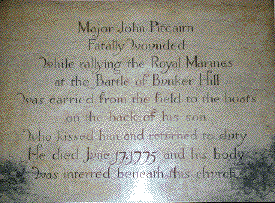
JohnPlaqueMajor John Pitcairn
Fatally wounded
while rallying the Royal Marines
at the Battle of Bunker Hill
was carried from the field to the boats
on the back of his son
who kissed him and returned to duty
He died June 17, 1775 and his body
was interred beneath this church

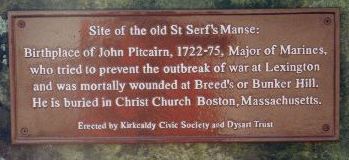
John’s birthplace, the old manse of Dysart, was demolished over a century ago. The marble plaque John erected to his parents’ memory in 1757-8 in St. Serf’s was destroyed by vandals in the early nineteenth century, after the kirk fell into ruin. As a result, until recently there was nothing to commemorate John in his hometown.

DysartPlaque


Read more about Major John Pitcairn in my novel Angels & Patriots Book One. Buy it today on Amazon in paperback or Kindle eBook.

Angels and Patriots Book One

Angels & Patriots Book One


Resources

  1. http://www.silverwhistle.co.uk/lobsters/pitcairn.html
  2. http://colonialamericans.weebly.com/major-john-pitcairn.html
  3. http://drbenjaminchurchjr.blogspot.com/2011/12/major-john-pitcairn.html
  4. Painting of “The Death of General Warren at the Battle of Bunker Hill” by John Trumbull the Boston Museum of Fine Arts
  5. Borneman, Walter R. American Spring: Lexington, Concord, and the Road to RevolutionNew York: Little, Brown and Company, 2014. Print.
  6. Hand-colored engraving described as “The shooting of Major
    Pitcairn (who had shed the first blood at Lexington) by the
    colored soldier Salem.” Courtesy of J. L. Bell

Lexington and Concord: The Last Days Leading up to a Revolution, Part 2

The violences committed by those who have taken up arms in Massachusetts Bay have appeared to me as the acts of a rude Rabble without plan, without concert, & without conduct, and therefore I think that smaller Force now, if put to the Test, would be able to encounter them with greater probability of Success….. 

….In this view of the situation of the King’s affairs, it is the opinion of the King’s servants, in which his Majesty concurs, that the essential step to be taken toward reestablishing government would be to arrest and imprison the principle actors and abettors in the Provincial Congress (whose proceedings appear in every light to be acts of treason….

~~Lord Dartmouth to General Thomas Gage, about April 16, 1775

lord dartmouth

The Earl of Dartmouth
Secretary of State for the Colonies 1772 – 1775

This was part of Lord Dartmouth’s long awaited, cross-Atlantic response to General Gage’s admonishments, which he had written to Lord Dartmouth in late January 1775, on how to handle the rebellious acts of the colonists. Those defiant acts were seemingly endless: the illegal proceedings of the Massachusetts Provincial Congress and the Continental Congress, the Suffolk Resolves, smuggling, seizures of powder and munitions, and threats to march into Boston “like locusts and rid the town of every soldier.” (Philbrick quoting Rev. John Andrews, pg 71)

thomas gage

General Thomas Gage
Royal Governor of Massachusetts 1774 – 1775

General Gage did not consider himself a royalist, but part of his advice to Dartmouth was something he believed the King wanted to hear:

“It’s the opinion of most People, if a respectable Force is seen in the Field, the most obnoxious of the Leaders seized, and a Pardon proclaimed for all other’s, that Government will come off Victorious, and with less Opposition than was expected a few Months ago.”

By the time Lord Dartmouth’s lengthy letter of advice reached Thomas Gage, tempers among the British ministry, the loyalists, and the patriots in Massachusetts had simmered down. In fact at this point, there was growing discord among the patriots’ own ranks, rooted in a misguided optimism that once King George III saw for himself that his ministers had misled him, the king would withdrawal his troops and the demand for unfair taxes would withdraw with them, leaving New England free. That optimism was founded in the colonists’ previous experiences with protests and the king’s withdrawal of the transgressions.

If Gage had chosen to do nothing in response to Dartmouth’s letter that spring, the patriots may have had a difficult time maintaining a united front. Ironically, Dartmouth’s letter, based on information and instructions months old, arrived around the same time Gage was receiving valuable information from his British spies. Those things came together to lead Gage to make a series of decisions that would change the course of history.

Just as ironically, one of Thomas Gage’s spies was a trusted colleague among the members of the Sons of Liberty and the Provincial Congress: Dr. Benjamin Church.

benjamin church

Dr. Benjamin Church

When it came to rebel secrets and plotting; only Samuel Adams, John Hancock, and Joseph Warren were more involved than Benjamin Church. But Benjamin had an expensive mistress, and spying brought the ready cash he needed to please her. He had no qualms about betraying his fellow patriots in exchange for the means to pay for the treasures that lay between the legs of his mistress, Phoebe Yates.

Church, among other spies, assured Gage there was a stockpile of provincial armaments located in Concord. Instead of taking Dartmouth’s advice to arrest the leaders of the Provincial Congress, Thomas Gage focused on securing and destroying the rebel military stores in Concord.

Sources:

Philbrick, Nathaniel. Bunker Hill A City, A Siege, A Revolution New York: Penguin Books, 2013. Print.

Borneman, Walter R. American Spring: Lexington, Concord, and the Road to Revolution New York: Little, Brown and Company, 2014. Print.