A Covenant of Blood: Portraying Major John Pitcairn in Historical Fiction: Guest Post by Avellina Balestri

Though I only recently published my first American Revolution novel, All Ye That Pass By: Gone for a Soldier, I have had the aspiration for some time, and have gone through variations of drafts since I was twelve. When I was fourteen, I even contacted the Dysart Trust and the Kirkcaldy Civic Society in the Lowlands of Scotland to learn more about their native son, Major John Pitcairn, the intrepid British marine officer who famously shouted “Disperse, ye rebels!” on Lexington Green where the American Revolution began. In the process, I befriended Carol McNeill, a stalwart historical society volunteer, who I carried on a regular correspondence with through phone and internet. I came to see her as my long-lost Scottish aunt and consider her to be one of the major influences of my formative years.

Together, we discussed many aspects of the town of Dysart’s history, as well as Major Pitcairn’s lineage. His mother was related to medieval royalty, and his father served as a chaplain under the Duke of Marlborough in the Cameronian Regiment. With a strong connection to the Covenanters, recruits to this regiment would be given Bibles upon entry and sometimes sign them in their own blood. This fierce and formidable nature passed on to John, who joined the Marines at a tender age and went on to serve with them for some 30 years, until his heroic death in action at the Battle of Bunker Hill. In his heroism that helped lay the groundwork for the marines eventually becoming a standing force and being named “royal,” as he had always hoped for throughout his career.

Pitcairn’s personal attitude towards colonial complaints on the eve of revolution was markedly unsympathetic, and he advocated taking a firm hand with the rabble-rousers. But in spite of being brusque in many instances, he came to command the liking of the Bostonian civilians among whom he was stationed. As representative of martial law on North Square, Pitcairn helped settle disputes between soldiers and civilians and organized comitees that prevented a break-down of civic order during the British occupation. One citizen of Boston called him “an amazingly gentle man”, and insisted that that “he was perhaps the only British officer in Boston who commanded the trust and liking of the inhabitants.” Even Patriot partisans and propagandists, who decided he was “a good man in a bad cause.” Ever the son of a preacher, he remained a regular church-goer, and although he had a salty tongue, he would abstain from swearing on the Lord’s Day.

In an official capacity, Pitcairn made an impression on his marines through his hands-on leadership style. He was a strict disciplinarian and demanded excellence, but led by example and maintained the same high standards in his own comportment. Ever active, he received daily reports from his battalion commanders, personally oversaw drilling, struggled to ascertain needed supplies from the high command, accompanied the marines on long marches into the hostile countryside, and at one point even lived with his men in the barracks Pitcairn was certainly not a person to cross, although he was generally humane in his treatment of those under his command, using the punishment of flogging only as a last resort, and even then with some distaste. He was also occasionally willing to spare the life of deserters. They earned respect for their tough, tenacious commander and came to view him as something of a surrogate father and embodiment of their fighting spirit. In time, he did turn them into an effective fighting force.

The Death of General Warren at the Battle of Bunker’s Hill, June 17, 1775 by John Trumbull. At right center, Pitcairn falls into the arms of his son.

Called “the best of husbands and fathers” by his intimates, Major Pitcairn tragically yet heroically fell into the arms of his marine son, William, when he was mortally wounded storming the rebel position at the Battle of Bunker Hill. Struck as many as four times in the chest (having already sustained two lesser wounds but refusing to retire), he died several hours later in Boston. His son William was seen wandering through a street after the battle, covered in blood. When someone approached to help him, he haltingly explained that it was not his blood but rather his father’s. “I have lost my father,” he murmured, close to tears. Some Marines nearby added, “We have all lost a father.” He truly had sealed his lifelong covenant as a gallant soldier and a faithful man in blood.

The following is an excerpt of Pitcairn’s first appearance in my novel Gone for a Soldier. He is attending a party in London where the protagonist, 18-year-old Edmund Southworth (alias Ned) has been taken by “Gentleman Johnny” Burgoyne. General Thomas Gage is also in attendance. I tried my best to stay as true to what we know of Pitcairn’s background and personality as I could, as well as representing Gage and the other historical characters in a believable manner, and I had a great deal of fun doing it! Major John Pitciarn, RIP.

(To purchase the Gone for a Soldier, from which this excerpt comes, in paperback or Kindle format, please go here: https://www.amazon.com/gp/aw/d/B0D9QMCS6N)

***

“Troubles?” came a gruff Scottish burr from behind them. “Send me to America, and by the faith of my body, these damned rebel bastards will disperse before I can get my sword out of the scabbard!”

Edmund turned to see a middle-aged man with wide brown eyes and a self-confident half-grin, dressed in an officer’s uniform with an anchor decorating his moon-shaped gorget.

“Ah, Major Pitcairn, allow me to introduce you to General Burgoyne’s traveling companion, who happens to probably be a distant relation of mine,” Gage said, gesturing to Ned. “Mister Edmund Southworth, this is Major John Pitcairn of His Majesty’s Marines.”

Pitcairn shook Ned’s hand so vigorously that Ned felt the need to check afterwards to make sure it was still attached to his wrist. “Come to join the service, lad?”

Ned cast a quick glance over his shoulder to see if Gage was likely to give away his recusancy. But the general kept his face suitably unexpressive. They were cousins indeed.

“I…have thought upon it, sir,” Ned answered.

“There’s a time for thinking and a time for action,” Pitcairn declared. “When I was younger than you, I was out about my duty, and all the better for it. The only real downside was the government’s unfortunate habit of disbanding the Marines, only to reassemble them, every other week. They seem to think we’re good for nothing but slicing off pirate’s heads and mopping the floor with Jacobite gore!”

“I think I might pay to see you personally confront pirates,” Gage declared. “Or one of those dreadful reptilian monsters lurking in Scottish lakes, for that matter…”

“What, pay me?” Pitcairn checked. “I just want to make sure the compensation is flowing in the right direction…”

Gage barely managed to suppress a laugh. “You may have to check with the admiralty about such matters…”

“Ohhhh don’t you get me started on that bloody ungrateful lot…”

“Now, now, my dear Major,” Gage chided him. “You know how quick they can be to interpret everything as mutinous. But you’ve survived worse at Louisbourg, alongside Brave Wolfe.”

“Yes, bottling up the frogs in their own damn pond, while they were shooting poisoned bullets at us, the Gallic curs!” Pitcairn snorted. “But we taught them a thing or two not to be forgotten, if they lived to remember, that is. Men of vision should have realized then and there the necessity of maintaining the Marines at all times. Someday we’ll be called royal, as God is my witness, and a man of my age and experience will be able to hold his head high as a general, as would be the case if I settled for an army commission. Mark my words, we will be made a standing force, ever on call to forward the national interest with fire and sword.…”

“Even if you remain the harshest critic of your own recruits,” Gage chuckled.

“It’s true that the damn animals passed onto me are never the easiest to train, but they always submit to me in the end, one way or t’other, and when we’re finally put into action, we’ll make any bloody revolutionary who dares to rear his ugly head submit to us.” He jutted out his chin.

“What if the next batch of recruits are short of stature like the last batch?” Gage inquired. “I know you were rather perturbed over the prospect.”

Pitcairn groaned. “I admit to having been hurt and mortified by their appearance. It can be a nightmare trying to clothe them in a manner not resembling clowns. If I have to blast out one more bloody Frenchman’s brains for daring to call us petits grenadiers, God spare me…”He paused his lament and stretched out his hand as if to measure Ned. “You, lad, you’re not too terribly short. Forsake the army, if they’re the ones after you, and cast your lot in with us.”

“I…umm…” Ned stammered.

“This young man and I were just having a religious conversation,” Gage remarked, as he poured Pitcairn a brandy. “So tell me, Major, as the son of the esteemed Reverend David Pitcairn, do you consider yourself a Presbyterian or an Anglican? Your father may have been a Presbyterian moderator, yet you’ve taken the Test Act affirming the King as governor of the Church of England and have a history of attending services of both persuasions. Indeed, on multiple occasions, we’ve witnessed each other receive the Sacrament of the Lord’s Supper under the auspices of the Church of England, yet when you are across the border in your native land, I hear that you still receive communion under the auspices of the Church of Scotland.”

“I’m a damned Protestant,” Pitcairn grunted, then raised his glass in a short salute. “If the King is the governor of the Church in England as well as a member of the Kirk in Scotland, according to the national settlement, my stance should be enough for any good Briton. Though I must say your King Henry was a damn greedy fellow…”

“No comment,” Gage sighed, and Ned couldn’t help but smirk.

“A bit of a loon too. Went through, what, six or seven wives? That’s a man just looking for trouble, if you ask me. One is quite enough…”

“You just nurse a grudge against King Henry because your relation Andrew Pitcairn and seven of his sons were slain at the Battle of Flodden,” Gage declared. “You blame us Englishmen for hammering the Scots again…”

“Perhaps I do,” Pitcairn admitted. “Family loyalty is precious to me. But there are other points of contention as well.”

“Such as?”

“The stuff that makes a real reformer,” the major replied. “Our man, John Knox, unlike King Henry, did not enrich himself by way of religious upheaval. He said, ‘None have I corrupted, none have I defrauded; merchandise have I not made.’ And he had no headless wives to haunt him either!”

“Well, no, but perhaps a monstrous regiment of women, and royal ones at that…”

“It was Mary Stuart that got under his skin,” Pitcairn specified. “She was Romish, through and through, and probably blew up one husband to move on to another…”

“But Knox even angered Queen Elizabeth in the south, a Protestant sovereign who might have been a source of succor for him, saying female rulers should be cast down,” Gage said.

“He didn’t mince words, I’ll give you that,” Pitcairn conceded. “But then again…”

“Neither do you.”

“Neither do I,” the major admitted. “That being said, Knox departed this veil of tears with his grieving wife by his bedside, reading Scripture to him as a good helpmate should. Also, like my father, I have managed to endure married life without any lethal explosions cutting short the experience. On top of that, my father was in the service of Good Queen Anne, so clearly, all’s well that ends well with the women.”

“So you people somehow charmed Queen Anne into forgetting your founder’s sentiments?”

“Oh, we can be the most charming folk alive when we want to be. Comes with being among the elect, you know!”

Edmund could see how much Pitcairn was enjoying himself, and found his daring sense of humor to be infectious. Ned giggled, and Pitcairn flashed a glance at him, resting his hand on his hip. “Who knows? We might even bother to pull the less fortunate folk of this island on board the ark on the day of the deluge, if you treat us right!”

“Well, if anyone could redeem us, your father was surely the man,” Gage said. “He will always be remembered not only for his piety but also for his gallantry as a chaplain in the Cameronian regiment.”

“Aye, alongside Marlborough on the continent,” Pitcairn confirmed. “He saw action at Blenheim.”

Gage turned to Ned. “The Cameronians are the inheritors of the Covenanters, you know. Altogether brazen folks, who refused to accept anything deemed too Papist from King Charles before the Civil War. When he tried to force them to accept his high liturgical tastes in the name of the Church of England, they signed their names to a covenant in Greyfriars Kirkyard…”

“And signed Bibles in blood,” Pitcairn finished, pouring some wine into his brandy.

“Good God, do the Cameronians still expect that sort of thing when it comes to the Bibles they give each new recruit?” Gage queried.

“Not expected,” Pitcairn said, stirring his brand and wine with his finger. “But not unexpected either.”

“Intense, that,” Gage chuckled.

“Nothing else will do for us, I’m afraid,” Pitcairn replied. “My father said it was our purpose to stand along the pathways of this world, crying, ‘Stay, passenger, read what we have written with our right hand!’”

“Your names,” Ned murmured. “That is what is written there, in your blood…”

Pitcairn smiled approvingly and nodded. “It’s just like in the Book of Life, on the Last Day. My father taught me that the devil is kept at bay by the man who puts the flow of his life upon the Word of God. That is the covenant, pure and simple, between God and man, sealed in blood. God’s blood. Our blood. That is everything in the end, aye, our last word upon any subject.”

Like a sacrament, Ned thought, though he dared not say it. An outward and visible sign of an inward and invisible grace.

“Once hunted by kings, then put into the service of kings,” Gage observed. “Quite an accomplishment for your people, Pitcairn.”

“Aye, when the rights of the Kirk were restored under William and Mary, we responded with the fiercest loyalty to the crown, and have done so ever since,” Pitcairn said. “But my father had greater hurdles to overcome than any past lack of royal patronage.”

“In what way?” Edmund asked.

Gage shot Ned a look as if cautioning him not to press the subject, but it was too late.

“He nearly killed himself trying to get our bloody roof fixed, because the damn committee in Dysart were too filthy cheap to cover the cost of either repairs or extensions for the manse next to Saint Serf’s church,” Pitcairn declared. “It was nigh uninhabitable, vermin-riddled, drafty, and leaking all over the damn place when it rained! I remember listening to mice gallivanting about all night and then having to ring out my soggy clothes in the morning! God’s bones! Five children and a maid in one room, that was how I grew up! No wonder I turned out like this! Pirates, Jacobites, and Frogs are nothing after being stuffed into a hole like bloody rabbits, and I was the youngest of the litter…”

“Oh…dear…” Ned managed awkwardly.

“Had to be christened the day I was born, and you know why?” Pitcairn pressed.

“Your father was a minister who could take care of the matter himself, and this auspicious birth occurred next door to the church to which he was assigned?” Gage offered.

“Besides that, though,” Pitcairn huffed. “It was December, along the Firth of Forth, in that miserable, medieval hovel! They thought I might not last the night!”

“Having experienced the chill of Scotland even in the spring, I sympathize with your plight coming into the world in an even more inhospitable northern season,” Gage commiserated.

“Indeed. The only thing that stood between me and an infant’s casket was…”

“Was being who you are,” Gage finished.

“Aye, was being who I am,” Pitcairn confirmed. “Perhaps it prepared me for my calling. A soldier must scorn the effects of heat or cold when going about his duty, and I was already trained to do just that from my infancy. What doesn’t kill you makes you strong and all that.”

“The reaper does seem rather intimidated by you,” Gage teased.

“Well, the reaper should have done us all a favor and paid a visit to the church committee,” Pitcairn decided. “No matter how cramped the manse was, my father always had to leave a room open for any guest who might stop by, because he was just the generous sort. Same with tea, you know. He wouldn’t keep more than a pound in the house without handing it out in charity to parishioners down on their luck, saying the house could not bear the excess.”

“Oh, well, he couldn’t have foreseen that a handful of Bostonian maniacs would cause a shortage,” Gage said. “Otherwise, he could have set up a nice little side business…”

“Should have too, but you know, he was a good man, God love him, for he loved God well. The damn committee may have given him hell, but surely he’s in heaven now, and I’ve made sure he’ll be remembered with all due reverence here on earth. His children will forever cherish him, even if he had too many of us to remain fully sane…”

“Then you had ten,” Gage remarked. “I am still trying to figure out how you managed it, being away from hearth and home so often.”

“I have an internal clock that sends me back to the nest for mating season,” Pitcairn declared, tapping his temple. “But your Lady Margaret has proven to be just as fertile as my dear Betty. And here you are today, with ten of your own. We play, we pay.”

“You’re right,” Gage conceded. “Someone should shoot us. I suppose I’ve just grown accustomed to bringing her along with me wherever I go. Then…things happen.”

“Is she still upset about the prospect of leaving the sickly young one behind when you go back to Boston?” Pitcairn asked sympathetically.

“Yes,” Gage admitted, “but it can’t be helped. He is…frail. A sea voyage might…” The general shook his head. “He is safer here.”

Pitcairn nodded. “You know, Betty and I are not unfamiliar with such things. Been through it ourselves, twice, and hope to God not to go through it again. I think…you are right to take precautions.”

“Several of the children who have stronger constitutions and are not enrolled in school here will be accompanying us back across the water,” Gage said. “That should assuage Margaret somewhat. The bulk of our offspring were born in the New World, so to their minds, it’s a matter of going home.”

“Ah, they’re bound to be little trouble-makers then, General,” Pitcairn twitted.

“Oh, they are, I assure you. In fact, they may need an exorcism to cast out some of that Yankee unruliness! Speaking of which…Pitcairn, you really must tell Youth Southworth here the story of Saint Serf and the devil. He’s just the sort to appreciate such a pious yarn.”

“I would, yes,” Ned confirmed.

“Well, legend has it that the holy hermit came to Dysart, on the steps of the salt sea, and vowed to be the salt of the earth,” Pitcairn began. “His intention was to commune with God and be the true salt of the earth. But Satan got wind of his presence and showed up in person to disrupt Serf’s devotions. Of course Serf would have none of it, so he wrestled the devil inside the cave that had served as his cell. He won, too. Then he went on to save Princess Theneva whose cousin had brought her full with child against her will. Her father had set her adrift in a boat out of shame, but a school of fish guided her to shore where Serf took her in and raised her child. The boy was Saint Mungo, the patron of Glasgow. But Serf remained the patron of Dysart, and for centuries, the townsmen thought praying to him would ward off English pirate raids.” Pitcairn squinted at Gage.

“I’m not apologizing,” Gage declared. “Your people did the same to us.”

“Well, we held our own in terms of defense as well as offense. The church still has a fine tower as a vantage point, with very neat slits for the arrows. You’re welcome to take a tour if you care to come back up our way again.” He made a gesture as if holding a crossbow.

“It’s not one of my personal aspirations,” Gage said.

“Not even as a pilgrim, General? I thought your family used to like that sort of thing,” Pitcairn joked. “All sorts of folk used to come out on pilgrimage back in the day. They would leave seashells in the walls of the church, paying tribute to some Papist statue or other, long gone, though the niche is still there, alongside a carving of lilies.”

Ned swallowed hard. “The niche…it must have been for…”

“The Lady,” Gage mumbled.

“Aye, most likely. But as I said, the building is properly reformed now. Most of the Romish bits and pieces were pulled down long before my time.” He smirked. “When we were children, my siblings and I used to throw stones at one of the broken ornaments left over on the arch outside. It was great fun.”

Gage clicked his tongue. “Little vandals!”

“Little Covenanters!” Pitcairn laughed. “We used to muck about in the caves where Saint Serf was supposed to have dwelt. Our nanny said we shouldn’t, that it was still haunted by Satan’s visit, but we were not the sort to be intimidated, even if we did sense a strange presence down there every so often. The caves were used for a wine cellar by then. We would pretend the bottles held the devil’s blood, and swish it around while chanting rhymes to ward off any lingering demons. Now I suppose I’ll have to content myself with stirring damn Yankee blood instead. The seditious kind, you understand. I have no quarrel with loyal sorts nor those in the households of fellow kingsmen!”

“Well, you are rather too colorful in your language to be a saint, even if you would happily wrestle Satan himself, so perhaps your decision to focus on subduing earthly rebels is for the best,” Gage remarked.

Pitcairn made a half-grin. “God’s blood, General, but this is any old damn Thursday! I don’t swear like this on the sabbath!”

“No, no, you don’t,” Gage admitted. “How, pray tell, do you manage it?”

“It’s a damn skill,” Pitcairn beamed. “I have impeccable self-control!”

“For one day a week only?”

“Yes, well, it’s the Lord’s Day,” Pitcairn replied, with a sincerity that Ned found endearing. “Besides, I’m not fool enough to present myself at the Lord’s Table to receive the Lord’s Supper with a dirty mouth. My father would roll over in his grave. So I go on a fast from language from the time the sun rises ‘til it sets.”

“And you never forget yourself?”

“My son makes that impossible. You see, if I swear before darkness falls on Sunday evening, I lose money to him. But I never lose. So he has to pay me instead.”

“A man of pure principle,” Gage chuckled. “Just not enough to win Colonel Gardiner’s approval, I’m afraid.”

Pitcairn nearly spit out a mouthful of brandy. “God’s wounds!”

“There you go again,” Gage sighed. “He’d have you standing on pointed logs for that!”

“Well, back then, my tongue was even saltier!” Pitcairn laughed. “I went straight from the manse into the Marines, and my mouth went straight from fair to foul! I just made the mistake of showing off my newfound skill around the wrong man! Ate me alive, he did!”

“Was this the same Colonel Gardiner who distinguished himself during the last Jacobite rebellion?” Ned queried.

“Aye, that he was, a fellow Lowland Scot,” Pitcairn confirmed. “He served as Sir John Cope’s second-in-command when the damn Highland rebels took Edinburgh for the Young Pretender. Didn’t think much of Cope’s handling of the situation, but was resolved to fight or die for the security of his country.”

“Cope, to my understanding, was a cautious but conscientious man who felt that he lacked support as a commander in Scotland because he was an Englishman,” Gage stated. “He had a particularly unsatisfactory experience with two Edinburgh volunteers he sent out as scouts, only for them to stop off at a tavern mid-mission for a meal of oysters and sherry. They proceeded to drink themselves into a state of unwarranted euphoria and get themselves captured by a young attorney’s clerk with Jacobite sympathies.”

“To be fair, they were hardly older than the clerk themselves, recruited directly out of the university to deal with the crisis,” Pitcairn recalled. “But I agree they deserved to be boxed about the ears. And Gardiner would have been the first man to do it. He was made of steel as surely as his sword and faced down the Highland Charge at Prestonpans without flinching. Even when Cope himself had fled the field, Gardiner stayed and rallied the survivors.”

“Cope did exhort his men to hold fast and behave like Britons, but they would not heed him,” Gage said. “They abandoned him rather than the other way around. There was little to be done for it…”

“Except to die fighting,” Pitcaurn declared. “The rebels took Gardiner down, but not before he received five bloody wounds in his body, the last one by a Lochaber ax! Still lived for many hours afterwards! Now that’s a damn proper way for a soldier to go…”

“No need to emulate it too closely,” Gage cautioned.

“Of course not! We should strive to do one better in the wound count!”

Gage rolled his eyes again. “Lest we falsely believe he had a death wish, it should be noted that Gardiner had complained about his horse being skittish before the battle. One cannot help but wonder whether his refusal to retreat was completely his own idea…”

“Seven hells! There’s no way that Gardiner would have willingly gone off with Cope to bring news of their own defeat,” Pitcairn countered. “He stayed because it suited his ferocity. Like my father, he took part in Marlborough’s campaigns. We Scots and Englishmen were just upon the brink of union by way of parliament. But I say that our unity was forged first and foremost amongst soldiers bleeding common blood. And Gardiner bled. Got shot in the mouth at Ramillies and was nearly bludgeoned to death by some scavenger knave. But a nun from a nearby convent intervened and nursed him back to health. He was only fifteen at the time, and to her credit, she treated him with maternal tenderness. She even tried to make a Papist out of him, but he had enough sense to refuse, though at the time, he hardly thought of God in any respect.”

“Until his vision,” Gage remarked, somewhat sarcastically.

“I spent little enough time with Gardiner, and I know some men called him mad,” Pitcairn said. “But my father knew him better and believed God had touched his lips with hot coals, granting him the gift of holy violence to pursue the goal of lasting glory. That’s enough for me.”

“And his burnt lips also caused him to see things?” Gage surmised.

“There has been precedent,” Pitcairn reminded him.

“What sorts of things did he see?” Ned asked, increasingly intrigued.

“Well, by the time the vision came to him, Gardiner was all grown up and leading a dissolute life,” Pitcairn related. “One night, as he waited in his chamber to rendezvous with a married woman, he started to flip through a book from his pious mother to pass the time. The Christian Soldier by the Puritan divine Thomas Watson, I believe it was. As he read, he saw a strange light fall upon the open page. He turned his head, thinking the candle upon the table had flared, but then saw another thing.” Pitcairn held out his hand, as if to indicate a mystery in their midst. “Yes, he claimed that he saw nothing less than Christ upon the cross, stretched out in His suffering, and he heard a voice, or what he thought was a voice, demanding, ‘O sinner, did I suffer all this for thee, and are these the returns?’ After that night, Gardiner abandoned his former way of life. He became devout, so much so, his friends questioned if a fall from his horse some time before had left him addled in the head.”

“Plausible,” Gage said.

“But not probable,” Pitcairn retorted. “Not to my mind. From the night of his visitation to the day of his death, he kept up the practice of praying and reading scripture in the wee hours of the morning, even during campaigns. And his fury over swearing…well, if one had seen God, it’s damn hard to lay the blame on him for that, even one such as myself. What he saw changed him, aye, in truth. And the manner in which the man fought testifies to something beyond himself. It’s as Thomas Watson said, ‘A Christian fights the Lord’s battles; he is Christ’s ensign-bearer. Now, what though he endures hard fate, and the bullets fly about? He fights for a crown!’”

“I have no desire to profane the sacred, believe me, but it seems strange in these latter days for God to simply show Himself in all His glory to one sinner, yet not others,” Gage remarked.

Pitcairn shrugged. “The Lord knows what He is about.”

“Yes, but I mean, you and I, we’re church-going men, and we’ve not seen anything like that. Or have you?”

“Hell, no,” Pitcairn chortled.

“There, that’s my point. It smacks of enthusiasm on Gardiner’s part, flights of fancy…”

“But He knows what He is about,” Pitcairn repeated, pointing upward. “If it were good for such a man as you, or even such a man as me, to see God before Judgment Day, well, we would. And if not, we won’t, and we’ll wait. It’s as simple as that.”

“Is it?”

“I think so,” Pitcairn said. “But whether you believe in Gardiner’s vision or not, none could fault the man’s guts nor his integrity. It’s what made his friendships last, even with those who thought him daft. Aye, the man even gained favor with the royal family. It made his cruel fate all the harder for so many to bear, especially how his servant found him, nearly stripped naked by those Highland barbarians, and crumpled in agony under a thorn tree.”

“Still alive, with five wounds?” Ned gasped.

Pitcairn nodded. “He was carted off to a nearby church manse where he was nursed by two young Jacobite ladies until he succumbed. His own home, a stone’s throw away, had also been converted into a hospital. Bloody tragic, those times, with him leaving behind a wife and five children. You know, he settled down right well with her after his past dalliances. They suffered through smallpox killing a number of their brood. Broke something inside him, I think. The illness, mixed with the grief, certainly broke his health. But his heart never lost its courage. His faith would not yield even when his breath did. When my father heard of his fall, he quoted Knox, ‘Live in Christ, die in Christ, and the flesh need not fear death.’ That’s the measure of a man, he said, that the spirit conquers flesh.”

“You don’t measure too badly yourself,” Gage said, with a slight smile.

Pitcairn smiled in return and made a roof shape with his hands. “Above the door of the manse where I was born, an inscription reads, ‘My hope is in the Lord.’ And so, for all my bloody sins, I am sworn to praise the Lord of Hosts who made souls like me to fill the ranks of fighting men, on land and sea.”

Pitcairn glanced across the room to where Burgoyne stood, leaning against a column, chatting it up with a young lady friend of the Duchess of Devonshire who looked positively enraptured with her wide doe eyes.

“Hell’s teeth, if that isn’t Gentleman Johnny, trying to get at it again. He’s giving that lass no space to breathe.”

“That noxious perfume he’s wearing is likely compromising her judgment,” Gage remarked. “She has only just made her coming out, you know, so this sort of experience is new to her.”

“Now, then, she can’t be much older than my youngest daughter Janet,” Pitcairn said in distaste. “Soon he’ll sweet-talk his way into slipping his hand down her bodice, or worse, her hand down his breeches!”

“That has been known to happen,” Gage sighed.

“This will never do. She bloody well needs rescuing.” With that, Pitcairn was off.

Gage gave Edmund a bemused look. “Every young lady should have a belligerent Scottish marine on hand, stuffed to the gills with paternal instinct, to save her from the wolves. He’s quite a decent sort, once you get used to him.”

“He seems like it,” Ned concurred.

“He’s akin to heavily salted oatmeal. Once you get used to the flavor, it’s actually hearty fare, and even good for you. Just make sure to have plenty of water on hand to wash it down.”

“Just not saltwater,” Ned laughed.

“Well, no,” Gage agreed. “Though that’s probably the kind his people would try to sell us if we ever found ourselves in his neck of the woods. His own tongue certainly seems to have been dipped in it, in more ways than one. As you may have noticed, his accent can at times compromise his diction.”

“I have not had any great difficulty understanding him thus far,” Ned replied.

“Yes, well, you’re not terribly far from the Scotch border, so perhaps you have an edge on us southerners. But then again, you’ve never heard him when he’s truly animated.”

“He seemed more than a bit animated to me…”

“Trust me, it can always get worse. At that point, his years stationed in England, which have moderated his burr somewhat, melt away like snow in the sun.”

“Thank you for the warning.”

“You should, you should thank me,” Gage said, wagging a finger. “I’ll even throw in a bit of advice for good measure. If you can’t understand what he’s saying, you have two options. The first is to ask him to repeat himself, which I would not recommend. It will only cause him to grow more animated. The second is to do what I do, which is to hang on every fifth word and pretend.”

“Quite a precise method.”

“Well, I’ve been at it for a while,” Gage chuckled.

They overheard Pitcairn talking loudly from across the room, asking the girl where her mother was as Burgoyne attempted to circumvent the situation by inviting the pretty young thing out for a stroll in the garden.

“So, would you like to lay a little bet on who will win out?” Gage asked.

“In a duel?” Ned inquired cheekily.

“They really do wave their respective pistols around too much when their blood starts to boil,” Gage exhaled. “But I am convinced they will remain mindful of their professional reputations…”

“You are?”

“No.”

“Oh…”

“And…Pitcairn’s won.”

“I think he’s proven his point about the marines being indispensable,” Ned remarked, observing Burgoyne throwing up his hands in despair as Pitcairn escorted the young lady back to her mother across the room.

“I am under the impression that even our dear Burgoyne understands why the Romans needed to build Hadrian’s Wall and does not wish to contradict their wisdom,” Gage said. “Pitcairn and his fellow North Britons only appear to have two moods: a friendly sort of angry, and…angry, pure and simple. The latter tends to shorten lifespans.”

ABOUT THE AUTHOR

Avellina Balestri is a Catholic author and editor based in the historic borderlands of Maryland and Pennsylvania. Her stories, poems, and essays have been featured in over thirty print and online publications. In addition to her American Revolution trilogy All Ye That Pass By, she published two books: Saplings of Sherwood, the first book in a Robin Hood retelling series, and Pendragon’s Shield, a collection of poetry. She is the Editor-in-Chief of Fellowship & Fairydust, a magazine inspiring faith & creativity and exploring the arts through a spiritual lens. Under its auspices, she has hosted two literary conferences, at Oxford University and Cambridge University respectively. She also had the honor of representing the state of Maryland at The Sons of the American Revolution National Orations Contest. Avellina believes that the Trinitarian divine dance and Incarnational indwelling mystery are reflected in all things good, true, and beautiful, and that the image of God is wondrously woven into every human heart. These themes are at the forefront of the stories she chooses to tell.

For more information about the author and her various projects, please visit the following websites:

www.fellowshipandfairydust.com

www.avellinabalestri.com


A Royal Meeting: Portraying King George III in Historical Fiction – Guest Post by Avellina Balestri

When planning my American Revolution novel trilogy, All Ye That Pass By, I was conflicted on whether or not to feature King George III as a character. Being one of my favorite British monarchs, George as depicted in most books and films, particularly those pertaining to the American Revolution, underwhelmed me. Ranging from “You’ll Be Back” George in Hamilton to “Not Now, Bill” George in Turn, to the fixation on his later physical and mental health issues found in The Madness of King George, he is almost always depicted as either fundamentally tyrannical or simply unhinged. Bridgerton has a few passing scenes which feel genuinely sympathetic towards him, but it’s such an ahistorical trainwreck, depicting him as mentally disturbed from a young age, that I find it difficult to get past go with the premise.

Practically the only decent and dignified cameo I can think of off the top of head was in the John Adams miniseries, depicting the titular character’s meeting with the King. But even then, George is simply being used as a historical marker to affirm American independence. It’s not really about George as much as about him represented the resignation of Britain to losing her colonies. The mother is forced to yield to the child. It’s an incredibly awkward moment, made only barely tolerable by the decorum of the two men involved. Is this really the crux of George as a man or a king? The best and brightest moment in his reign? No. He deserves better.

George III age 22 when he was the Prince of Wales, painting by Joshua Reynolds

Conservative, George definitely was. Stubborn, it’s fair to say. Tyrannical, no. A devout Anglican Christian, a faithful family man, and a truly conscientious king who sought to uphold the British constitution, he sincerely believed the Mother Country had the right to directly tax her colonies when it proved expedient to the common good of the empire. And there’s nothing inherently wrong with that. Indeed, it was the 18th century default position for almost all European powers, which only proved unexpected due to the benign neglect prevelent in Britain’s handling of her colonies. How we turned a fairly vanilla conservative political position into the litmus test for human decency in the popular imagination I know not. Origin mythology, I guess.

George had an endearing personal touch that derived from a spirit of humility. He took his role as king with utmost seriousness, but never allowed that to go to his head. In his Book of Common Prayer, he crossed out “George, Our Gracious King” and replaced it with “George, a miserable sinner.” He took off his crown at his coronation when the time came to receive communion, recalling that Christ wore a crown of thorns. He overcame youthful introversion by making a point of speaking to every guest at any function he attended, and in personal interactions, he presented himself as a dignified yet plain-spoken country gentlemen, balancing mild manners with wry wit. In addition to this, George was a royal geek. He was fascinated by the sciences and what made things tick, ranging from agriculture to astronomy to mechanics. He also was a lover and patron of the arts and music.

King George III, painting by Benjamin West 1779

All this having been said, when the time came for me to decide whether or not to feature him in my trilogy, I hesitated. Might it not be better to leave some mystique surrounding the character of the king, given how much the storyline focuses on the divided loyalties of a Catholic recusant between the institutions of the Church and the Crown, exacerbated by the civil war tearing apart the British Empire? Perhaps. But in the end, I realized, this story was a deeply personal one, emphasizing the characters and their bonds with one another. How could I leave King George out of that equation? How could I deprive him of a chance to show how he could inspire loyalty in his own right, through his own virtues?

So I did my best to make His Majesty come to life in the following scene, in which General John Burgoyne takes my fictional protagonist Edmund “Ned” Southworth to a garden party in London. I based it largely on accounts of real interactions King George had with his subjects. I hope I managed to do the Last King of the United Empire justice. He deserves it.

(To purchase the first book in the trilogy, Gone for a Soldier, from which this excerpt comes, in paperback or Kindle format, please go here: https://www.amazon.com/gp/aw/d/B0D9QMCS6N)

***

When the weekend arrived, Burgoyne whisked Edmund off to an elegant garden party, where the general mixed and mingled amiably with London’s elite as they admired some of the earliest spring blooms peeking their heads out from the warming earth. Ned, for his part, stayed out of the way as much as possible, awkwardly hovering over a punch bowl in the corner. For all his blue blood, the young man felt more at home at a harvest dance with honest country folk than lavish galas with glittering assemblies.

As Ned started to fill another glass of punch for himself, there was a sudden fanfare of horns, and then the garden grew hushed.

Burgoyne made his way over to Ned and whispered in his ear, “It’s the King. Stand up straight.”

Ned dropped the ladle of punch with a splash and clank. “You…you didn’t tell me that—”

“Didn’t I? Oh well. Surprise!”

Edmund had the sudden desire to hide under the table until the royal visitation was over. This was partly because he realized there was punch staining his white ruffled shirt, making it look as if he had been stabbed in an ill-fated fencing lesson and that his blood ran an insipid pink shade. The other part was the simple knee-jerk reaction of any recusant. Catholics might well sing about “Great George, our King” to ease the trepidation of their Protestant neighbors and dispense with accusations of lingering Jacobitism, but few would be entirely comfortable with said king showing up in the flesh to scrutinize them. They were, after all, marked by their refusal to acknowledge him as supreme governor of the Church in England, and the measures they took to keep the ancient faith alive made them dangerously akin to outlaws.

But it was too late for Ned to take refuge beneath the table now, much too late…

In the course of all that worrying, the King had already made his grand entrance, cut a path through the garden party attendees, making small talk with each one of them as he went, and planted himself in front of Burgoyne and Edmund. Ned imitated the general’s low bowing and kept his eyes down, becoming increasingly fixated upon his stained shirt. He felt sure his face was turning as pink as the punch.

He looked up slightly as the King and the general exchanged courtesies. Burgoyne, as usual, was gushing and grandstanding, but Ned was in no mindset to process his monologue, beyond something to do with His Majesty’s inestimable virtues, and Burgoyne’s inestimable talents, and the colonial troublemakers needing to be put in their place. He did happen to notice that the King’s clothes were formal but not showy, the kind any dignified country gentlemen would wear, as opposed to Burgoyne’s ostentatious fare. And on his jacket was pinned a very pretty button.

After that, Ned recalled the King asking him a direct question, which his panicked brain failed to properly process. He found himself replying, “Yes, sire,” followed by “pretty button,” and was absolutely horrified by his own voice sounding so childish. He felt Burgoyne nudge him in the ribs, adding to his mortification.

The King was looking at Edmund full in the face now, his large blue eyes slightly perplexed.

“Your button, sire… it’s very fine, very fine indeed…”

“Indeed,” concurred the King, in perfect monotone. “It pertains to our patronage of The Handel Society.”

“Oh…wonderful, I mean…well done,” Ned replied, desperately trying to find some conversational footing. “I-I have always admired him, s-s-sire.”

Joy to the world! He was stuttering now. But this did not appear to faze the King, who merely smiled kindly, warming Edmund inside.

“As you may know, our grandfather was the first to stand for the Hallelujah at the performance of Handel’s Messiah in London,” the King remarked.

“Yes, sire,” Ned acknowledged, “because he found the power of the piece to be so moving.”

The King leaned forward slightly. “It was not without precedent for our grandfather to slip into slumber during performances, however moving they might be. When he found himself roused, momentary confusion, accompanied by eagerness to suitably respond to what could have been the royal anthem, might follow…”

“Ahhh.”

“We are not, of course, saying that is how it happened,” the King stated tactfully.

“No, sire.”

“Either way, we honor the tradition the late king set by standing whenever the Hallelujah is performed, and we are wide awake each time.”

“Me too,” Ned blurted. “I mean…I stand, and we all stand, because Your Majesty stands, and I think it’s fitting that we should do so, for the King of Kings.”

“We believe that was Handel’s intention,” the King said. “He said that he had seen the face of God, and so he made us see it too.”

“And so we do,” Ned concurred.

The King’s expression grew wistful. “I recall meeting that great composer after a performance when we were still a young prince under ten years. He seemed flattered by our enthusiasm for his work and said, ‘While that boy lives, my music will never want a protector.’ We have not forgotten that moment, thirty years on, nor shall we whilst God preserve us. We have purchased his harpsichord. We play it, even.”

“That’s wonderful, sire,” Ned responded cheerfully, genuinely pleased to hear the instrument was still in use.

“We hope the original owner does not mind too terribly, wherever he is. His genius was matched by a temper. Nearly ran a man through for touching the instrument.”

“If there’s anyone he wouldn’t mind playing upon it, surely it would be Your Majesty,” Ned insisted.. “You…you wear his button, after all…”

The King chuckled. “Do you play anything, hmm?”

“My sister does, though I am no good. I do drop everything and listen, though, whenever music of quality is being played. It’s like…like a prayer, like everything we could feel…joy and sorrow and glory, and the brevity of here, and the eternity of there…” He caught himself rambling, and thought of some way to finish. “As you said, sire, it’s as if God gives us a glimpse of His face, and we are left to marvel.”

“Yes,” the King said softly. “Marvel. That is the gift Handel gave us.” He turned to Burgoyne, who appeared to have gone into a blank stare, finding himself no longer at the center of attention. “This young man…he’s not the same as the one who was with you the last time, is he?”

“No, Your Majesty,” Burgoyne answered, relocating himself. “I’m afraid not. He’s not nearly as accustomed to garden parties, though he is fresh from the farm…”

“Afraid?” The King’s eyes glimmered quizzically. “No need, sir, no need. We like things fresh from the farm.”

Ned chuckled. “That…that makes sense, Your Majesty. After all…your name, it means…”

“Farmer,” the King finished. “A tiller of soil, a tender of vines…”

“And what is England if not a farm with soil to be tilled and vines to tend?” Ned asked. “She needs a farmer to see to her needs, and nothing else will do. That’s why our patron saint shares the same name, because the blood of the martyrs is the seed of the faith. Thus he served his Master as a soldier and a farmer, both. And he proved the guardian of kings in time of travail.”

“And what does it signify to you that Handel shared the same Christian name as us?”

“That he sowed songs, Your Majesty,” Ned answered, beaming. “One of the finest crops.”

The King snort-laughed, then grew serious. “Heed our advice, young man. Do not abandon your own plot of land for the allure of the court. A simple, honest life spent close to the earth keeps a man’s face bronzed and his eyes bright. Besides, the Creator deigns to reveal Himself to us through the book of creation, second only to sacred scripture, if we are but willing to look upon it with an inquiring mind and open heart.”

“Agreed, sire,” Ned replied with a smile. “I often feel God’s presence most keenly when nature surrounds me, especially walking the hills of home.”

“Good. This tour of the city seems not to have ruined you yet, though it might be wise not to risk too many more, what?”

“Indeed, sire,” Ned chuckled. “I shall abide by your counsel and remain true to my roots.”

“We are pleased,” said the King. Then he unexpectedly took off his button, and extended it to Ned. “Become a member of the Society.”

Ned blinked. “Are you quite sure you want me to take that, sire? It’s a very fine button…”

“We have a box,” the King replied simply.

“Oh…well…in that case…” Edmund reached out and accepted the button from the royal hand. “I am much obliged, Your Majesty.”

The King gestured at the punch stain on Ned’s shirt. “If you affix it there, it might cover that.

Ned felt his face burning as he did as he was instructed.

The King nodded in satisfaction. “We wish you success in your military career and continued good health wherever duty takes you.”

“Umm…th-thank you, Your Maj‒”

“Oh, he’s not a recruit, sire,” Burgoyne chortled, laying a hand on Ned’s shoulder. “Faith, he cannot be, I fear! He is a Papist! Lancashire recusant family. Fine father. Lent me some coin when I was hard-pressed with the ponies and the ladies! Passed on, poor soul, and here is his lad, under my wing!” He pulled Ned a little close to him, and Ned tried hard not to appear unduly embarrassed, no matter how he felt inside. “We’re two peas in a pod, he and I!”

The King glared at Burgoyne as if the man was touched in the head, then glanced over to Ned as if to determine whether or not the boy was being held hostage by a madman and required a royal rescue. At last, he turned back to Burgoyne.

“When next you see Lady Charlotte, pray tell your wife that the King, along with his Queen who shares a name with her, extend their fondest felicitations and pray for her good health.”

Edmund blushed, recalling suddenly that Gentleman Johnny was a married man, and Burgoyne himself bore a chastened expression as he promised to relay the gracious royal greeting back home, whenever he got back home.

Then the King turned to Ned once more. “A recusant, are you?”

“Yes, Your Majesty,” Edmund confirmed, butterflies in his stomach.

“Have you made any renovations to your house of late?”

“No, sire,” Ned answered cautiously, guessing the query might well refer to priest holes and secret chapels. “Our space is sufficient.”

“We see.” The King squinted dubiously. “It is good to take care in such matters. Too many alterations risk unsettling the foundation, after all.”

“We are very keen to keep our foundation solid, sire.”

“And in terms of your daily bread,” the King continued, “what is your source of sustenance up there, hmm?”

Edmund found himself saying, perhaps unwisely, “Very little to speak of, Your Majesty, save for the sacrifice of Christ.”

Any recusant would have known the double meaning, would have known that he meant the sacrifice of the Holy Mass which they risked so much to attend.

But the King seemed unaware of it, or at least he chose to act as if he were. In fact, he seemed to approve of Ned’s answer, and interpreting it in a manner applicable to all Christians, he replied, “That too is my dependency.”

And in that moment, as the King departed from them, Edmund Southworth saw George the Third not only as his sovereign, but as a sinner, like himself, saved by grace. In that, at least, there was no separation between them.

ABOUT THE AUTHOR

Avellina Balestri is a Catholic author and editor based in the historic borderlands of Maryland and Pennsylvania. Her stories, poems, and essays have been featured in over thirty print and online publications. Prior to her American Revolution trilogy All Ye That Pass By, she published two books: Saplings of Sherwood, the first book in a Robin Hood retelling series, and Pendragon’s Shield, a collection of poetry. She is the Editor-in-Chief of Fellowship & Fairydust, a magazine inspiring faith & creativity and exploring the arts through a spiritual lens. Under its auspices, she has hosted two literary conferences, at Oxford University and Cambridge University respectively. She also had the honor of representing the state of Maryland at The Sons of the American Revolution National Orations Contest. Avellina believes that the Trinitarian divine dance and Incarnational indwelling mystery are reflected in all things good, true, and beautiful, and that the image of God is wondrously woven into every human heart. These themes are at the forefront of the stories she chooses to tell.

For more information about the author and her various projects, please visit the following websites:

www.fellowshipandfairydust.com

www.avellinabalestri.com


The Battle of Guilford Courthouse

At daybreak on March 14, 1781, Major General Nathanael Greene’s army moved out of camp at Speedwell Iron Works in North Carolina and marched the road to Guilford Courthouse to meet his opponent British General Charles, Lord Cornwallis in a long awaited battle. Greene had studied this land well. The choice of position was wholly his decision. The grounds lay in the middle of irregular cultivated fields interspersed with small clearings. The courthouse stood on a hill in one of the clearings. A gentle declivity formed an undulating slope nearly half a mile in length. Greene’s army consisted of 4,243 foot and 160 horse. Fifteen hundred were Continentals, the rest militia. He put his order of battle in place. It was a model of Daniel Morgan’s at Cowpens. The enemy would have to march up New Garden Road where Greene deployed the first of three defensive lines. He positioned one thousand North Carolina militia on the edge of the woods behind a rail fence.

Major General Nathanael Greene instructing the North Carolina Militia in the first line, Battle of Guilford Courthouse.

They would have a good view of the British as they marched out of the woods, through fields and across a small stream. Twelve hundred Virginia militiamen formed the second line. Fourteen hundred experienced Continentals from Virginia, Maryland and Delaware drew up on a brow of the gently rising hill near the courthouse and formed the third line.

Battle of Guilford Court House, a portrait of the battle by H. Charles McBarron Jr.

They were in overall command of General Isaac Huger and Colonel Otho Holland Williams. The army had four 6-pound cannon and one hundred artillerymen. Greene posted two on the road between the militia regiments and the other two between the Virginia and Delaware fronts.

Colonel Otho Holland Williams

Colonel William Washington’s cavalry protected the right flank while Colonel Harry Lee’s horsemen positioned themselves on the left. To the rear, the Reedy Fork Road served as the line of retreat. Like at Cowpens, each line would deliver two or three well-executed volleys and then retire to the second line.

The battlefield at Guilford Courthouse was much larger and Greene was unable to see the entire field. On the morning of March 15, 1781, the wailing pipes of the Scottish Highlanders filtered through the woods. The first British and Hessian troops stepped out on the field and charged the Americans. British Colonel Banastre  Tarleton’s cavalry arrived on the main road with instructions not to charge without positive orders. They were followed by a second wave of infantry with Cornwallis leading the 71st Regiment of Highlanders and the German Regiment of Bose under the command of General Alexander Leslie on the right.

Colonel Banastre Tarleton

An ineffective artillery volley ensued then the British moved forward. The North Carolina line fired too early and their center collapsed. Cornwallis pressed Colonel James Webster’s 33rd foot and Jaegers forward from the left. The Virginia militia fired and gave fight. A volley thundered that threw back Webster’s men dropping both British and Americans. A musket ball smashed Virginia militia General Edward Stevens’ thigh. Webster suffered a mortal wound. There was a brief pause as Webster’s men retreated to reform. General Charles O’Hara’s reserves of grenadiers and the 2nd Battalion of Guards united with Alexander Leslie’s troops. They crossed a ravine and emerged from the woods and attacked Greene’s third line, the Maryland and Delaware Continentals. The 1st Marylanders stood their ground. O’Hara was hit in the chest.

General Alexander Leslie

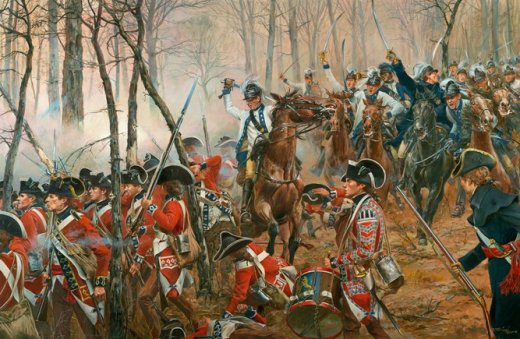
He turned his command over to Colonel James Stewart. Stewart headed for the fleeing 2nd Marylanders and captured two cannon. He turned on the 1st Maryland and they volleyed at the same time. Their colonel, John Gunby lost his mount and was pinned under it. His deputy commander, Colonel John Eager  Howard, took over for him. A bugle sounded and William Washington and his dragoons thundered through the 2nd Guards and slaughtered them. John Eager Howard regrouped his Marylanders. The shattered British troops tried to reform.

Battle of Guilford Courthouse. Painting by Don Troiani depicting William Washington’s dragoons thundering through the 2nd Guards

Greene pressed forward into the midst of the battle. There was nothing between him and the enemy but woods. His aide saw the danger and warned, “You are riding into the enemy, General Greene!” Greene calmly nodded, turned his horse and rode back to his position. The enemy was gaining ground on his right. At 3:30 pm, two hours after the battle began, he saw that the enemy had turned his left flank. He ordered a retreat before his army could be encircled.

Major General Nathanael Greene

Cornwallis’ lost twenty-five percent of his army in the pyrrhic British victory. The days leading up to Guilford Courthouse overwhelmed Nathanael Greene and he fainted after  the battle, but it was the turning point that forced Cornwallis out of the Carolinas and into Virginia where he met his final surrender to Franco/American forces led by George Washington on October 19, 1781.


Resources:

Beakes, John H. Jr. Otho Holland Williams in The American Revolution. Charleston, South Carolina: The Nautical and Aviation Publishing Co. of American, 2015.

Buchannan, John. The Road to Charleston. Charlottesville: University of Virginia Press, 2019.

Buchannan, John. The Road to Guilford Courthouse. Toronto: John Wiley & Sons, Inc., 1997.

Carbone, Gerald M. Nathanael Greene A Biography of the American Revolution, 2008.

Greene, George Washington. The Life of Nathanael Greene, Major General in the Army of the Revolution. 3 Volumes. New York: Hurd and Houghton. Cambridge: Riverside Press, 1871.

Piecusch, Jim, and John H. Beakes, Jr. Cool Deliberate Courage John Eager Howard in the American Revolution. Berwyn Heights, Maryland: Heritage Books, Inc., 2009.

Featured image. The equestrian statue of General Nathanael Greene at Guilford Courthouse Military Park, Greensboro, North Carolina


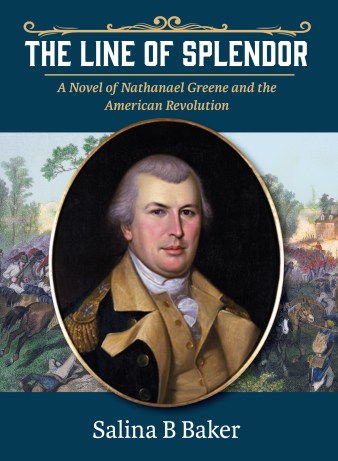
My biographical novel about General Nathanael Greene titled “The Line of Splendor, A Novel of Nathanael Greene and the American Revolution” is available on Amazon. Click on the cover to get your copy.

The Line of Splendor: A Novel of Nathanael Greene and the American Revolution

The American Revolution was fought between the years 1775 and 1783 on American soil (and sometimes Canadian) between the American Continental Army and their allies the French and Spanish against the colonial mother country Britain and paid soldiers called Hessians. The American victory culminated primarily when British General Lord Charles Cornwallis surrendered at Yorktown, Virginia on October 19, 1781, after a four week long Franco/American siege under General George Washington and Comte de Rochambeau. 

But who was the American general who drove Lord Cornwallis out of the Carolinas and into Virginia in the first place? George Washington’s most trusted and capable major general, Nathanael Greene. I have written a biographical novel about this often forgotten general whose name every American should know and whose tireless effort is often lost to the annals of history. 

Major General Nathanael Greene

When the first shots of the American Revolutionary War were fired in Massachusetts on April 19, 1775, thirty-two-year-old Nathanael Greene, a self-educated Quaker with no military experience, dismayed his family and marched toward Boston as general of the Rhode Island provincial army. General George Washington recognized his unwavering belief in American independence and the qualities that catapulted him to a major general in the Continental Army.

From the hard lessons learned on the battlefields of New York, to his appointment as Quartermaster General during the harsh winter at Valley Forge, his role in convicting the British spy who colluded to obtain the plans to West Point, to the godsend who took command of the ragged remnants of the Southern Continental Army, Nathanael Greene’s complex perseverance and brilliant strategies broke military doctrines.

This is the story of the man who rose to become a national hero by resuscitating and then propelling the American states to victory in their war for independence and the personal cost of that war.

The Line of Splendor: A Novel of Nathanael Greene and the American Revolution” is available on Amazon. Click on the cover or the link to order your copy and learn about the life of one of the greatest generals of the American Revolution. Huzzah!  https://www.amazon.com/Line-Splendor-Nathanael-American-Revolution-ebook/dp/B0CDN4MLY2

The Battle of Hobkirk’s Hill

On August 16, 1780, American General Horatio Gates lost an army to British General Lord Charles Cornwallis just north of Camden, South Carolina. Gates abandoned his vanquished army and rode 180 miles to Hillsboro, North Carolina. Gates was the third major general the civilian governing body, the Continental Congress, sent to command the Continental Army’s Southern Department and the third to fail in the attempt. His predecessors, Robert Howe and Benjamin Lincoln surrendered Savannah, Georgia and Charleston, South Carolina respectively to the British. This time, Congress left the choice to the commander-in-chief of the Continental Army: General George Washington. He chose his most trusted and capable major general, Nathanael Greene, who had been by Washington’s side since 1775 at the Siege of Boston where Patriots were keeping the British locked in Boston after the first shots of the American Revolutionary War were fired in Massachusetts.

Major General Nathanael Greene

Greene took command of the ragged, starving remnants of the Southern Army from Horatio Gates in Charlotte, North Carolina on December 3, 1780. His army, including militia forces, totaled 2,300 but only 800 were properly armed and clothed. Greene, who was from Rhode Island and had spent his entire life in the north, had to adapt quickly to the new environment where the landscape, climate, and rivers were different. A place where the majority of the people were poor and the powerful Rice King’s of the south were cowed. Where civil authority had broken down and a civil war raged between Patriots and Loyalists. General Charles Cornwallis was 70 miles south at Winnsboro, South Carolina with a well-equipped principle force of 4,000 men. What was a Continental general with a new independent command to do? Ignore every military doctrine that warned of dividing an army in the face of a superior foe.

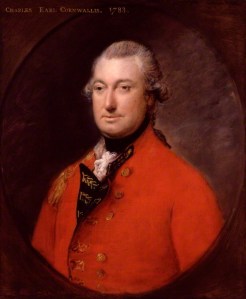
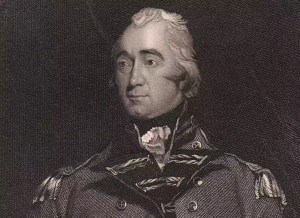
General Lord Charles Cornwallis

Greene executed a strategy that began with sending General Daniel Morgan and a flying detachment to northwest South Carolina to “spirit up the people.” Greene led his wing of the army from Charlotte to Cheraw, South Carolina where food for the army was more plentiful. Cornwallis sent his cavalry colonel Banastre Tarleton to “rid the countryside of Morgan.” On January 17, 1781, Morgan defeated Tarleton at a place called the Cowpens. Cornwallis lost 1,000 men at Cowpens. Furious, he went after Morgan.

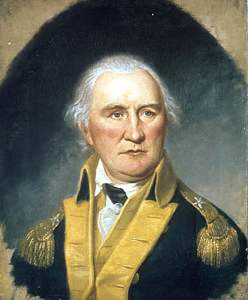
General Daniel Morgan

With a small contingent of guard, Greene set out through 300 miles of perilous Loyalist country to support Morgan’s retreat toward Salisbury, North Carolina. Cornwallis burned his baggage train to lighten his army’s pursuit. Greene moved his army’s junction to Guilford Courthouse, North Carolina where he decided that a retreat to the Dan River on the border of North Carolina and Virginia was the only way to preserve his army. On February 15, Cornwallis’s troops marched up to the banks of the Dan River. They saw the American campfires burning on the other side. Greene had taken every boat in the Roanoke Valley and there was nothing Cornwallis could do but stare. Greene moved his army back to Guildford Courthouse where he and Cornwallis clashed on the afternoon of March 15, 1781. It was a pyrrhic British victory that cost Cornwallis more than 500 men. He retreated to Wilmington, North Carolina, a coastal port 200 miles away.

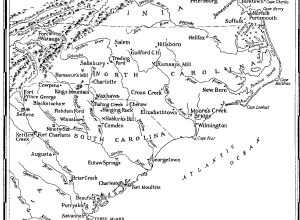
North and South Carolina during the American Revolutionary War

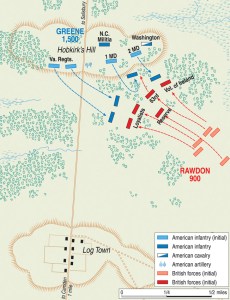
Undaunted by the loss at Guilford Courthouse, Greene turned his attention to the British outposts in the interior of South Carolina. The Southern Army marched through country that was extremely difficult to operate—cut by deep creeks and impassable morasses, heavy timber, and thick underbrush. On April 20, they pulled up to the stockade walls of Camden, South Carolina where Lord Francis Rawdon had 900 Loyalist and British troops garrisoned. Aware that it was too strong to attack, Greene pulled his army back to Hobkirk’s Hill, a sandy ridge two miles north of Camden over which ran the Salisbury Road.

Colonel Lord Francis Rawdon

In the early morning hours of April 25, 1781, a skittish drummer deserted from the Maryland line. He carried word to Rawdon that the American Army was weakened by detachments and lack of food. General Greene had no artillery with him. It was in the rear along with the baggage train and that militia General Thomas Sumter had not come up yet to support the Americans. Rawdon listened to the drummer. He armed the boy along with every man in the garrison, including musicians and drummers.

Nathanael Greene’s troops were camped on Hobkirk’s Hill in order of battle in a wide line across the hill. Colonel Otho Holland Williams had overall command of the Maryland troops to the left of the road, and General Isaac Huger ranked command over the Virginia Continentals to the right. Otho’s two regiments were the 1st Maryland, commanded by Colonel John Gunby and the 2nd Maryland commanded by Colonel Benjamin Ford. Gunby’s deputy was the brilliant Colonel John Eager Howard, who had led the regiment at Cowpens and taken up command at Guilford Courthouse when Gunby was pinned beneath his horse. The 2nd Virginians were under the direct command of Colonel Samuel Hawes with the 1st under Colonel Richard Campbell. Two hundred fifty North Carolina militia were in back of the Continentals. Colonel William Washington’s 3rd Continental Dragoons—only about fifty mounted due to the difficulty of procuring horses—were held in reserve.

Colonel Otho Holland Williams

To protect them from surprise, pickets were stationed 300 yards in front of their lines supported by Maryland, Virginia, and Delaware Continentals. Greene’s men were enjoying the quiet morning buoyed by his orders that every man would receive two days’ worth of food and a gill of spirits as soon as quartermaster Colonel Edward Carrington arrived with the stores. Their arms were stacked. Coats and shoes lay scattered. Washington’s dragoon horses grazed peacefully at their loose tethers. Men were relaxing by a rivulet, soaking their sore feet or cleaning their kettles when they heard the sound of sharp musketry at the base of the hill.

The American drums beat to arms as the pickets clashed with Lord Rawdon’s vanguard. The surprised Americans, many still barefoot and half-dressed, rushed to form their lines. Gun smoke curl up and through the towering pine trees. Otho Holland Williams tried to keep his surprise concealed when he mounted his horse and galloped from the front lines to Greene’s headquarters. When he arrived, General Greene, who had been enjoying the rare luxury of a cup of coffee, was on his feet. Satisfied, Otho returned to the lines before the fighting became widespread.

Greene abandoned his breakfast and jumped into the saddle, followed by his aides majors Lewis Morris and Ichabod Burnett. North Carolina militia officer Guilford Dudley was marching up the back side of the hill with the artillery. Otho ordered Dudley to “March to the right and support Colonel Campbell.”

Greene rode forward with a good view of the hill. Captain Robert Kirkwood’s Delaware pickets were slowly being pushed back by Rawdon’s vanguard. The British commander had arranged his men in a single line with his Corps of Observation in the rear, the right wing supported by 675 provincial regulars and the Volunteers of Ireland on the left. Rawdon’s line was narrow. Greene believed that they could strike their flanks, rear, and front. He quickly ordered Colonel Richard Campbell to wheel left upon the enemy’s right flank. He communicated that he wanted Colonel Benjamin Ford that he was to wheel his men to the right.

As Rawdon advanced, Greene sent orders to unmask the artillery. The American gunners shredded the tightly packed British columns with volleys of whistling grapeshot. Through the clearing blue smoke, General Greene saw the destruction and was beside himself with satisfaction. “Victory is in reach! Draw forth and send instructions to Colonels Gunby and Hawes to conduct a bayonet charge in the center. Then send Colonel Washington and his dragoons to turn the enemy’s right flank and charge them in the rear.”

Lord Rawdon raged as he saw his men fall and the Continentals charging with bayonets. He took his aggressive anger out on one of his aides, “I was told that Greene had no artillery!” He shouted orders to the Volunteers of Ireland who came up and added their fire against the Maryland ranks. Rawdon continued to disseminate orders to his aides, “Rally, my boys, and bring up all from the rear. Lengthen our lines and avoid the flanking maneuver the American general intends on executing.”

Aside from the 63rd foot, all of Rawdon’s troops were American Tories fighting against American Whigs, and they were quick to take advantage of the thick woods on the hill. The firing was so intense that musket barrels became too hot to hold in their hands.

As Nathanael Greene’s infantry rolled forward so too did William Washington and his dragoons. They swept down around the hill to avoid felled trees and heavy undergrowth, and then rode hard for Major John Coffin’s dragoons on the British right flank. They clashed and swung their short blades from the saddles of their wheeling horses. Coffin’s men scattered. Although deterred by the thick undergrowth, Washington gathered his dragoons under the direct command of captains William Parsons and Walker Baylor and fell upon the rear of the British infantry. They became bogged down in taking prisoners who were, in fact, Lord Rawdon’s desperate attempt to arm as many as he could. The musicians, surgeons, and teamsters had no stomach to stand up against a force of hard galloping dragoons, and they quickly surrendered.

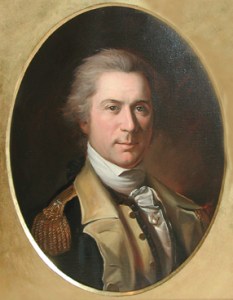
Colonel William Washington

The American infantry continued to push forward. Many of the Marylanders under Colonel Benjamin Ford were new recruits, and some began firing without orders. Ford was shot off his horse and suffered a mortal wound. None of the skittish 2nd Marylanders came to their colonel’s aide. Gunby’s and Hawes’ men continued a steady advance. Some forgot to use their bayonets and fired instead. The trusted captain of the right company, William Beatty, was shot through the heart and dropped dead.

Colonel John Eager Howard

His company, the 1st Marylanders, became deranged and fell out of line. The other companies under Colonel John Eager Howard were still advancing, and instead of pushing them all forward Colonel John Gunby saw they were marching in the form of a bow and ordered them to fall back to the foot of the hill and reform. The consequences were fatal. General Greene had told them not to fire. Now, they were being told to halt in the face of a charging British force. They broke and ran. This left the 2nd Marylanders isolated, and they too fell back followed by the 1st Virginians.

Otho Holland Williams saw the panic and rode toward them, but neither he nor Colonels Howard or Gunby could stop it. Greene was up on the ridge where he had spent most of the battle with Samuel Hawes’ 2nd Virginians. He exposed himself like a captain of grenadiers and attempted to restore order. It became obvious that Lord Rawdon understood that Hawes’ men were alone, and, seeing his advantage, pressed the hill to flank them and silence the American artillery.

Swept up in the tide of retreating troops, the American gunners mishandled their frightened teams and snagged the limbers in heavy brush. The horses panicked and had to be cut from the limbers. Bitterly disappointed, Greene issued the order for his surviving regiments to withdraw, and they formed with the now-rallied Gunby’s men at the foot of the hill.

The troubles the gunners were encountering came to Greene’s attention as they tried to pull the cannon out of the reach of the enemy with drag ropes. He jumped from his saddle, and with the horse’s bridle in one hand and a drag rope in the other, he encouraged the dismayed gunners, “There is not a man here who does not have the courage to take the cannon off.” Seeing that their general was with the artillery, others came to help. Greene wasted no time, and he rode on to see what could be done about bringing the rout to a halt.

Major John Coffin’s British dragoons charged toward the cannon with swords aloft and began to put some of the men dragging the cannon to the sword. The assault gave the others time to get the guns hitched to horses and safely away backed up by Washington’s charging dragoons, each with prisoners in tow. It was a wasted effort. Bogged down by captives and the wooded lay of the land, Washington’s cavalry could not act with effect.

Greene called a retreat. Washington caught up with the main army and delivered the prisoners he probably should not have taken. Greene ordered the prisoners processed. He knew Rawdon was in pursuit. He did not know that Rawdon had left Major John Coffin with his cavalry on Hobkirk’s Hill to claim the ground as a British victory.

Greene ordered Washington to go back and screen their retreat and to take Captain Kirkwood’s Delaware unit with him. He also instructed Washington to take up their stragglers and wounded, and bring them back. If circumstances and time permitted, bury their dead.

Greene led his army three miles north of Hobkirk’s Hill and stopped to camp at Saunders’ Creek in the same sandy Pine Barrens where Horatio Gates had lost an army. Lord Rawdon broke off his pursuit and returned to the walls of Camden. Both commanders lost 200 men—dead, wounded, captured, and missing. Greene was in a vexatious mood after the loss he was certain could have been a victory. He changed his password and countersign to “Persevere” and “Fortitude.” The loss angered him and wounded his pride. He directed his anger at Maryland Colonel John Gunby saying his actions were the cause for the loss and had Gunby court-martialed.

On April 28, he issued orders in the camp at Rugeley’s Mill, “General Huger, Colonel Harrison, and Colonel Washington are to compose a court to inquire into the conduct of Colonel Gunby in the action of the 25th instant.” The testimony found that Gunby was exerting himself in rallying and forming his troops, only committing an error in judgment. Greene could not let it pass. He castigated Gunby publicly in written orders:

Col. Gunby’s Spirit and activity were unexceptional. But his order for the regiment to retire, which broke the line, was extremely improper and unmilitary; and in all probability the only cause why we did not obtain a complete victory.

Despite  Greene’ loss, by April 24 Cornwallis had had enough of Nathanael Greene. He abandoned the Carolinas and marched to Virginia. Greene’s strategy began to strangle the British. He cut off Lord Rawdon’s supply line and forced him to evacuate Camden on May 9. Over that month under Greene’s orders, the British outposts fell at the hands of “Light-Horse” Harry Lee and militia generals Francis Marion and Andrew Pickens. Greene laid siege to the last remaining outpost at the fortified town of Ninety-Six on May 22. The siege ended in bloody, hand to hand combat. Nathanael retreated on June 18. Lord Rawdon marched into Ninety-Six two days later and eventually burned the outpost.

Greene moved his army to the High Hills of Santee near Camden where the air was cooler and the mosquitos were less relentless. Although it was a camp of repose, there was not a moment that allowed him to let his guard down or cease his endless letters of instruction, exhortation, and solicitation regarding the condition of his ragged, malaria-ridden army and their needs. Still, his sense of humor didn’t completely escape him. He wrote to General Henry Knox that no general had run as often or “more lustily” as he had and likened his flight to that of “a Crab, that could run either way.”

Hobkirk’s Hill and the collapse of the British outposts in South Carolina was not be the end of Greene’s strategy. His relentless perseverance to keep the British locked in Savannah and Charleston paid off. On October 19, 1781, Lord Cornwallis surrendered to Franco/American forces at Yorktown, Virginia. If it had not been for General Nathanael Greene, the surrender at Yorktown likely would not have happened.


My biographical novel about General Nathanael Greene title “The Line of Splendor: A Novel of Nathanael Greene and the American Revolution” is available on Amazon. Click the cover to get your copy!


Resources:

Beakes, John H. Jr. Otho Holland Williams in The American Revolution. Charleston, South Carolina: The Nautical and Aviation Publishing Co. of American, 2015

Beakes, John H. Jr. and Piecuch, Jim. Cool Deliberate Courage: John Eager Howard in the American Revolution.  Heritage Books, 2009

Buchannan, John. The Road to Charleston. Charlottesville: University of Virginia Press, 2019

Carbone, Gerald M. Nathanael Greene A Biography of the American Revolution, 2008.

Golway, Terry. Washington’s General Nathanael Greene and the Triumph of the American Revolution. New York: Henry Holt and Company

Greene, George Washington. The Life of Nathanael Greene, Major General in the Army of the Revolution.3 Volumes. New York: Hurd and Houghton. Cambridge: Riverside Press, 1871

Thayer, Theodore. Nathanael Greene Strategist of the American Revolution. New York: Twayne Publishers, 1960


Loyal and Steadfast: Animals of the American Revolution

While many people today view their pets as close members of their family, even with human-like thoughts and feelings, this phenomenon was not as common in the eighteenth century. By 1775 at the start of the American Revolutionary War, dogs were well established and part of the culture, although they were not always welcome and ownership was restricted. Horses have been useful animals since the dawn of history, whether they’re used for a sport, work, or war. This attachment endured and directly contributed to the well-being, success and sometimes distress of many people whether they were American, British, French, or German.


Dogs

Spado

Continental Army Major General Charles Lee, a native of England, fought for the British army in the French and Indian War. When the war was over, he returned home and became a soldier of fortune. When he moved to North America in 1773, the Patriots hailed him as a military expert. Lee was slovenly, used foul language, sarcasm, and insults, and criticized his superiors. On the other hand, he was a composed, brilliant and courageous leader in battle.

Engraved caricature of Charles Lee with his dog, Spado

Charles Lee was often accompanied by at least one or two of his canine companions that only added to his eccentric perception for he proclaimed, “If you love me, you must love my dogs.” His favorite was Spado, which a guest at a dinner party described as “a native of Pomerania, which I should have taken for a bear had I seen him in the woods.” On another occasion in late 1775, Lee had Abigail Adams shake Spado’s paw. Comparing their trustworthiness with his fellow humans, Lee wrote to Abigail’s husband, John Adams, “Once I can be convinced that men are as worth objects as dogs, I shall transfer my benevolence.”

Lee’s dogs provided him with a sense of comfort. About a year later, Lee was captured in New Jersey. Either Spado wasn’t with the general or if he was, the British raiders didn’t bring Spado along. Lee wrote to George Washington from British-held New York asking that his dogs be brought to him as “I never stood in greater need of their Company than at present.”

Evidently Lee’s friends undertook to send Spado to the estate that the general had purchased in Virginia, but the dog was lost and an advertisement appeared Dunlap’s Maryland Gazette, published in Baltimore with a reward. Some of those Maryland newspapers made their way north because on March 9, 1777 Abigail Adams wrote to her husband, “I see by the news papers you sent me that Spado is lost. I mourn for him. If you know any thing of His Master pray Let me hear, what treatment he meets with, where he is confined &c.”

But evidently Spado was gone for good. When General Lee was finally released from captivity in the spring of 1778, his best companion was not there to greet him. He was never as cheerful afterward.

Lila

George Washington was an avid dog lover and fox hunter, Greyhounds, spaniels, terriers, newfoundlands, briards, and many toy breeds could be found in Washington’s extensive Mount Vernon kennel.  Before and after the war, he visited his kennels daily and provided his pups with creative names, such as Madame Moose, Drunkard, Vulcan, Taster, Duchess, and Truelove.

George Washington and his Dogs

Washington’s love for his four-legged friends carried over to the Revolutionary War. At the Battle of Germantown on October 4, 1777, fog blanketed the fighting troops, causing mass confusion and many accidental misfires. British General William Howe’s pet fox terrier, Lila, was one of the many lost in the confusion. Disoriented, Lila followed Washington and the Continental Army home from the battle. After Washington identified Howe as Lila’s owner from her collar he felt it was his duty to return her, opposed to keeping her as a trophy of war.

General William Howe and a Fox Terrier similar to Lila

He delivered the dog back to Howe along with the following note, likely written by aide-de-camp, Alexander Hamilton, “General Washington’s compliments to General Howe. He does himself the pleasure to return him a dog, which accidentally fell into his hands, and by the inscription on the Collar appears to belong to General Howe.”

Azor

Baron Von Steuben of Prussia landed at Portsmouth, New Hampshire on December 1, 1777 with French aides and a large dog. Throughout the entire Revolutionary War, Steuben was accompanied by his beloved and much indulged Italian Greyhound, Azor.  Even before Steuben’s party landed on American soil, Azor’s “discerning ear for music” put him in good stead with the crew of the ship which took them to New Hampshire. Azor howled pitifully every time the captain of the ship attempted to sing.

Baron von Steuben and an Italian Greyhound similar to Azor

Steuben’s  aide, Pierre-Étienne du Ponceau, wrote:  “We travelled on horseback. I must not forget the Baron’s dog Azor, the only pedestrian among us. He was a beautiful Italian grey hound who had an excellent ear for music.”

Baron von Steuben was promoted to major general and inspector general of the Continental Army. He proved to be a godsend to the fledging American army encamped for the winter at Valley Forge. He had a few idiosyncrasies that endeared him to the American troops: He wore enormous pistols in his uniform sash; he cursed in a multitude of foreign languages, and he was constantly followed by Azor. Ultimately, Steuben went down in history for the bravery, discipline, and grit he brought to the American troops and a dog that was there to provide him companionship and comfort. I found no record of what happened to Azor, but the dog was still with Steuben as late as 1786.


Horses

The American Revolution’s armies got their horsepower from horses. These animals carried cavalrymen into battle, pulled cannons, carts and wagons of all description, hauled baggage on their backs, moved messengers swiftly over countless miles, and brought officers and gentlemen to wherever they needed to be. The rebel colonists used their own horses in the war, but the British and Hessians often had to take theirs since it was difficult to ship horses across the Atlantic from England. Taking horses was not unknown among the Patriots, especially cavalry units who wore out their horses and horse furniture quickly, however they were supposed to pay the owner or provide a promissory note for the animal.

Cavalry

Without the cavalry troops used in the American Revolution, the Americans would not have stood a chance against the massive British Army. These horses provided them with faster feet to travel farther in a shorter time.

The Continental mounted forces rendered valuable service during the latter stages of the war, specifically in the Southern Theater of the American Revolution. William Washington’s 3rd Continental Light Dragoons played an instrumental role in the in the battles of Cowpens and Guilford Court House. Henry “Light Horse Harry” Lee’s Legion, as well as militia units led by generals Andrew Pickens, Thomas Sumter and Francis Marion, saw extensive action in American Major General Nathanael Greene’s operations in the southern colonies.

The Battle of Guildford Courthouse depicting Colonel William Washington’s dragoons

The hated and feared British cavalry officer, Colonel Banastre Tarleton often clashed with these legions and dragoon companies, one of the most famous being the Battle of Cowpens on January 17, 1781 when Tarleton and Washington dueled for a moment at the end of the battle.

The Battle of Cowpens by William Ranney 1845. Banastre Tarleton and William Washington at the end of the battle.

The British Army sent two regiments of light dragoons to serve in North America during the Revolutionary War. The first to arrive was the 17th Light Dragoons, who landed in Boston in 1775, while the city was still under siege by the Continental Army. They remained in America for the next eight years, serving in nearly every major campaign up through the end of hostilities.

Nelson and Blueskin

During the American Revolution, Washington was gifted two horses, Nelson and Blueskin who returned with Washington to Mount Vernon after the war.

Blueskin was a half-Arabian blue roan – meaning that he had darker skin and lighter colored hair, so during the summer months when his hair was short, he looked bluish in color. When the weather turned colder and his coat thickened, he appeared to be white. Washington rode Blueskin in some battles during the war. However, Blueskin didn’t tolerate the sounds, smells and sights of battle as steadily as Washington would have liked. Many portraits of Washington depict him atop Blueskin, possibly due to the horse’s greyish-white color.

Washington depicted at Trenton riding Blueskin

In fact Washington often rode his other favorite horse, Nelson, to battle instead. Washington did use Blueskin for ceremonial events, which may also have contributed to Blueskin getting more “portrait time” than Nelson. Nelson was said to have “carried the General almost always during the war.” Described as a “splendid charger,” the animal was chestnut, with white face and legs. Nelson was less skittish during cannon fire and the startling sounds of battle. Washington chose to ride Nelson on the day the British army under the direction of Lord Cornwallis surrendered at Yorktown, Virginia in 1781.

Washington depicted at the Battle of Monmouth riding Nelson.

Nelson died at Mount Vernon “many years after the Revolution, at a very advanced age.” His death was reported to George Washington during the Christmas season of 1790, when the old horse would have been twenty-seven years old.

Britain

Britain was the name of the horse that Major General Nathanael Greene owned before the American Revolutionary War ignited on April 19, 1775. Nathanael often rode Britain into Boston and to visit friends and family in Rhode Island. The horse’s name could lead us to understand that before the first shots of the war were fired even men who became officers in the Continental Army still had a mental connection to the American Colonies’ mother country, Britain. There is no depiction of Britain so instead I present the equestrian statue of Nathanael Greene at Guilford Courthouse.

Equestrian statue of General Nathanael Greene at Guilford Courthouse

Warren

When General Benedict Arnold stormed Breymann’s Redoubt during the Battle of Bemis Heights near Saratoga, New York on October 7, 1777, he was riding a horse that he borrowed from a friend. “On he rushed through deepening twilight on a horse named for the dead hero [Joseph Warren] who had given him the commission with which his military career had begun.” [1] Arnold was shot in the thigh. The horse was shot in the heart and fell on Arnold pinning him beneath it, but it was this heroic action that won the pivotal battle that brought on an American alliance with France that aided in the Siege of Yorktown and the final British surrender in October 1781.

General Benedict Arnold depicted storming Breymann’s Redoubt

Paul Revere’s Horse

On the night of April 18, 1775, Dr. Joseph Warren sent Paul Revere and William Dawes to alert the countryside from Boston to Concord that the British regulars were out of Boston and on the march.

What was the name of the horse Revere rode? There is no evidence that Revere owned a horse at the time he made his famous ride. He likely owned a horse or he certainly had ready access to horses at some point in order to become the experienced rider that he was. If he had owned a horse in April 1775, it is unlikely he would have tried to bring it with him when he was rowed across the Charles River to Charlestown.

Paul Revere’s Ride

Revere left several accounts of his “Midnight Ride,” and although he states that he borrowed the horse from John Larkin, neither he nor anyone else takes much notice of the horse, or refers to it by name. Revere calls it simply “a very good horse.” In the years since 1775 many names have been attached to the animal, the most exotic probably being Scheherazade. The only name for which there is any evidence, however, is Brown Beauty. The following excerpt is taken from a genealogy of the Larkin family, published in 1930.

Samuel (Larkin) … born Oct. 22, 1701; died Oct. 8, 1784, aged 83; he was a chairmaker, then a fisherman and had horses and a stable. He was the owner of “Brown Beauty,” the mare of Paul Revere’s Ride made famous by the Longfellow poem. The mare was loaned at the request of Samuel’s son, deacon John Larkin, and was never returned to Larkin.


Resources:

https://www.americanrevolutioninstitute.org/asset/engraving-of-charles-lee-with-his-dog/

https://boston1775.blogspot.com/2014/07/abigail-adams-and-hand-of-friendship.html

https://boston1775.blogspot.com/2018/08/whatever-happened-to-spado.html

https://www.battlefields.org/learn/articles/american-dogs

https://www.americanheritage.com/case-generals-dog

https://nationalpurebreddogday.com/the-war-of-independence-and-an-iggie-was-there/

Lockhart, Paul. The Drillmaster of Valley Forge. New York. Harper Collins. 2008

[1] Philbrick, Nathaniel. Valiant Ambition. New York. Penguin Books. 2016. Page 167

https://www.mountvernon.org/library/digitalhistory/digital-encyclopedia/article/nelson-horse/

https://www.presidentialpetmuseum.com/george-washingtons-blueskin/

https://www.paulreverehouse.org/frequently-asked-questions-about-the-midnight-ride-of-paul-revere/

Featured Image The Cowpens, South Carolina, January 17, 1781. By Don Troiani.

“Act Worthy of Yourselves” an Alternate Ending

I wrote the short story “Act Worthy of Yourselves” that asks the question “What if Dr. Joseph Warren had survived Bunker Hill?” as part of the Historical Writers Forum anthology “Alternate Endings” because frankly, Dr. Joseph Warren is the love of my American Revolution life.

This young and largely forgotten patriot is an important character in the first book of my historical fantasy series, Angels and Patriots Book One: Sons of Liberty, Lexington and Concord, Bunker Hill. I’ve also have published non-fiction works about Warren including a short piece titled America’s First Martyr in the Military Writers Society of America’s 2021 anthology Untold Stories, numerous blog posts, and three audio clips for a website called Hear About Hear that provides audio clips for historic places. The three audio clips can be heard at Old South Meeting House in Boston, Massachusetts, Bunker Hill Monument in Charlestown, Massachusetts, and King’s Chapel in Boston where Warren delivered two Boston Massacre Orations (1772 & 1775), was killed at age 34 at the Battle of Bunker Hill on June 17, 1775, and the chapel where his funeral was held, respectively.

Dr. Joseph Warren

Warren was a Boston physician, Son of Liberty, politician, orator, masonic Grand Master, president of the Massachusetts Provincial Congress and a major general. He was a member of the Sons of Liberty, a group of political dissidents formed in Boston to protest King George III and Parliament’s taxation and control of colonial authority. Their protests against the Mother country’s sudden subjugation after more than a century of autonomy, proliferated in the America colonies in the 1760s. Some of their famous members were Paul Revere, John Hancock, and Samuel Adams. John Adams, a Massachusetts lawyer and politician was not a Son of Liberty, but he was a sympathizer.

It was Joseph Warren who sent Paul Revere, along with William Dawes, on that ride to warn the countryside that the British regulars were out of Boston and on the march looking for rebel munitions on the night of April 18, 1775. He was holding the rebellion together in Massachusetts during the spring of 1775 while Samuel Adams and John Hancock were hiding in Lexington for fear of being hanged by the British for treason.

Through the committees of the Provincial Congress, he tirelessly wrote letters to leaders of other colonies, rallying for the cause, asking for help, and pressing them for their responsibilities in the rebellion against Britain. He gathered militia, supplies, and directed the provincial army who conducted the siege of Boston on the British in that town after the first shots of the war were fired in Lexington and Concord, Massachusetts on April 19, 1775.

His death at the Battle of Bunker Hill was widely lamented by his friends and patients such as Abigail Adams, John Adams, Samuel Adams, John Hancock, patriots who fought alongside Warren on that fateful day and as far reaching as Philadelphia and the southern colonies. His death, early in the war, served to leave him in obscurity. He deserves to be known for everything he did in the infancy of the American Revolution to promote freedom and liberty. So the questions is “what if Joseph Warren had survived Bunker Hill?” Where would he have stood among the American Founding Fathers, many of whom were his fellows long before the rest of the world had heard their names.

One last very important comment. 

My share of royalties will go to the Dr. Joseph Warren Foundation an organization dedicated to educating the public about his life & contributions to the American Revolution. 


I hope you enjoy my short story “Act Worthy of Yourselves” in our anthology as much as I enjoyed writing it! Available on Amazon in paperback or Kindle. Click the cover to get your copy!

Authors:

Virginia Crow
Cathie Dunn
Sharon Bennett Connolly
Karen Heenan
Samantha Wilcoxson
Michael Ross
Salina B Baker
Elizabeth Corbett


“Remember the Ladies” an Alternate Ending: Guest Post by Michael L Ross

I wrote my alternate ending about Abigail Adams and women’s suffrage after researching women’s rights and looking at the current storm on abortion rights with the overturn of Roe vs. Wade. When I was writing my first book, “Clouds of War”, I was surprised by the fact that most women couldn’t sign contracts, and lost control over the property as soon as they were married. In researching my as-yet-unpublished Revolutionary War novel, I discovered that in some colonies, women could vote before the signing of the US Constitution, but lost that right. That led me to look at where these laws depriving women of rights came from – and the answer was somewhat astonishing.  It turns out that there was a barrister named William Blackstone in England, who spread the idea of “coverture” because he believed women were emotionally and intellectually unfit for politics, business, and most intellectual endeavors. Blackstone was an obscure lawyer who had lost his job and was not particularly adept at the law, but his book “Commentaries on the Laws of England” was particularly popular with men. It became a mantra of male dominance, without bothering to prove the points it contained.

In studying the Revolutionary War, I read many of the original letters and documents from Abigail and John Adams, Benjamin Franklin, Mercy Otis Warren, Thomas Jefferson, and George Washington. I was impressed in particular with the logic, intellect, and writing of Abigail Adams. Thanks to her separation for months at a time from her husband, she wrote over two thousand letters. Though she requested that they be burned at her death, thankfully, someone did not follow that instruction, and we have a large collection of her thoughts and feelings during that period.

One letter, in particular, caught my attention, from Abigail to John, and his reply. She had just heard of the decision to declare independence from England, and being of sharp mind, immediately realized that the slate of laws was wiped clean, and they might begin afresh. She was excited at the prospect of equal rights for women, including the vote, and wrote to John that when they made the new laws, the men must “remember the ladies”. John effectively laughed at her and expressed many of the same opinions voiced in Blackstone’s book. In real life, while she was vexed, Abigail acted as the submissive wife of her time and culture, though voicing her indignation in letters both to John, Thomas Jefferson, and her friend Mercy Otis Warren. Reading Abigail’s displeasure led me to wonder – what if? What if she had rallied the other leading women, as well as the poor non-landowning farmer men, to demand the right to vote? How could she have leveraged it to make the men listen?  What had the women done before as a group, and what had its effect been?

From there, the story “Remember the Ladies” practically wrote itself, primarily using Abigail’s own words. I hope you enjoy it.

Abigail Adams

John Adams

Mercy Otis Warren

Alternate Endings: The Lure of Dr. Joseph Warren

I was asked what inspired me to write the short story “Act Worthy of Yourselves” as part of the Historical Writers Forum anthology “alternate endings” a collection of short stories by a group of eight talented historical writers who each have their own story that asks the question, what if an historical event was altered and changed the course of history?

My story asks, “What if Dr. Joseph Warren had survived the Battle of Bunker Hill?” one of the bloodiest battles of the American Revolution fought on the Charlestown peninsula northeast of Boston on June 17,1775. The title “Act Worthy of Yourselves” is a line from Warren’s Boston Massacre Oration which he delivered at Old South Meeting House in Boston on March 6, 1775 to a crowd so large that he was forced to climb through the window behind the pulpit to avoid being crushed.

This post is part of our blog hop tour for “alternate endings.”

In 2015, I was searching for the topic of my next book. I had written two standalone novels set in Victorian America and I wanted to pursue something historically different. I asked myself how much I knew about the American Civil War as that was the first love of my historical life. But it was set in the same time period and I realized I needed to move to a different era. I did know quite a bit about the American Revolution and Colonial America and decided I was willing to put my effort into learning more.

Where to start? Ah, yes. Why not start with the obvious—the Sons of Liberty, a group of political dissidents formed in Boston to protest King George III and Parliament’s taxation and control of colonial authority. Their protests against the Mother country’s sudden subjugation after more than a century of autonomy, proliferated in the America colonies in the 1760s. Who did I know that belonged to the Sons of Liberty? Why Paul Revere, John Hancock, and Samuel Adams their ringleader, of course. John Adams, a Massachusetts lawyer and politician was not a Son of Liberty, but he was a sympathizer. Boston was already militarily occupied in response to acts of what the King considered disobedience.

My research immediately led me to a list of Massachusetts Sons of Liberty and among them was a handsome, young doctor named Joseph Warren. It was love at first sight. I could not get enough of who he was, what he did, his growth as a man, politician, orator, leader, and masonic Grand Master. He apprenticed under Loyalist Dr. James Lloyd and medically treated people from all walks of life. The rising Patriot admiration for him and his efforts for the Patriot cause could not be ignored nor the threat he posed to the British, who in the end, were pleased to see he and his sedition put to death on a battlefield.

Dr. Joseph Warren circa 1764 by John Singleton Copley

I had read the poem “The Midnight Ride of Paul Revere” by Henry Wadsworth Longfellow when I was in sixth grade and it always stuck with me. Imagine my delight when I found out that Joseph Warren was the guy who sent Paul Revere, along with William Dawes, on that ride to warn the countryside that the British regulars were out of Boston and on the march looking for rebel munitions on the night of April 18, 1775.  That it was Joseph Warren who was holding the rebellion together in Massachusetts during the spring of 1775 while Samuel Adams and John Hancock were hiding in Lexington for fear of being hanged by the British for treason. During the time many of his colleagues including Adams and Hancock attended the second Continental Congress in Philadelphia in late spring 1775, he became president of the Massachusetts Provincial Congress.

Warren tended to be dauntless, storming into a situation without thought for personal risk. John Adams once said, “Warren was a young man whom nature had adorned with grace and manly beauty, and a courage that would have been rash absurdity, had it not been tempered by self-control.” 

Then, there was the tragedy of Warren’s personal life. His wife died at age 26, leaving him a widower with four children under age eight. When he was killed at age 34 at the Battle of Bunker Hill his children were orphaned.

So Joseph Warren rose as a shining star in my novel “Angels and Patriots Book One: Sons of Liberty, Lexington and Concord, Bunker Hill.” Because the series is historical fantasy, my main character is an archangel with the human name Colm Bohannon. How much farther can you elevate someone than have a man and an archangel become friends and learn love and loyalty from one another? Not much. How much do you weep when you know how it historically ended?

As I wrote, I began to share facts about Joseph Warren and I found that he is adored and even worshipped among history and American Revolutionary War enthusiasts and authors. For years, the question that came up was and always has been, “What if Joseph Warren had survived Bunker Hill?” This ubiquitous and charismatic leader took the reins of the rebellion politically and militarily and accepted a provincial generalship on the day the American Continental Army was formed, June 14, 1775—three days before his death.

There were many questions on my mind and on the mind of others.

*If he had survived, how would General George Washington have received him? Or perhaps Washington would have relinquished his appointment as commander-in-chief of the Continental Army and recommended Warren in his stead?

*Would Warren have been one of the greatest tactical or strategic generals of the war?

*Would his concern for civilians taken him in a political direction?

*What about his medical practice and experience? Would he have benefited the Continental Army with his expertise?

*Would he have stayed behind to see to matters in Massachusetts? Or gone on to preside over the Continental Congress, the civilian governing body during the war?

*Would he have discovered great medical break throughs?

*How would his life and his children’s lives unfolded during and beyond the war?

*How far would he have reached for the stars while a new nation was rising?

As an author and person who came to adore Dr. Joseph Warren but not blind to his faults, I couldn’t let these burning questions pass me by when the opportunity arose to write an alternate ending to his life. If only for this moment, in this anthology, he is given another chance. Perhaps others who have asked the same question will agree with how I see it. Perhaps not. Nevertheless, I know people who know who Joseph Warren was will want to read it and share in their opinions. For those who don’t know who he was, the story I wrote is based in fact and I didn’t change the outcome of the Revolutionary War.

Dr. Joseph Warren’s name is not a household word like George Washington, Alexander Hamilton, John Adams or Thomas Jefferson. His premature death saw to that. Beyond my own novel, if I can raise awareness of his accomplishments through a historical alternate ending, I will be satisfied that I tried.

One other person who I should mention that is part of the story is Joseph’s youngest brother, Dr. John Warren. His name and extraordinary medical accomplishments are lesser known than those of his brother’s. John’s part in this story is based in fact. I assure you will be surprised and impressed.

Dr. John Warren circa 1806 by Rembrandt Peale


I hope you enjoy our anthology as much as we have enjoyed writing it! Available on Amazon in paperback or Kindle. Click the cover to get your copy!

Authors:

Virginia Crow
Cathie Dunn
Sharon Bennett Connolly
Karen Heenan
Samantha Wilcoxson
Michael Ross
Salina B Baker
Elizabeth Corbett


My share of royalties will go to the Dr. Joseph Warren Foundation an organization dedicated to educating the public about his life & contributions to the American Revolution.