“Through much fatigue and many dangers past, The Warworn soldier’s braved his way at last.” ~~ Joseph Plumb Martin
I could think of no better way to express my love for this narrative except to offer a review. I’ve read countless quotes from Joseph’s memoir in books about the Revolutionary War and have written about him in my own novels. But to read his memoir in it’s entirety plunged me into his world during his nearly eight years of service with the Continental Army.
Joseph wrote and published his memoirs in 1830 at the age of 70. The book was lost to history, rediscover in the 1950’s, and published again in 1962. Like many memoirs, he may have embellished it, but it’s rooted in the experiences endured by the common soldier instead of the heroic accounts of men like Washington, Greene, and Knox. Nevertheless, this is an eye opening tale of suffering, endurance, and patriotism.
Joseph was born in Massachusetts on November 21, 1760, therefore he was just a teenager when he joined the army in 1776. At the time, he lived with his grandparents in Connecticut and had difficulty gaining their permission to enlist. He and his company were soon sent to New York where they saw action at Long Island, Kipp’s Bay, Harlem Heights, and White Plains.
Later in the war, he was at Germantown, the siege of Fort Mifflin, and the Battle of Monmouth. His company was shipped off to the Hudson Highlands and West Point. He spoke of Benedict Arnold’s treason and John Andre’s execution. He was with the unit of sappers at Yorktown who dug the parallel entrenchments used to besiege Cornwallis’ army.
In his memoir, Joseph paints a picture of camaraderie between he and his “messmates.” Their shared struggles with constant starvation, nakedness, lack of shelter, sickness, fatigue, and hard duty is a theme throughout.
“To have to lie, as I did, almost every other night on the cold and often wet ground… without a blanket, and with nothing but thin summer clothing, was tedious.”
“The army was now (Valley Forge) not only starved but naked; the greatest part were not only shirtless and barefoot, but destitute of all other clothing, especially blankets.”
“…I have often been so beat out with long and tedious marching, that I have fallen asleep while walking the road, and not been sensible of it till I have jostled against some one in the same situation;…”
He candidly wrote about the officers who made bad decisions, quartered in homes and ate well — “for they must have victuals, let the poor men fare as they would.” His detailed descriptions of the army’s failure to provide pay and provisions, his food foraging expeditions, and food sometimes provided to the soldiers by civilians underlies the desperation he experienced enduring starvation.
Yet amid all these descriptions of misery, Joseph demonstrates a sense of humor, compassion, courage, mischief, and admiration for “handsome ladies.” He refers to those who are killed or dies as “Poor young man!” or “Poor fellow!” When his regiment returns to White Plains, he sees that the Hessians who died at the battle there the year before are ill-buried and he feels sorry for them. “Here the Hessian sculls as thick as a bomb shells; — poor fellows! they were left unburied in a foreign land…”
When the war ended in 1783, he wrote that the happiness he had anticipated was not realized. “….there was as much sorrow as joy transfused on the occasion. We lived together as a family of brothers for several years (setting aside some little family squabbles, like most other families,) had shared with each other the hardships, dangers and sufferings incident to a soldier’s life…”
He concludes with after the war the soldiers were never given the land they were promised nor their yearly clothing allowance. But the heart rending message was how the country vilified them — the army was idle during the war or the militia could have done the job. The soldiers’ hardships were debased and underrated.
“President Monroe was the first of all our Presidents, except President Washington, who ever uttered a syllable in the ‘old soldiers’ favor.”
Of the voices of slander, he wrote:
“It was very easy for them to build castles in the air, but they had not felt the difficulty of making them stand there.”
“And now, kind Reader, I bid you a cordial and long farewell.” ~~ Joseph Plumb Martin
On the night of March 5, 1770, a conflict occurred between eight British soldiers and their captain and a crowd of citizens angered that British regiments occupied their town. The crowd threw snowballs, oyster shells and wielded clubs to taunt the soldiers near the Custom House. The confrontation resulted in the soldiers firing into the crowd, killing five and wounding others. Dr. Joseph Warren was one of the doctors called to treat the wounded and perform autopsies on the dead. The Patriots vowed not to forget “the bloody massacre” that would later become known as The Boston Massacre. Each year after, on March 5, they held an oration to remind the town of the event.
Paul Revere’s engraving of the Boston Massacre copied from an earlier version by Henry Pelham. Gilder-Lehrman Institute of American History.
In 1775, March 5 fell on the Sabbath. Therefore, “at a Meeting of the Freeholders & other Inhabitants of the Town of Boston…The Comittee appointed by the Town…to apply to a proper Gentleman to deliver an Oration…had made Choice of Joseph Warren Esq. to deliver an Oration on the 6th. of March instant, who had accordingly accepted of said Service.” It was voted that the oration be delivered “at the Old South Meeting House half past 11 O’Clock A.M.”
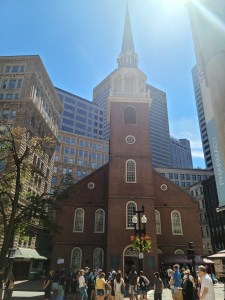
Old South Meeting House circa 2022
Boston buzzed with excitement. The oration was considered a town meeting—illegal under the Massachusetts Government Act. Unlike previous occasions of the commemoration, British troops were abundant in Boston (they had been removed to Castle William after the massacre). The British soldiers were going to resent an oration whose purpose was, in the words of Samuel Adams, “to commemorate a massacre perpetuated by soldiers and to show the danger of standing armies.” Dr. Joseph Warren had delivered the oration in 1772. Samuel Adams wanted Warren’s experience in the pulpit. He knew that Warren would not be intimidated.
In his diary for September 6, 1775, from England, former Massachusetts Governor Thomas Hutchinson mentioned a call from a Colonel James. “He tells an odd story of the intention of the Officers the 5 [six] March that 300 were in the Meeting to hear Dr Warrens oration— that if he had said anything against the King &c an Officer was prepared who stood near, with an Egg to have thrown in his face and that was to have been a signal to draw swords & they would have massacred Hancock Adams & hundreds more & he added he wished they had.” Hutchinson commented, “I am glad they did not for I think it would have been an everlasting disgrace to attack a body of people without arms to defend themselves.”
A crowd of 5,000 gathered at Old South Meeting House including those British officers. Samuel Adams “had long expected they would take that Occasion to beat up a Breeze” and invited them to sit in the pews directly in front of the pulpit so they “might have no pretence to behave ill.” This put the soldiers uncomfortably close to the many leading patriots in attendance. The officers were not only sitting in the pews, some were seated on the steps leading up to the pulpit, and some were sitting on the pulpit itself.
The pulpit today at Old South Meeting House circa 2017.
After spending the morning treating patients, Dr. Warren arrived around eleven o’clock. Rivington’s New York Gazette reported, “A single horse chair stopped at the apothecary’s opposite the meeting, from which descended the orator [Warren]…and entering the shop, was followed by a servant with a bundle, in which were the Ciceronian toga…Having robed himself, he proceeded across the street to the meeting.” A toga was worn by a citizen of Rome and distinguished him from a soldier or a slave. As a student at Harvard, Warren had performed the popular play Cato with his classmates. By wearing a toga, Warren was sending a strong message: citizens would not be intimidated by tyrannical threats.
Since the meetinghouse was jammed with people, he was taken around to the back of the building, where he climbed a ladder to access the pulpit through the rear window. The pulpit was covered in black cloth provided by John Hancock. A soldier grunted. One barked, “Scoundrel.” Warren ignored the British officers who meant to coerce him, looked out over the audience and began to speak. “My ever honored fellow citizens, it is not without the most humiliating conviction of my want of ability that I now appear before you: but the sense I have of the obligation I am under to obey the calls of my country at all times, together with an animating recollection of your indulgence exhibited upon so many occasions, has induced me once more, undeserving as I am, to throw myself upon that candor which looks with kindness on the feeblest efforts of an honest mind.”
He contended that personal freedom is the natural right of every man. “And no man or body of man, can without being guilty of flagrant injustice, claim a right to dispose of the person or acquisitions of any other man, or body of men, unless it can be proved that such a right has arisen from some compact between the parties in which it has been explicitly and freely granted.”
He spoke of their forefathers having nobly resolved never to wear the yoke of despotism, but tyranny, when once established, entailed its curses on a nation. Yet, there was a time when America and Great Britain became so united in affection both countries flourished due to mutual prosperity. He proclaimed, “The hearts of Britons and Americans, which lately felt the generous glow of mutual confidence and love, now burn with jealousy and rage. The many injuries offered to the town, I pass over in silence. I cannot now mark out the path which led to that unequaled scene of horror, the sad remembrance of which, takes the full possession of my soul. The sanguinary theatre again opens itself to view. The baleful images of terror crowd around me, and discontented ghosts, with hollow groans, appear to solemnize the anniversary of the fifth of March. Approach we then the melancholy walk of death.”
When Warren spoke of the events of March 5, 1770, he focused on the agony and despair of the families who had lost loved ones that night. “Come widowed mourner, here satiate thy grief; behold the murdered husband gasping on the ground, and to complete the pompous show of wretchedness, bring in each hand thy infant children to bewail their father’s fate. Take heed, ye orphan babes, lest, whilst your streaming eyes are fixed upon the ghastly corpse, your feet glide on the stones bespattered with your father’s brain.”
Warren’s voice rose to an emotional crescendo. “Our country is in danger, but not to be despaired of. Our enemies are numerous and powerful; but we have many friends, determine to be free, and heaven and earth will aid the resolution. On you depend the fortunes of America. You are to decide the important question, on which rest the happiness and liberty of millions yet unborn. Act worthy of yourselves. An independence from Great Britain is not our aim. No, our wish is that Britain and the colonies may, like the oak and the ivy, grow and increase in strength together. The interest and safety of Britain, as well as the colonies, require that the wise measures, recommended by the honourable Continental Congress, be steadily pursued. But if these pacific measures are ineffectual, and it appears that the only way to safety, is through fields of blood, I know you will not turn your faces from your foes, but will, undauntedly, press forward, until tyranny is trodden under foot, and you have fixed your adored goddess Liberty on the American throne.”
He finished by stating, “With having redeemed your country, and secured the blessing to future generations, who, fired by your example, shall emulate your virtues, and learn from you the heavenly art of making millions happy; with heart felt joy, which transports all your own, you cry, the glorious work is done. Then drop the mantle to some young Elisha, and take your seats with kindred spirits in your native skies.”
The audience stood to a thundering applause. What happened next was recorded in the diary of Lieutenant John Barker of the King’s Own Regiment. “…when after he [Warren] had finished a most seditious inflammatory harangue, John Hancock stood up and made a short speech in the same strain, at the end of which some of the Officers cried out, fie! fie! Which being mistaken for the cry of fire an alarm immediately ensued, which fill’d the people with consternation that they were getting out as fast as they cou’d by the doors and windows. It was imagined that there wou’d have been a riot, which if there had wou’d in all probability have proved fatal to Hancock, Adams, Warren, and the rest of those Villains as they were all up in the pulpit together, and the meeting was crowded with Officers and Seaman in such a manner that they cou’d not have escaped; however it luckily did not turn out so, it wou’d indeed have been a pity for them to have made their exit that way, as I hope we shall have the pleasure before long of seeing them do it by the hands of the Hangman.”
The British responded to Warren’s Boston Massacre Oration with ridicule. On March 15, 1775, British officers and Loyalists gathered on King Street and then proceeded to the nearby British Coffee House where they conducted a mock town meeting. Loyalist physician Thomas Bolton, read a satirical lampoon of Warren’s oration. In addition to his assault on Warren, Bolton reviled other prominent Patriots including John Adams, John Hancock, John Rowe, Charles Lee, William Molineux, Samuel Cooper, Josiah Quincy, and Dr. Thomas Young. Bolton accused that William Molineux, who died in 1774, “through the Strength of his own Villiany, and the Laudanum of Doctor Warren, he quitted this planet and went to a Secondary one, in search of Liberty.”
Despite the Loyalist reaction, “the Thanks of the Town [Boston] be & hereby are given to Joseph Warren Esq. for the Elegant & Spirited Oration delivered by him at their Request.”
References:
Photos of Old South Meeting House by Salina B Baker.
City of Boston. A Report of the Record Commissioners of the City of Boston Containing the Boston Town Records, 1770-1777. Boston: Rockwell and Churchill, City Printers, 1887. https://archive.org/details/recordsrelatingt18bost



 Salina B Baker