Please join me on the website, HEAR about HERE, where you can hear stories about people, places and events that happened near you using the GPS on your phone. Their mission is to tell you all about it three minutes at time. So HEAR more about these treasures with them and their Tale Collections from their contributors.
I am one of their contributors, so listen to my tales of true stories!
In December 1775, twenty-five-year old Boston bookseller Henry Knox, led an expedition from Cambridge, Massachusetts to Fort Ticonderoga in upstate New York to retrieve 50 tons of artillery and bring it back to General George Washington. Hear the story of Knox’s noble train of artillery and this amazing journey.
The patriots commemorated the anniversaries of the Boston Massacre, a bloody conflict that took place near the State House on March 5, 1770, between the citizens of Boston and British soldiers in which five civilians died. Hear the story of the circumstances surrounding Dr. Joseph Warren’s 1775 oration on the event.
The Battle of Bunker Hill was fought on the Charlestown peninsula north of Boston on June 17, 1775. The peninsula was the original objective of both the colonial and British troops. Hear the story of Dr. Joseph Warren’s part in that pyrrhic battle.
After the Siege of Boston ended in March 1776 and the British withdrew, Dr. Joseph Warren’s remains were recovered from the Charlestown peninsula where he was hastily buried after the Battle of Bunker Hill. Hear the story of his honorable obsequies.
General George Washington proclaimed January 1, 1776 was the first day of “a new army, which in every point of view is entirely continental.” Hear the story of the celebration of that event.
The Billop House on Staten Island was the site of a peace conference between British Admiral Lord Richard Howe, Benjamin Franklin, and John Adams during the Revolutionary War in September 1776. Hear the story of what transpired.
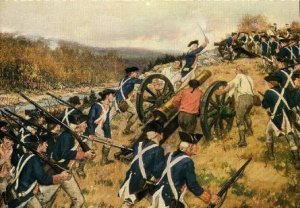
The Battle of White Plains in New York was fought between General George Washington’s Continental Army and General William Howe’s British and Hessian armies on October 28, 1776. Hear the story of this important battle.
On the night of March 5, 1770, a conflict occurred between eight British soldiers and their captain and a crowd of citizens angered that British regiments occupied their town. The crowd threw snowballs, oyster shells and wielded clubs to taunt the soldiers near the Custom House. The confrontation resulted in the soldiers firing into the crowd, killing five and wounding others. Dr. Joseph Warren was one of the doctors called to treat the wounded and perform autopsies on the dead. The Patriots vowed not to forget “the bloody massacre” that would later become known as The Boston Massacre. Each year after, on March 5, they held an oration to remind the town of the event.
Paul Revere’s engraving of the Boston Massacre copied from an earlier version by Henry Pelham. Gilder-Lehrman Institute of American History.
In 1775, March 5 fell on the Sabbath. Therefore, “at a Meeting of the Freeholders & other Inhabitants of the Town of Boston…The Comittee appointed by the Town…to apply to a proper Gentleman to deliver an Oration…had made Choice of Joseph Warren Esq. to deliver an Oration on the 6th. of March instant, who had accordingly accepted of said Service.” It was voted that the oration be delivered “at the Old South Meeting House half past 11 O’Clock A.M.”
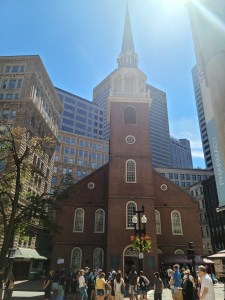
Old South Meeting House circa 2022
Boston buzzed with excitement. The oration was considered a town meeting—illegal under the Massachusetts Government Act. Unlike previous occasions of the commemoration, British troops were abundant in Boston (they had been removed to Castle William after the massacre). The British soldiers were going to resent an oration whose purpose was, in the words of Samuel Adams, “to commemorate a massacre perpetuated by soldiers and to show the danger of standing armies.” Dr. Joseph Warren had delivered the oration in 1772. Samuel Adams wanted Warren’s experience in the pulpit. He knew that Warren would not be intimidated.
In his diary for September 6, 1775, from England, former Massachusetts Governor Thomas Hutchinson mentioned a call from a Colonel James. “He tells an odd story of the intention of the Officers the 5 [six] March that 300 were in the Meeting to hear Dr Warrens oration— that if he had said anything against the King &c an Officer was prepared who stood near, with an Egg to have thrown in his face and that was to have been a signal to draw swords & they would have massacred Hancock Adams & hundreds more & he added he wished they had.” Hutchinson commented, “I am glad they did not for I think it would have been an everlasting disgrace to attack a body of people without arms to defend themselves.”
A crowd of 5,000 gathered at Old South Meeting House including those British officers. Samuel Adams “had long expected they would take that Occasion to beat up a Breeze” and invited them to sit in the pews directly in front of the pulpit so they “might have no pretence to behave ill.” This put the soldiers uncomfortably close to the many leading patriots in attendance. The officers were not only sitting in the pews, some were seated on the steps leading up to the pulpit, and some were sitting on the pulpit itself.
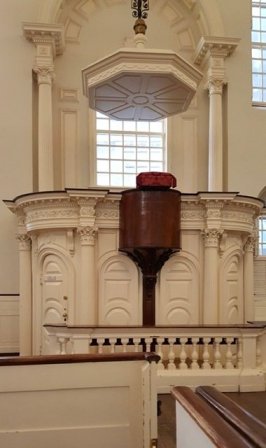
The pulpit today at Old South Meeting House circa 2017.
After spending the morning treating patients, Dr. Warren arrived around eleven o’clock. Rivington’s New York Gazette reported, “A single horse chair stopped at the apothecary’s opposite the meeting, from which descended the orator [Warren]…and entering the shop, was followed by a servant with a bundle, in which were the Ciceronian toga…Having robed himself, he proceeded across the street to the meeting.” A toga was worn by a citizen of Rome and distinguished him from a soldier or a slave. As a student at Harvard, Warren had performed the popular play Cato with his classmates. By wearing a toga, Warren was sending a strong message: citizens would not be intimidated by tyrannical threats.
Since the meetinghouse was jammed with people, he was taken around to the back of the building, where he climbed a ladder to access the pulpit through the rear window. The pulpit was covered in black cloth provided by John Hancock. A soldier grunted. One barked, “Scoundrel.” Warren ignored the British officers who meant to coerce him, looked out over the audience and began to speak. “My ever honored fellow citizens, it is not without the most humiliating conviction of my want of ability that I now appear before you: but the sense I have of the obligation I am under to obey the calls of my country at all times, together with an animating recollection of your indulgence exhibited upon so many occasions, has induced me once more, undeserving as I am, to throw myself upon that candor which looks with kindness on the feeblest efforts of an honest mind.”
He contended that personal freedom is the natural right of every man. “And no man or body of man, can without being guilty of flagrant injustice, claim a right to dispose of the person or acquisitions of any other man, or body of men, unless it can be proved that such a right has arisen from some compact between the parties in which it has been explicitly and freely granted.”
He spoke of their forefathers having nobly resolved never to wear the yoke of despotism, but tyranny, when once established, entailed its curses on a nation. Yet, there was a time when America and Great Britain became so united in affection both countries flourished due to mutual prosperity. He proclaimed, “The hearts of Britons and Americans, which lately felt the generous glow of mutual confidence and love, now burn with jealousy and rage. The many injuries offered to the town, I pass over in silence. I cannot now mark out the path which led to that unequaled scene of horror, the sad remembrance of which, takes the full possession of my soul. The sanguinary theatre again opens itself to view. The baleful images of terror crowd around me, and discontented ghosts, with hollow groans, appear to solemnize the anniversary of the fifth of March. Approach we then the melancholy walk of death.”
When Warren spoke of the events of March 5, 1770, he focused on the agony and despair of the families who had lost loved ones that night. “Come widowed mourner, here satiate thy grief; behold the murdered husband gasping on the ground, and to complete the pompous show of wretchedness, bring in each hand thy infant children to bewail their father’s fate. Take heed, ye orphan babes, lest, whilst your streaming eyes are fixed upon the ghastly corpse, your feet glide on the stones bespattered with your father’s brain.”
Warren’s voice rose to an emotional crescendo. “Our country is in danger, but not to be despaired of. Our enemies are numerous and powerful; but we have many friends, determine to be free, and heaven and earth will aid the resolution. On you depend the fortunes of America. You are to decide the important question, on which rest the happiness and liberty of millions yet unborn. Act worthy of yourselves. An independence from Great Britain is not our aim. No, our wish is that Britain and the colonies may, like the oak and the ivy, grow and increase in strength together. The interest and safety of Britain, as well as the colonies, require that the wise measures, recommended by the honourable Continental Congress, be steadily pursued. But if these pacific measures are ineffectual, and it appears that the only way to safety, is through fields of blood, I know you will not turn your faces from your foes, but will, undauntedly, press forward, until tyranny is trodden under foot, and you have fixed your adored goddess Liberty on the American throne.”
He finished by stating, “With having redeemed your country, and secured the blessing to future generations, who, fired by your example, shall emulate your virtues, and learn from you the heavenly art of making millions happy; with heart felt joy, which transports all your own, you cry, the glorious work is done. Then drop the mantle to some young Elisha, and take your seats with kindred spirits in your native skies.”
The audience stood to a thundering applause. What happened next was recorded in the diary of Lieutenant John Barker of the King’s Own Regiment. “…when after he [Warren] had finished a most seditious inflammatory harangue, John Hancock stood up and made a short speech in the same strain, at the end of which some of the Officers cried out, fie! fie! Which being mistaken for the cry of fire an alarm immediately ensued, which fill’d the people with consternation that they were getting out as fast as they cou’d by the doors and windows. It was imagined that there wou’d have been a riot, which if there had wou’d in all probability have proved fatal to Hancock, Adams, Warren, and the rest of those Villains as they were all up in the pulpit together, and the meeting was crowded with Officers and Seaman in such a manner that they cou’d not have escaped; however it luckily did not turn out so, it wou’d indeed have been a pity for them to have made their exit that way, as I hope we shall have the pleasure before long of seeing them do it by the hands of the Hangman.”
The British responded to Warren’s Boston Massacre Oration with ridicule. On March 15, 1775, British officers and Loyalists gathered on King Street and then proceeded to the nearby British Coffee House where they conducted a mock town meeting. Loyalist physician Thomas Bolton, read a satirical lampoon of Warren’s oration. In addition to his assault on Warren, Bolton reviled other prominent Patriots including John Adams, John Hancock, John Rowe, Charles Lee, William Molineux, Samuel Cooper, Josiah Quincy, and Dr. Thomas Young. Bolton accused that William Molineux, who died in 1774, “through the Strength of his own Villiany, and the Laudanum of Doctor Warren, he quitted this planet and went to a Secondary one, in search of Liberty.”
Despite the Loyalist reaction, “the Thanks of the Town [Boston] be & hereby are given to Joseph Warren Esq. for the Elegant & Spirited Oration delivered by him at their Request.”
References:
Photos of Old South Meeting House by Salina B Baker.
City of Boston. A Report of the Record Commissioners of the City of Boston Containing the Boston Town Records, 1770-1777. Boston: Rockwell and Churchill, City Printers, 1887. https://archive.org/details/recordsrelatingt18bost
Rally the boys! Hasten the chiefs! Our Warren’s there and bold Revere. With hands to do, and words to cheer!
And Warren was there. You just had to look a little harder to find him.
My seven day return trip to Boston was a pilgrimage I’m sure few people take. At the time, I was writing the first book in my Historical Fantasy series about the American Revolution, “Angels and Patriots Book One, Sons of Liberty, Lexington and Concord, Bunker Hill” in which Warren is an important character. My husband and I were determined to find evidence that Dr. Joseph Warren was indeed still in and around Boston so we could walk in his foot steps and visit the places where he had influence.
Green Dragon Tavern. The Sons of Liberty regularly met here and the tavern played an important part in the freedom of Boston during the American Revolution. The St. Andrews Lodge of Freemasons bought the tavern in 1764. The Masons used the first floor for their meeting rooms, some led by Grand Master Joseph Warren. This isn’t the original tavern or site which was located in the North End in the 1700s. Aside from the back bar, he was listed on the menu with his fellows, who each had a menu item. We ate and drank at the tavern four nights.
Green Dragon Tavern
Boston Museum of Fine Arts. The museum is massive. It was no easy feat finding the gallery where John Singleton Copley’s paintings hang. The painting of Joseph Warren hangs on a wall between the paintings of John Hancock and Mercy Otis Warren. Copley’s paintings of Samuel Adams and Paul Revere were also in the gallery. The paintings are almost life-size and breathtaking!
We found John Trumbull’s painting of The Death of General Warren at the Battle of Bunker’s Hill, June 17, 1775 in a different gallery. It was small and somewhat faded and hung out of the reach of tourists.
The State House. Joseph was mentioned in a small exhibit on the second floor. What looks like a hacksaw to the right behind the sword’s tip is a doctor’s bone saw. In April 1776, after the Siege of Boston ended and Joseph’s body was recovered from Bunker Hill (Breed’s Hill), his remains laid in state here for three days until his funeral at King’s Chapel.
Old State House
The Old South Meeting House. Joseph delivered two Boston Massacre Orations in the meeting house. One in 1772, and one in 1775. This was where the patriots met to build a revolution. To my dismay, the Plexiglas in which his likeness and achievements is etched, reflected light (even without a flash) and the camera shot was impossible to see. This is the pulpit (today) from which he gave his oration.
Old South Meeting House Pulpit
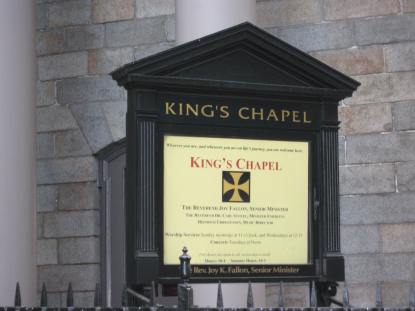
King’s Chapel. The Freemasons made the arrangements for their Most Worshipful Grand Master Joseph Warren’s funeral, which was held in King’s Chapel in the heart of Boston on April 8, 1776.
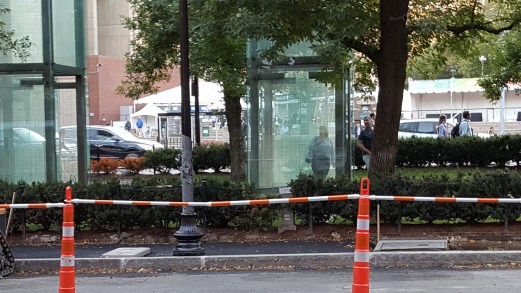
Boston City Hall Plaza. The house where Joseph lived with his family and his medical apprentices was once located here. It’s recently been in the news. Joseph’s biographer, Dr. Samuel Forman, and others are intent on erecting a monument on the grounds proclaiming that this was the spot where the Revolutionary War began because Joseph dispatched Revere and Dawes to Lexington from his house. This is a view of the plaza (where the event tents are) from the Bell in Hand tavern across the street. The WWII Holocaust Memorial is the green glass between the two locations.
Bunker Hill Monument. This is where Joseph was shot in the head in the waning hours of the Battle of Bunker Hill (Breed’s Hill) on June 17, 1775. Dr. Joseph Warren and Colonel William Prescott are the only names on the Massachusetts Gate. While my husband climbed the monument, I sat inside the adjoining building and watched the tourists largely dismiss the seven foot tall statue of Joseph’s likeness, which commanded the attention in the sparse room. It saddened me to witness how obscure he really is.
Bunker Hill Monument
Warren Tavern. Located at 2 Pleasant Street in Charlestown, MA, it’s a few blocks from the Bunker Hill monument. The tavern, named for him, dates to 1780 and is dedicated to all things Joseph Warren. Of course he was never there, but his close friend, Paul Revere visited and George Washington stopped there in 1789. We visited Bunker Hill and ate at Warren Tavern on my birthday.
The Clarke-Hancock House in Lexington. Joseph dispatched Paul Revere and William Dawes to this house to warn his fellow Sons of Liberty John Hancock and Samuel Adams, who were hiding there, that the British regulars were out to possibly arrest them. We were the only tourists there at the time we visited.
Clarke-Hancock House
Harvard. Of the three buildings that made up the Harvard campus when Joseph attended from 1755 to 1759, only one original building is still standing — his dormitory, Massachusetts Hall. Washington housed his army in the dormitory in 1775 – 1776.
The Roxbury Latin School. We didn’t visit the school where Joseph was a student and later a teacher after graduating from Harvard. There is a statue of him in the school’s courtyard that was once located in Warren Square in his childhood town of Roxbury. The General Joseph Warren Society contributes to the school’s annual fund. This picture is from the school’s website.
Grand Lodge of Masons of Massachusetts. We didn’t visit the masonic lodge, that houses a museum, because we arrived after it closed and it was our last day in Boston. We will visit next time and look for Grand Master Joseph Warren.
Forest Hills Cemetery, Jamaica Plains, MA. Perhaps, if Joseph remains hadn’t been moved from Granary Burying Ground in Boston, where some of his fellows are buried, like Samuel Adams and Paul Revere, and a place thousands of tourists visit daily, history may not have forgotten him. But the magnificent beauty of Forest Hills Cemetery where he’s buried changed my mind. As soon as I saw the cemetery gates, I knew he belonged there. The cemetery is expansive and magnificent: full of beautiful gravestones, monuments, statues, and gracefully curving roads. Forest Hills Cemetery
The road where his burial site is located is called Mount Warren.
Joseph’s remains are buried in a joint family plot with his paternal grandmother, Deborah Warren; his mother and father, Mary and Joseph Warren; his oldest son, Joseph; his youngest brother, Dr. John Warren; and John’s son, Dr. John Collins Warren. A glacial boulder selected by the Warren family serves as a giant tombstone. The remains of each person, appears that at one time, they were buried in their own grave. Except for Joseph’s, it appears that the original tombstones surround the boulder.
A statue of Joseph stands atop the boulder. The statue was erected on October 22, 2016 by the 6th Masonic District that hosted a ceremony where their Grand Master dedicated a new memorial to “the namesake of our Distinguished Service Medal, M.W. Joseph Warren” in conjunction with members of the Warren family. The flags on his grave site are new, so someone is visiting.
Forest Hill Cemetery Gates
Statue of Joseph Warren erected on his family grave site by the 6th Masonic District October 2016
Warren family grave site in Forest Hills Cemetery
Men Joseph knew during his lifetime, General William Heath and William Dawes are also buried in Forest Hills.
Vine Lake Cemetery. We traveled to Medfield, MA to visit the grave of the woman who was nanny to Joseph’s four children and assumed to be his fiancé at the time of his death: Mercy Scollay. My husband gathered acorns from the ground around Joseph’s grave site and placed them on Mercy’s grave. The inscription on her gravestone read:
I know whom I have believed and I am persuaded that He is able to keep that which I have committed to him against that day.
Mercy lived another 50 years after Joseph’s devastating death. She never married.
This was the last picture I took in Boston the evening before we left. Faneuil Hall is the brick building to the left. Samuel Adams’ statue is in the mall in front. Faneuil Hall was only two stories high during Joseph’s time.
Dr. Joseph Warren is an important character in my award-winning historical fantasy series Angels & Patriots Book One. Sons of Liberty, Lexington and Concord, Bunker Hill Available on Amazon in paperback or Kindle eBook.


 General George Washington proclaimed January 1, 1776 was the first day of “a new army, which in every point of view is entirely continental.” Hear the story of the celebration of that event.
 The Billop House on Staten Island was the site of a peace conference between British Admiral Lord Richard Howe, Benjamin Franklin, and John Adams during the Revolutionary War in September 1776. Hear the story of what transpired.
 The Battle of White Plains in New York was fought between General George Washington’s Continental Army and General William Howe’s British and Hessian armies on October 28, 1776. Hear the story of this important battle.










 Salina B Baker