Happy 277th Birthday, Dr. Joseph Warren

“Our country is in danger, but not to be despaired of. Our enemies are numerous and powerful; but we have many friends, determining to be free, and heaven and earth will aid the resolution. On you depend the fortunes of America. You are to decide the important question, on which rest the happiness and liberty of millions yet unborn. Act worthy of yourselves.”

~~ Dr. Joseph Warren (from his 1775 Boston Massacre Oration)

President Ronald Reagan quoted these words in his 1981 presidential inaugural address. Like the patriots of colonial America, Reagan was inspired by Dr. Joseph Warren’s determination, fortitude, and passion. Without Joseph’s influence and actions, this nation may not have been born.

Joseph Warren was a Boston physician who cared for rich and poor, American and English, free and slave. He was deeply involved with his fellow patriots, Sons of Liberty, and masonic lodge brothers: John Adams, John Hancock, Samuel Adams, and Paul Revere—to name a few.
Warren-5638
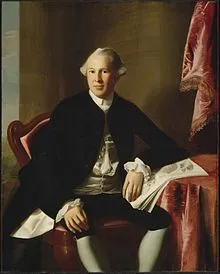
Dr. Joseph Warren

In April 1775, Joseph was elected president of the Massachusetts Provincial Congress and the Committee of Safety, to replace the absent John Hancock. With little money or resources, he was faced with the challenges of a rapidly evolving revolutionary political and military climate. He was a tireless devoted leader who responded to each new challenge with intelligence and courage.

He held the American rebellion together during the critical months (April – June 1775) that spanned the Battle of Lexington and Concord, and the Battle of Bunker Hill. Those collective months were his swan song.

If he had lived, he may have outshined all the Founding Fathers. Loyalist Peter Oliver surmised in 1782 that if Warren had lived, George Washington would have been “an obscurity.” But, the imminent grief of Joseph’s death eased, and his dazzling light dimmed.

Joseph Warren was born on June 11, 1741. The eldest of four boys–Samuel, Ebenezer, and John–Joseph grew up outside of Boston on the Warren family farm in Roxbury, Massachusetts. The Warren farm produced a distinctive kind of apple called Warren or Roxbury Russet. The senior Joseph Warren turning his eye upon his eldest son Joseph said, “I would rather a son of mine were dead, than a coward.” It would prove to be a prophetic statement.

By age fourteen, Joseph was attending Harvard. In October 1755, while working in the orchard, his father died after a fall from a ladder. Suddenly, Joseph was the head of the household, and it was a responsibility he took to heart.

Due to the generosity of the community, he was able to continue his studies at Harvard, where he became interested in medicine. Joseph learned the prevailing humeral approach to disease. Ancient Greek and Roman medicine ascribed diseases to imbalances in the humors; the four distinctive attributes of living organisms: blood, phlegm, yellow bile, and black bile. As a physician, Joseph would have prescribed and prepared herbal medications to return the bodily humors to balance, and thus, cure the patient’s affliction.

Upon graduation, as repayment for the community’s sponsorship at Harvard, Joseph taught public grammar school at the Roxbury Latin school. After that year long stint, he was free to pursue his profession as a doctor.

During a time when a layman could practice medicine, Joseph was a passionate proponent of disciplined medical education. When a colleague, Dr. Thomas Young, prescribed a treatment for tuberculosis that resulted in the patient’s death, Joseph’s quill flew. With sardonic humor and under the pen name, Philo Physic, he carried on a ruthless debate with Dr. Young in the newspapers.

In early 1764, a smallpox epidemic swept Boston and the surrounding areas. Joseph went to work for the physicians’ initiative for community wide inoculation at Castle William, a fort and smallpox hospital just south of Boston. The doctors administered inoculations, and worked on case reporting and quarantine measures. It is here where Joseph met John Adams who had come to be inoculated.
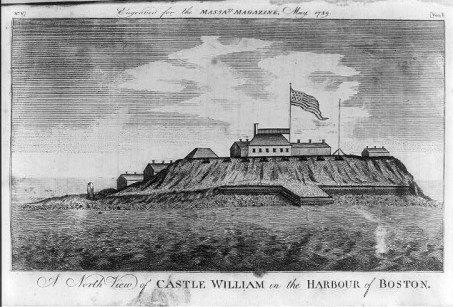
1789_CastleWilliam_BostonHarbor_MassachusettsMagazine

The following year, Joseph wrote articles calling for the establishment of an organization of Massachusetts physicians (the Massachusetts Medical Society would be established in 1782 by Joseph’s youngest brother John).

As a woman, I find descriptions of Joseph’s beauty and mannerisms alluring. His elegance was also apparent to men.

Richard Frothingham, in his 1865 text on the Life and Times of Joseph Warren, amply describes Warren, whose sandy blonde hair and gentle complexion was considered, especially by the ladies, as being quite handsome.

“He had a graceful figure, was scrupulously neat in his person, of thorough culture, and had an elegant address; and these traits rendered him a welcome visitor in polite circles, while a frank and genial manner made him a general favorite.  He had a great love for his fellow man; and being a stranger to the passion of avarice, and even neglectful to a fault in pecuniary matters, he had an ear ever open to the claims of want, and a hand ever extended to afford relief.” [1]

John Adams wrote in a letter dated July 29, 1775, shortly after Joseph’s death:  “Warren was a young man whom nature had adorned with grace and manly beauty, and a courage that would have been rash absurdity, had it not been tempered by self-control.” [2]

Joseph’s religious roots were Puritan, and his writings reveal his passionate use of religious allegories coupled with erotic metaphors. His 1772 and 1775 Boston Massacre Orations are filled with such references. How did his religious beliefs influence his associations with women?

Joseph married seventeen-year-old orphaned heiress, Elizabeth Hooton, in September 1764. She was probably pregnant when the couple married. Their first child, Elizabeth “Betsey”, was born sometime in March 1765. The marriage appeared to have been, at least in the beginning, little more than a union of convenience. The couple went on to have three more children: Joseph, Richard, and Mary.

No authentic records of Elizabeth’s thoughts, beliefs, or life with Joseph exists. Her portrait lacks adornments–jewelry, hairdressing, a book, a favorite pet–to suggest her personal tastes. Elizabeth died on April 26, 1773. (Paul Revere’s wife, Sarah, died a few weeks later.)

SC38660
Elizabeth Hooton Warren

The only accounts of Joseph’s thoughts on his wife were written following her death. On her passing, Joseph wrote:

Aetherial Spirits see the S[y]stem’s right, But mortal Minds demand a clearer Sight, In Spight of Reason’s philosophic Art, A tear must fall to indicate the Heart.[4] 

After Elizabeth’s death, Mercy Scollay cared for his children and became a member of the Warren household. Mercy was said to be Joseph’s intellectual equal. She was certainly articulate in her writings. Lore suggests she was Joseph’s fiancee at the time of his death. There is no documented evidence of that engagement.

After Joseph’s death, his youngest brother, Dr. John Warren, eventually got custody of the children. Their welfare remained in dire straits until 1778 when General Benedict Arnold (who had befriended Joseph at Cambridge) gave $500 for their education and petitioned Congress for the amount of a major general’s half pay for their welfare until the youngest reached majority.

Joseph’s biographer, Dr. Samuel Forman wrote that Joseph was “dismissive of women”. [3] Yet, history tells the tale of a handsome young doctor whose female patients feigned continuing illnesses as a ploy for Dr. Warren’s lingering attentions.


Joseph was too occupied with establishing his medical practice, a smallpox epidemic, attempts to organize a province medical society, and his new life as a husband and soon-to-be father to notice the growing colonial despair over the acts of the British parliament. Then, parliament passed the Stamp Act on March 22, 1765. The new tax was imposed on all American colonists and required them to pay a tax on every piece of printed paper they used. Joseph went from a young independent physician to a committed radical Whig and Son of Liberty insider.

Enter Joseph’s political mentor, the much older, Samuel Adams. Their budding interaction was to mature into one of the most significant of their lives and of the patriot movement.

Joseph’s first successful strategic battle was an initiative to resolve a Boston dispute between his masonic lodge, St. Andrew’s Lodge of the Ancients, and the exclusionary and privileged English St. John’s Grand Lodge of the Moderns. The members of St. John’s refused to allow the inclusion of St. Andrew’s “common folk” into their masonic celebrations and rituals. One can imagine Joseph leaning in close to his fellow St. Andrew’s lodge members, Paul Revere and John Hancock, and with a smile, saying, “Screw this. We will procure our own Grand Lodge charter.”

A committee headed by Joseph, by-passed England and applied to Scotland for St. Andrew’s chartering as a Grand Lodge. The application was granted, and the commission establishing a new Grand Lodge of the Ancients with Joseph as its Grand Master was dated May 30, 1769. Now, St. John’s and St. Andrew’s Masonic lodges were on even ground.

I adjourn our visit with Joseph Warren’s life until June 17, when we will follow him to Bunker Hill.
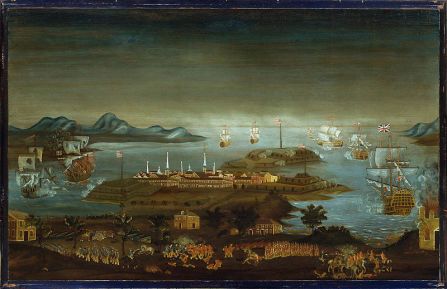
The_Battle_of_Bunker_Hill_(1776-77)
Battle of Bunker Hill

Resources:

Frothingham, Richard.  Life and Times of Joseph Warren.  1865:  Little Brown & Company, New York, NY.

Forman, Samuel A.  Dr. Joseph Warren, The Boston Tea Party, Bunker Hill, and the Birth of  American Liberty.  2012:  Pelican Publishing Company, Gretna, Louisiana.

Philbrick, Nathaniel. Bunker Hill A City, A Siege, A Revolution. 2013: Penguin Books, New York, NY.

http://www.revolutionarywarjournal.com/warren/#more-519; Revolutionary War Journal 2017

Warren, M.D., Edward. The Life of John Warren, M.D. Surgeon-General During The War Of The Revolution; First Professor Of Anatomy And Surgery In Harvard College; President of the Massachusetts Medical Society, Etc. 1874: Noyles, Holmes, and Company, Boston

Painting of Joseph Warren by John Singleton Copley, 1765. Museum of Fine Arts, Boston, MA

Painting of Elizabeth Hooton Warren by John Singleton Copley, 1772. Museum of Fine Arts, Boston, MA

Painting of Margaret Gage in the Turquerie style, circa 1771, by John Singleton Copley. Timken Museum of Art in San Diego, California.

Image of the Battle of Bunker Hill by Winthrop Chandler, Museum of Fine Arts, Boston, MA

[1] (Frothingham, pg 19)

[2] http://www.revolutionarywarjournal.com/warren/#more-519

[3] (Forman, pg 191)

[4] (Forman, pg 183)


Dr. Joseph Warren is an important character in my award-winning historical fantasy novel Angels & Patriots Book One. Sons of Liberty, Lexington and Concord, Bunker Hill Available on Amazon in paperback or Kindle eBook.

Angels & Patriots Book One


Dr. Joseph Warren’s 1775 Boston Massacre Oration


On the night of March 5, 1770, a conflict occurred between eight British soldiers and their captain and a crowd of citizens angered that British regiments occupied their town. The crowd threw snowballs, oyster shells and wielded clubs to taunt the soldiers near the Custom House. The confrontation resulted in the soldiers firing into the crowd, killing five and wounding others. Dr. Joseph Warren was one of the doctors called to treat the wounded and perform autopsies on the dead. The Patriots vowed not to forget “the bloody massacre” that would later become known as The Boston Massacre. Each year after, on March 5, they held an oration to remind the town of the event.

Paul Revere’s engraving of the Boston Massacre copied from an earlier version by Henry Pelham. Gilder-Lehrman Institute of American History.

In 1775, March 5 fell on the Sabbath. Therefore, “at a Meeting of the Freeholders & other Inhabitants of the Town of Boston…The Comittee appointed by the Town…to apply to a proper Gentleman to deliver an Oration…had made Choice of Joseph Warren Esq. to deliver an Oration on the 6th. of March instant, who had accordingly accepted of said Service.” It was voted that the oration be delivered “at the Old South Meeting House half past 11 O’Clock A.M.”

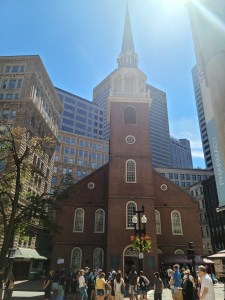
Old South Meeting House circa 2022

Boston buzzed with excitement. The oration was considered a town meeting—illegal under the Massachusetts Government Act. Unlike previous occasions of the commemoration, British troops were abundant in Boston (they had been removed to Castle William after the massacre). The British soldiers were going to resent an oration whose purpose was, in the words of Samuel Adams, “to commemorate a massacre perpetuated by soldiers and to show the danger of standing armies.” Dr. Joseph Warren had delivered the oration in 1772. Samuel Adams wanted Warren’s experience in the pulpit. He knew that Warren would not be intimidated.

In his diary for September 6, 1775, from England, former Massachusetts Governor Thomas Hutchinson mentioned a call from a Colonel James. “He tells an odd story of the intention of the Officers the 5 [six] March that 300 were in the Meeting to hear Dr Warrens oration— that if he had said anything against the King &c an Officer was prepared who stood near, with an Egg to have thrown in his face and that was to have been a signal to draw swords & they would have massacred Hancock Adams & hundreds more & he added he wished they had.” Hutchinson commented, “I am glad they did not for I think it would have been an everlasting disgrace to attack a body of people without arms to defend themselves.”

A crowd of 5,000 gathered at Old South Meeting House including those British officers. Samuel Adams “had long expected they would take that Occasion to beat up a Breeze” and invited them to sit in the pews directly in front of the pulpit so they “might have no pretence to behave ill.” This put the soldiers uncomfortably close to the many leading patriots in attendance. The officers were not only sitting in the pews, some were seated on the steps leading up to the pulpit, and some were sitting on the pulpit itself.

The pulpit today at Old South Meeting House circa 2017.

After spending the morning treating patients, Dr. Warren arrived around eleven o’clock. Rivington’s New York Gazette reported, “A single horse chair stopped at the apothecary’s opposite the meeting, from which descended the orator [Warren]…and entering the shop, was followed by a servant with a bundle, in which were the Ciceronian toga…Having robed himself, he proceeded across the street to the meeting.” A toga was worn by a citizen of Rome and distinguished him from a soldier or a slave. As a student at Harvard, Warren had performed the popular play Cato with his classmates. By wearing a toga, Warren was sending a strong message: citizens would not be intimidated by tyrannical threats.

Since the meetinghouse was jammed with people, he was taken around to the back of the building, where he climbed a ladder to access the pulpit through the rear window. The pulpit was covered in black cloth provided by John Hancock. A soldier grunted. One barked, “Scoundrel.” Warren ignored the British officers who meant to coerce him, looked out over the audience and began to speak. “My ever honored fellow citizens, it is not without the most humiliating conviction of my want of ability that I now appear before you: but the sense I have of the obligation I am under to obey the calls of my country at all times, together with an animating recollection of your indulgence exhibited upon so many occasions, has induced me once more, undeserving as I am, to throw myself upon that candor which looks with kindness on the feeblest efforts of an honest mind.”

He contended that personal freedom is the natural right of every man. “And no man or body of man, can without being guilty of flagrant injustice, claim a right to dispose of the person or acquisitions of any other man, or body of men, unless it can be proved that such a right has arisen from some compact between the parties in which it has been explicitly and freely granted.”

He spoke of their forefathers having nobly resolved never to wear the yoke of despotism, but tyranny, when once established, entailed its curses on a nation. Yet, there was a time when America and Great Britain became so united in affection both countries flourished due to mutual prosperity. He proclaimed, “The hearts of Britons and Americans, which lately felt the generous glow of mutual confidence and love, now burn with jealousy and rage. The many injuries offered to the town, I pass over in silence. I cannot now mark out the path which led to that unequaled scene of horror, the sad remembrance of which, takes the full possession of my soul. The sanguinary theatre again opens itself to view. The baleful images of terror crowd around me, and discontented ghosts, with hollow groans, appear to solemnize the anniversary of the fifth of March. Approach we then the melancholy walk of death.”

When Warren spoke of the events of March 5, 1770, he focused on the agony and despair of the families who had lost loved ones that night. “Come widowed mourner, here satiate thy grief; behold the murdered husband gasping on the ground, and to complete the pompous show of wretchedness, bring in each hand thy infant children to bewail their father’s fate. Take heed, ye orphan babes, lest, whilst your streaming eyes are fixed upon the ghastly corpse, your feet glide on the stones bespattered with your father’s brain.”

Warren’s voice rose to an emotional crescendo. “Our country is in danger, but not to be despaired of. Our enemies are numerous and powerful; but we have many friends, determine to be free, and heaven and earth will aid the resolution. On you depend the fortunes of America. You are to decide the important question, on which rest the happiness and liberty of millions yet unborn. Act worthy of yourselves. An independence from Great Britain is not our aim. No, our wish is that Britain and the colonies may, like the oak and the ivy, grow and increase in strength together. The interest and safety of Britain, as well as the colonies, require that the wise measures, recommended by the honourable Continental Congress, be steadily pursued. But if these pacific measures are ineffectual, and it appears that the only way to safety, is through fields of blood, I know you will not turn your faces from your foes, but will, undauntedly, press forward, until tyranny is trodden under foot, and you have fixed your adored goddess Liberty on the American throne.”

He finished by stating, “With having redeemed your country, and secured the blessing to future generations, who, fired by your example, shall emulate your virtues, and learn from you the heavenly art of making millions happy; with heart felt joy, which transports all your own, you cry, the glorious work is done. Then drop the mantle to some young Elisha, and take your seats with kindred spirits in your native skies.”

The audience stood to a thundering applause. What happened next was recorded in the diary of Lieutenant John Barker of the King’s Own Regiment. “…when after he [Warren] had finished a most seditious inflammatory harangue, John Hancock stood up and made a short speech in the same strain, at the end of which some of the Officers cried out, fie! fie! Which being mistaken for the cry of fire an alarm immediately ensued, which fill’d the people with consternation that they were getting out as fast as they cou’d by the doors and windows. It was imagined that there wou’d have been a riot, which if there had wou’d in all probability have proved fatal to Hancock, Adams, Warren, and the rest of those Villains as they were all up in the pulpit together, and the meeting was crowded with Officers and Seaman in such a manner that they cou’d not have escaped; however it luckily did not turn out so, it wou’d indeed have been a pity for them to have made their exit that way, as I hope we shall have the pleasure before long of seeing them do it by the hands of the Hangman.”

The British responded to Warren’s Boston Massacre Oration with ridicule. On March 15, 1775, British officers and Loyalists gathered on King Street and then proceeded to the nearby British Coffee House where they conducted a mock town meeting. Loyalist physician Thomas Bolton, read a satirical lampoon of Warren’s oration. In addition to his assault on Warren, Bolton reviled other prominent Patriots including John Adams, John Hancock, John Rowe, Charles Lee, William Molineux, Samuel Cooper, Josiah Quincy, and Dr. Thomas Young. Bolton accused that William Molineux, who died in 1774, “through the Strength of his own Villiany, and the Laudanum of Doctor Warren, he quitted this planet and went to a Secondary one, in search of Liberty.”

Despite the Loyalist reaction, “the Thanks of the Town [Boston] be & hereby are given to Joseph Warren Esq. for the Elegant & Spirited Oration delivered by him at their Request.”


References:

Photos of Old South Meeting House by Salina B Baker.

Barker, John. The British in Boston Being the Diary of Lieutenant John Barker of the King’s Own Regiment from November 15, 1774 to May 31, 1776.Cambridge: Harvard University Press, 1924. https://www.google.com/books/edition/The_British_in_Boston/fY0rAQAAIAA

City of Boston. A Report of the Record Commissioners of the City of Boston Containing the Boston Town Records, 1770-1777.  Boston: Rockwell and Churchill, City Printers, 1887. https://archive.org/details/recordsrelatingt18bost

Cushing, Harry Alonzo. The Writings of Samuel Adams, Volume III,1773-1777. The Project Gutenberg eBook of The Writings of Samuel Adams – Volume 3, 2015. https://www.gutenberg.org/cache/epub/2093/pg2093-images.html

Di Spigna, Christian. Founding Martyr: The Life and Times of Dr. Joseph Warren, the American Revolution’s Lost Hero. New York: Crown, 2018.

MHS Collections Online. An Oration delivered March 15th 1775 from the Coffee House by Doctor Thomas Bolton. https://www.masshist.org/database/viewer.php?item_id=3034&img_step=1&pid=34&mode=dual

UNIVERSITY OF MICHIGAN LIBRARY, M|LIBRARY Digital Collections. An oration; delivered March sixth, 1775. At the request of the inhabitants of the town of Boston; to commemorate the bloody tragedy of the fifth of March, 1770. / By Dr. Joseph Warren. ; [Two lines of quotations in Latin] https://quod.lib.umich.edu/cgi/t/text/text-idx?c=evans;cc=evans;rgn=div1;view=text;idno=N11558.0001.001;node=N11558.0001.001:4