A Royal Meeting: Portraying King George III in Historical Fiction – Guest Post by Avellina Balestri

When planning my American Revolution novel trilogy, All Ye That Pass By, I was conflicted on whether or not to feature King George III as a character. Being one of my favorite British monarchs, George as depicted in most books and films, particularly those pertaining to the American Revolution, underwhelmed me. Ranging from “You’ll Be Back” George in Hamilton to “Not Now, Bill” George in Turn, to the fixation on his later physical and mental health issues found in The Madness of King George, he is almost always depicted as either fundamentally tyrannical or simply unhinged. Bridgerton has a few passing scenes which feel genuinely sympathetic towards him, but it’s such an ahistorical trainwreck, depicting him as mentally disturbed from a young age, that I find it difficult to get past go with the premise.

Practically the only decent and dignified cameo I can think of off the top of head was in the John Adams miniseries, depicting the titular character’s meeting with the King. But even then, George is simply being used as a historical marker to affirm American independence. It’s not really about George as much as about him represented the resignation of Britain to losing her colonies. The mother is forced to yield to the child. It’s an incredibly awkward moment, made only barely tolerable by the decorum of the two men involved. Is this really the crux of George as a man or a king? The best and brightest moment in his reign? No. He deserves better.

George III age 22 when he was the Prince of Wales, painting by Joshua Reynolds

Conservative, George definitely was. Stubborn, it’s fair to say. Tyrannical, no. A devout Anglican Christian, a faithful family man, and a truly conscientious king who sought to uphold the British constitution, he sincerely believed the Mother Country had the right to directly tax her colonies when it proved expedient to the common good of the empire. And there’s nothing inherently wrong with that. Indeed, it was the 18th century default position for almost all European powers, which only proved unexpected due to the benign neglect prevelent in Britain’s handling of her colonies. How we turned a fairly vanilla conservative political position into the litmus test for human decency in the popular imagination I know not. Origin mythology, I guess.

George had an endearing personal touch that derived from a spirit of humility. He took his role as king with utmost seriousness, but never allowed that to go to his head. In his Book of Common Prayer, he crossed out “George, Our Gracious King” and replaced it with “George, a miserable sinner.” He took off his crown at his coronation when the time came to receive communion, recalling that Christ wore a crown of thorns. He overcame youthful introversion by making a point of speaking to every guest at any function he attended, and in personal interactions, he presented himself as a dignified yet plain-spoken country gentlemen, balancing mild manners with wry wit. In addition to this, George was a royal geek. He was fascinated by the sciences and what made things tick, ranging from agriculture to astronomy to mechanics. He also was a lover and patron of the arts and music.

King George III, painting by Benjamin West 1779

All this having been said, when the time came for me to decide whether or not to feature him in my trilogy, I hesitated. Might it not be better to leave some mystique surrounding the character of the king, given how much the storyline focuses on the divided loyalties of a Catholic recusant between the institutions of the Church and the Crown, exacerbated by the civil war tearing apart the British Empire? Perhaps. But in the end, I realized, this story was a deeply personal one, emphasizing the characters and their bonds with one another. How could I leave King George out of that equation? How could I deprive him of a chance to show how he could inspire loyalty in his own right, through his own virtues?

So I did my best to make His Majesty come to life in the following scene, in which General John Burgoyne takes my fictional protagonist Edmund “Ned” Southworth to a garden party in London. I based it largely on accounts of real interactions King George had with his subjects. I hope I managed to do the Last King of the United Empire justice. He deserves it.

(To purchase the first book in the trilogy, Gone for a Soldier, from which this excerpt comes, in paperback or Kindle format, please go here: https://www.amazon.com/gp/aw/d/B0D9QMCS6N)

***

When the weekend arrived, Burgoyne whisked Edmund off to an elegant garden party, where the general mixed and mingled amiably with London’s elite as they admired some of the earliest spring blooms peeking their heads out from the warming earth. Ned, for his part, stayed out of the way as much as possible, awkwardly hovering over a punch bowl in the corner. For all his blue blood, the young man felt more at home at a harvest dance with honest country folk than lavish galas with glittering assemblies.

As Ned started to fill another glass of punch for himself, there was a sudden fanfare of horns, and then the garden grew hushed.

Burgoyne made his way over to Ned and whispered in his ear, “It’s the King. Stand up straight.”

Ned dropped the ladle of punch with a splash and clank. “You…you didn’t tell me that—”

“Didn’t I? Oh well. Surprise!”

Edmund had the sudden desire to hide under the table until the royal visitation was over. This was partly because he realized there was punch staining his white ruffled shirt, making it look as if he had been stabbed in an ill-fated fencing lesson and that his blood ran an insipid pink shade. The other part was the simple knee-jerk reaction of any recusant. Catholics might well sing about “Great George, our King” to ease the trepidation of their Protestant neighbors and dispense with accusations of lingering Jacobitism, but few would be entirely comfortable with said king showing up in the flesh to scrutinize them. They were, after all, marked by their refusal to acknowledge him as supreme governor of the Church in England, and the measures they took to keep the ancient faith alive made them dangerously akin to outlaws.

But it was too late for Ned to take refuge beneath the table now, much too late…

In the course of all that worrying, the King had already made his grand entrance, cut a path through the garden party attendees, making small talk with each one of them as he went, and planted himself in front of Burgoyne and Edmund. Ned imitated the general’s low bowing and kept his eyes down, becoming increasingly fixated upon his stained shirt. He felt sure his face was turning as pink as the punch.

He looked up slightly as the King and the general exchanged courtesies. Burgoyne, as usual, was gushing and grandstanding, but Ned was in no mindset to process his monologue, beyond something to do with His Majesty’s inestimable virtues, and Burgoyne’s inestimable talents, and the colonial troublemakers needing to be put in their place. He did happen to notice that the King’s clothes were formal but not showy, the kind any dignified country gentlemen would wear, as opposed to Burgoyne’s ostentatious fare. And on his jacket was pinned a very pretty button.

After that, Ned recalled the King asking him a direct question, which his panicked brain failed to properly process. He found himself replying, “Yes, sire,” followed by “pretty button,” and was absolutely horrified by his own voice sounding so childish. He felt Burgoyne nudge him in the ribs, adding to his mortification.

The King was looking at Edmund full in the face now, his large blue eyes slightly perplexed.

“Your button, sire… it’s very fine, very fine indeed…”

“Indeed,” concurred the King, in perfect monotone. “It pertains to our patronage of The Handel Society.”

“Oh…wonderful, I mean…well done,” Ned replied, desperately trying to find some conversational footing. “I-I have always admired him, s-s-sire.”

Joy to the world! He was stuttering now. But this did not appear to faze the King, who merely smiled kindly, warming Edmund inside.

“As you may know, our grandfather was the first to stand for the Hallelujah at the performance of Handel’s Messiah in London,” the King remarked.

“Yes, sire,” Ned acknowledged, “because he found the power of the piece to be so moving.”

The King leaned forward slightly. “It was not without precedent for our grandfather to slip into slumber during performances, however moving they might be. When he found himself roused, momentary confusion, accompanied by eagerness to suitably respond to what could have been the royal anthem, might follow…”

“Ahhh.”

“We are not, of course, saying that is how it happened,” the King stated tactfully.

“No, sire.”

“Either way, we honor the tradition the late king set by standing whenever the Hallelujah is performed, and we are wide awake each time.”

“Me too,” Ned blurted. “I mean…I stand, and we all stand, because Your Majesty stands, and I think it’s fitting that we should do so, for the King of Kings.”

“We believe that was Handel’s intention,” the King said. “He said that he had seen the face of God, and so he made us see it too.”

“And so we do,” Ned concurred.

The King’s expression grew wistful. “I recall meeting that great composer after a performance when we were still a young prince under ten years. He seemed flattered by our enthusiasm for his work and said, ‘While that boy lives, my music will never want a protector.’ We have not forgotten that moment, thirty years on, nor shall we whilst God preserve us. We have purchased his harpsichord. We play it, even.”

“That’s wonderful, sire,” Ned responded cheerfully, genuinely pleased to hear the instrument was still in use.

“We hope the original owner does not mind too terribly, wherever he is. His genius was matched by a temper. Nearly ran a man through for touching the instrument.”

“If there’s anyone he wouldn’t mind playing upon it, surely it would be Your Majesty,” Ned insisted.. “You…you wear his button, after all…”

The King chuckled. “Do you play anything, hmm?”

“My sister does, though I am no good. I do drop everything and listen, though, whenever music of quality is being played. It’s like…like a prayer, like everything we could feel…joy and sorrow and glory, and the brevity of here, and the eternity of there…” He caught himself rambling, and thought of some way to finish. “As you said, sire, it’s as if God gives us a glimpse of His face, and we are left to marvel.”

“Yes,” the King said softly. “Marvel. That is the gift Handel gave us.” He turned to Burgoyne, who appeared to have gone into a blank stare, finding himself no longer at the center of attention. “This young man…he’s not the same as the one who was with you the last time, is he?”

“No, Your Majesty,” Burgoyne answered, relocating himself. “I’m afraid not. He’s not nearly as accustomed to garden parties, though he is fresh from the farm…”

“Afraid?” The King’s eyes glimmered quizzically. “No need, sir, no need. We like things fresh from the farm.”

Ned chuckled. “That…that makes sense, Your Majesty. After all…your name, it means…”

“Farmer,” the King finished. “A tiller of soil, a tender of vines…”

“And what is England if not a farm with soil to be tilled and vines to tend?” Ned asked. “She needs a farmer to see to her needs, and nothing else will do. That’s why our patron saint shares the same name, because the blood of the martyrs is the seed of the faith. Thus he served his Master as a soldier and a farmer, both. And he proved the guardian of kings in time of travail.”

“And what does it signify to you that Handel shared the same Christian name as us?”

“That he sowed songs, Your Majesty,” Ned answered, beaming. “One of the finest crops.”

The King snort-laughed, then grew serious. “Heed our advice, young man. Do not abandon your own plot of land for the allure of the court. A simple, honest life spent close to the earth keeps a man’s face bronzed and his eyes bright. Besides, the Creator deigns to reveal Himself to us through the book of creation, second only to sacred scripture, if we are but willing to look upon it with an inquiring mind and open heart.”

“Agreed, sire,” Ned replied with a smile. “I often feel God’s presence most keenly when nature surrounds me, especially walking the hills of home.”

“Good. This tour of the city seems not to have ruined you yet, though it might be wise not to risk too many more, what?”

“Indeed, sire,” Ned chuckled. “I shall abide by your counsel and remain true to my roots.”

“We are pleased,” said the King. Then he unexpectedly took off his button, and extended it to Ned. “Become a member of the Society.”

Ned blinked. “Are you quite sure you want me to take that, sire? It’s a very fine button…”

“We have a box,” the King replied simply.

“Oh…well…in that case…” Edmund reached out and accepted the button from the royal hand. “I am much obliged, Your Majesty.”

The King gestured at the punch stain on Ned’s shirt. “If you affix it there, it might cover that.

Ned felt his face burning as he did as he was instructed.

The King nodded in satisfaction. “We wish you success in your military career and continued good health wherever duty takes you.”

“Umm…th-thank you, Your Maj‒”

“Oh, he’s not a recruit, sire,” Burgoyne chortled, laying a hand on Ned’s shoulder. “Faith, he cannot be, I fear! He is a Papist! Lancashire recusant family. Fine father. Lent me some coin when I was hard-pressed with the ponies and the ladies! Passed on, poor soul, and here is his lad, under my wing!” He pulled Ned a little close to him, and Ned tried hard not to appear unduly embarrassed, no matter how he felt inside. “We’re two peas in a pod, he and I!”

The King glared at Burgoyne as if the man was touched in the head, then glanced over to Ned as if to determine whether or not the boy was being held hostage by a madman and required a royal rescue. At last, he turned back to Burgoyne.

“When next you see Lady Charlotte, pray tell your wife that the King, along with his Queen who shares a name with her, extend their fondest felicitations and pray for her good health.”

Edmund blushed, recalling suddenly that Gentleman Johnny was a married man, and Burgoyne himself bore a chastened expression as he promised to relay the gracious royal greeting back home, whenever he got back home.

Then the King turned to Ned once more. “A recusant, are you?”

“Yes, Your Majesty,” Edmund confirmed, butterflies in his stomach.

“Have you made any renovations to your house of late?”

“No, sire,” Ned answered cautiously, guessing the query might well refer to priest holes and secret chapels. “Our space is sufficient.”

“We see.” The King squinted dubiously. “It is good to take care in such matters. Too many alterations risk unsettling the foundation, after all.”

“We are very keen to keep our foundation solid, sire.”

“And in terms of your daily bread,” the King continued, “what is your source of sustenance up there, hmm?”

Edmund found himself saying, perhaps unwisely, “Very little to speak of, Your Majesty, save for the sacrifice of Christ.”

Any recusant would have known the double meaning, would have known that he meant the sacrifice of the Holy Mass which they risked so much to attend.

But the King seemed unaware of it, or at least he chose to act as if he were. In fact, he seemed to approve of Ned’s answer, and interpreting it in a manner applicable to all Christians, he replied, “That too is my dependency.”

And in that moment, as the King departed from them, Edmund Southworth saw George the Third not only as his sovereign, but as a sinner, like himself, saved by grace. In that, at least, there was no separation between them.

ABOUT THE AUTHOR

Avellina Balestri is a Catholic author and editor based in the historic borderlands of Maryland and Pennsylvania. Her stories, poems, and essays have been featured in over thirty print and online publications. Prior to her American Revolution trilogy All Ye That Pass By, she published two books: Saplings of Sherwood, the first book in a Robin Hood retelling series, and Pendragon’s Shield, a collection of poetry. She is the Editor-in-Chief of Fellowship & Fairydust, a magazine inspiring faith & creativity and exploring the arts through a spiritual lens. Under its auspices, she has hosted two literary conferences, at Oxford University and Cambridge University respectively. She also had the honor of representing the state of Maryland at The Sons of the American Revolution National Orations Contest. Avellina believes that the Trinitarian divine dance and Incarnational indwelling mystery are reflected in all things good, true, and beautiful, and that the image of God is wondrously woven into every human heart. These themes are at the forefront of the stories she chooses to tell.

For more information about the author and her various projects, please visit the following websites:

www.fellowshipandfairydust.com

www.avellinabalestri.com


The New Year’s Day Raising of the Union Flag on Prospect Hill

On New Year’s Day, Monday, January 1, 1776, British officers approached the American lines in Roxbury, Massachusetts under a flag of truce. At least one of the men was carrying copies of a broadside for distribution among the soldiers of the Continental Army. This was King George III’s speech, delivered before Parliament back on October 27, 1775. It had been published with the hope of putting the fear of God into the rebel army.
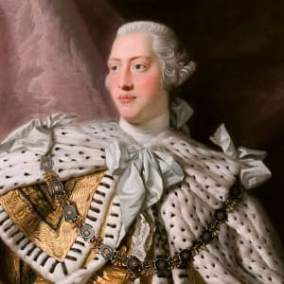
King George III

The king declared that the colonists’s  “strongest protestations of loyalty to me” were both absurd and offensive given that they were presently engaged in a “rebellious war . . . carried for the purpose of establishing an independent Empire.” The colonists must either return to the British fold or admit that they were engaged in a war of independence.

The reaction among the army was rage and indignation. The speech was burned in public by the soldiers. Its charges of traitorous rebellion and its ominous reference to “foreign assistance,” assuredly ended any hope of reconciliation or a short war. The effect of the King’s speech on General George Washington was profound.
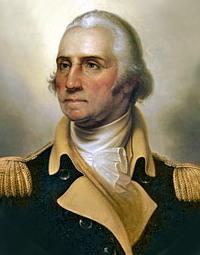
George Washington

If nothing else could “satisfy a tyrant and his diabolical ministry,” he wrote to his aide Colonel Joseph Reed, “we were determined to shake off all connections with a state so unjust and unnatural. This I would tell them, not under covert, but in words as clear as the sun in its meridian brightness.”

As it happened, Washington had already acted to strengthen the solidarity and resolve of his troops.  January 1 was the first day of “a new army, which in every point of view is entirely continental.” He stressed the hope that “the importance of the great Cause we are engaged in will be deeply impressed upon every man’s mind.” Everything “dear and valuable to freemen” was at stake.

To celebrate this event, Washington replaced the large red flag previously raised by Israel Putnam on the heights of Prospect Hill. With the crash of a 13-gun salute, he raised a new flag — a flag of thirteen red and white stripes, with the British colors (the crosses of St. George and St. Andrew) represented in the upper corner. The works at Prospect Hill were the equal of any fortification in Boston being situated on a large outcropping with a commanding view of the Mystic River and all of Boston Harbor.  Prospect Hill

Soon after the Battle of Chelsea Creek, Israel Putnam’s men had transformed the British schooner Diana’s seventy-five foot mainmast into a flag pole, and it was from this tar-stained pine that the Union flag of the Continental Army proudly waved. When the British in Boston saw it flying from Prospect Hill, they at first mistook it for a flag of surrender.

e5e078302370a4ed890a7e54c4e878b6
Prospect Hill and the Union Flag today.

It has been argued that the Somerville, Massachusetts annual New Year’s Day flag ceremony on Prospect Hill commemorates something that never really happened. There are others who claim it is accurate.


Resources:

https://patch.com/massachusetts/somerville/research-upholds-traditional-prospect-hill-flag-story

Philbrick, Nathaniel. Bunker Hill A City, A Siege, A Revolution. 2013Penguin Books, New York, NY.

McCullough, David. 1776. 2005: Simon & Schuster, New York, NY.


Lexington and Concord: The Last Days Leading up to a Revolution, Part 2

The violences committed by those who have taken up arms in Massachusetts Bay have appeared to me as the acts of a rude Rabble without plan, without concert, & without conduct, and therefore I think that smaller Force now, if put to the Test, would be able to encounter them with greater probability of Success….. 

….In this view of the situation of the King’s affairs, it is the opinion of the King’s servants, in which his Majesty concurs, that the essential step to be taken toward reestablishing government would be to arrest and imprison the principle actors and abettors in the Provincial Congress (whose proceedings appear in every light to be acts of treason….

~~Lord Dartmouth to General Thomas Gage, about April 16, 1775

lord dartmouth

The Earl of Dartmouth
Secretary of State for the Colonies 1772 – 1775

This was part of Lord Dartmouth’s long awaited, cross-Atlantic response to General Gage’s admonishments, which he had written to Lord Dartmouth in late January 1775, on how to handle the rebellious acts of the colonists. Those defiant acts were seemingly endless: the illegal proceedings of the Massachusetts Provincial Congress and the Continental Congress, the Suffolk Resolves, smuggling, seizures of powder and munitions, and threats to march into Boston “like locusts and rid the town of every soldier.” (Philbrick quoting Rev. John Andrews, pg 71)

thomas gage

General Thomas Gage
Royal Governor of Massachusetts 1774 – 1775

General Gage did not consider himself a royalist, but part of his advice to Dartmouth was something he believed the King wanted to hear:

“It’s the opinion of most People, if a respectable Force is seen in the Field, the most obnoxious of the Leaders seized, and a Pardon proclaimed for all other’s, that Government will come off Victorious, and with less Opposition than was expected a few Months ago.”

By the time Lord Dartmouth’s lengthy letter of advice reached Thomas Gage, tempers among the British ministry, the loyalists, and the patriots in Massachusetts had simmered down. In fact at this point, there was growing discord among the patriots’ own ranks, rooted in a misguided optimism that once King George III saw for himself that his ministers had misled him, the king would withdrawal his troops and the demand for unfair taxes would withdraw with them, leaving New England free. That optimism was founded in the colonists’ previous experiences with protests and the king’s withdrawal of the transgressions.

If Gage had chosen to do nothing in response to Dartmouth’s letter that spring, the patriots may have had a difficult time maintaining a united front. Ironically, Dartmouth’s letter, based on information and instructions months old, arrived around the same time Gage was receiving valuable information from his British spies. Those things came together to lead Gage to make a series of decisions that would change the course of history.

Just as ironically, one of Thomas Gage’s spies was a trusted colleague among the members of the Sons of Liberty and the Provincial Congress: Dr. Benjamin Church.

benjamin church

Dr. Benjamin Church

When it came to rebel secrets and plotting; only Samuel Adams, John Hancock, and Joseph Warren were more involved than Benjamin Church. But Benjamin had an expensive mistress, and spying brought the ready cash he needed to please her. He had no qualms about betraying his fellow patriots in exchange for the means to pay for the treasures that lay between the legs of his mistress, Phoebe Yates.

Church, among other spies, assured Gage there was a stockpile of provincial armaments located in Concord. Instead of taking Dartmouth’s advice to arrest the leaders of the Provincial Congress, Thomas Gage focused on securing and destroying the rebel military stores in Concord.

Sources:

Philbrick, Nathaniel. Bunker Hill A City, A Siege, A Revolution New York: Penguin Books, 2013. Print.

Borneman, Walter R. American Spring: Lexington, Concord, and the Road to Revolution New York: Little, Brown and Company, 2014. Print.