Women Camp Followers of the American Revolution

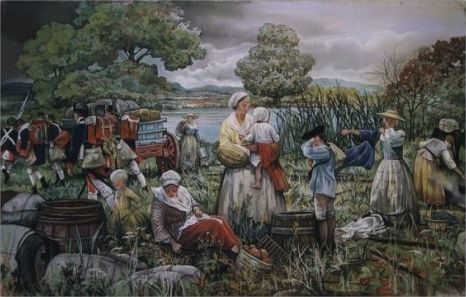
Most of their names are forgotten or were never recorded. They were wives, daughters, and girlfriends of British, American, and German soldiers and officers. Some followed the army looking for food and protection and work because they were no longer able to support themselves after the men left for war. Others were determined to be with their husbands no matter the cost. These women played a vital role in the American Revolution, sewing, nursing, cooking, guarding baggage, and offering support only they could provide their husbands. They suffered giving birth while enduring the hardships of war and moving armies.

Today, women who followed the army are referred to as “camp followers,” even though that term was not used in the eighteenth century. While General George Washington and many officers did not like to admit it, the army needed them even though the army could barely provision its own troops.  But, if women were not permitted in military camps, the army stood to lose a number of good soldiers. Men with families in need asked for furloughs or deserted in order to provide for their destitute loved ones.

On August 4, 1777, Washington wrote:

“the multitude of women in particular, especially those who are pregnant, or have children, are a clog upon every movement. The Commander in Chief earnestly recommends it to the officers to use every reasonable method in their power to get rid of all such as are not absolutely necessary.”

General George Washington

In fact Washington’s disdain for the camp followers was demonstrated three weeks later on August 24, 1777, when he marched his army through Philadelphia. Washington ordered that “not a woman belonging to the army is to be seen,” so the considerable number of camp followers were spirited off into alley ways and side streets. As the women tramped along parallel to the army’s line of march, they seethed with resentment and “poured after their soldiers.”

Washington’s resentment seems somewhat hypocritical. Martha Washington spent every winter with her husband in the Continental Army camp. She performed a lot of the same tasks as the camp followers, but she also brought an air of gentility and insisted on some formal social activities, as did American general Nathanael Greene’s wife, Caty, General Henry Knox’s wife, Lucy, and Sarah Alexander, wife of Major General Lord Stirling, when they were in camp. Caty sometimes brought her children to camp. Other times, she left them with relatives.
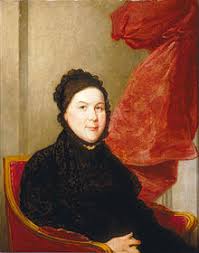
Caty Greene

A year before Washington’s march through Philadelphia, American General William Smallwood and his Maryland Battalion consisting of nearly 700 men, joined General Washington’s forces in New York. The battalion included wives, mothers, daughters, mistresses, and other assorted women looking for safety and work.  Captain Nathaniel Ramsey’s wife, Margaret Jane Peale “Jenny” traveled in a small carriage and endured many of the hardships of army life with her husband. Jenny didn’t perform manual labor. Instead, she acted as a hostess, and her quarters became the center of social life for the Maryland officers.

A month later, in August 1776, when British General William Howe’s army landed on Gravesend Beach on the southern tip of Long Island in preparation for their first battle for New York with the Continental Army, women and children were among the British troops.

There were some 250 women and 500 children among British General John Burgoyne’s army that marched south from Montreal, Canada in June 1777, with the ultimate intention of taking Albany, New York.  Burgoyne had his mistress with him. His German commander, General Fredrich von Riedesel Baron of Eisenbach, was accompanied by his wife, Baroness Frederika Charlotte Riedesel. Frederika spent a year traveling from Germany with their three small daughters to be with her husband.

fredricka
Frederika Charlotte Riedesel

Frederika and her children joined other officers’ wives who followed at some distance behind the first line of advance.  Frederika wrote about Burgoyne’s small tactical victory at the Battle of Freeman’s Farm in September and his retreat at the Battle of Bemis Heights on October 7, a turning point in the American Revolution.  She also documented her own harrowing experiences in her journal:

I saw the whole battle myself, and, knowing that my husband was taking part in it, I was filled with fear and anguish and shivered whenever a shot was fired….

It was a terrible bombardment, and I was more dead than alive … Little Frederika, was very much frightened, often starting to cry, and I had to hold my handkerchief over her mouth to prevent our being discovered.

The greatest misery and extreme disorder prevailed in the army.  The commissary had forgotten to distribute the food supplies among the troops … more than thirty officers came to me because they could stand the hunger no longer.

My children lay on the floor with their heads in my lap.  And thus we spent the whole night.  The horrible smell in the cellar, the weeping of the children, and, even worse, my own fear prevented me from closing my eyes.

An incident occurred a few months earlier on the morning of July 27, 1777, as a group of Native Americans, an advance party from Burgoyne’s army led by a Wyandot called Panther, descended on the village of Fort Edward. Two warriors, one of whom was Panther, were escorting twenty-five-year old Jane McCrea and her companion, Sara McNeil, to the British camp. McNeil was related to one of Burgoyne’s generals and McCrea was engaged to a loyalist. The women became separated and McCrea was killed and scalped.

The_Death_of_Jane_McCrea_John_Vanderlyn_1804_crop
This depiction of The Death of Jane McCrea was painted in 1804 by John Vanderlyn.

American Benedict Arnold claimed that both women “were shot, scalped, stripped, and butchered in the most shocking manner…” Arnold’s outrage served to help make the death of Jane McCrea a sensation.

Mary McCauley followed the Seventh Pennsylvania Regiment. Her husband, John, was an artillery man. During the Battle of Monmouth, New Jersey, on June 28, 1778, Mary carried water from a nearby spring to the thirsty men on that hot and smoky battlefield. The water was also used to cool the blazing cannons. John collapsed during the battle, perhaps from the heat, and Mary immediately took his place at the cannon. She assisted in firing it with the rest of the crew for the remainder of the battle.

Women who offered their services to the army chose to give up the security of home (if they had one left) and embark on a journey that offered discomfort, hardship, and danger. They worked just as hard and suffered just as much as the men they worked beside. Many of the contributions of Revolutionary War era women have been forgotten. It is only appropriate to remember their courage and sacrifice, honoring them as well as the fighting men they supported.


Resources:

O’Donnell, Patrick K. Washington’s Immortals New York: Grove Press, 2016. Print.

Philbrick, Nathaniel. Valiant Ambition New York: Penguin Books, 2016. Print.

Pancake, John S. 1777 The University of Alabama Press, 1997. Print.

O’Shaughnessy, Andrew Jackson. The Men Who Lost America New Haven & London Yale University Press, 2013. Print.

https://www.history.org/history/teaching/enewsletter/volume7/nov08/women_revarmy.cfm

https://www.historyisfun.org/blog/witness-to-war/


The Taking of Dorchester Heights

General George Washington, the newly appointed commander-in-chief of the fledgling Continental Army, arrived at army headquarters in Cambridge, Massachusetts on July 2, 1775. The amateur general desired to prove himself with an assault on besieged Boston that would end the war in one fell swoop. The Continental Congress and Washington’s war council refused to allow it. Without consent, and a lack of gunpowder, heavy weaponry, and congressional funding, offensive operations were virtually impossible.

Henry_Knox_by_Gilbert_Stuart_1806
General Henry Knox

But he would have his artillery. By the end of January 1776, Henry Knox had returned to Cambridge with “a noble train of artillery.” The expedition to retrieve the guns from Fort Ticonderoga, at the southern tip of Lake Champlain, had been an astounding feat of fortitude.

In a meeting of his war council, on February 16, 1776, Washington argued for attacking Boston. “A stroke well aimed at this critical juncture might put a final end to the war.”

General Nathanael Greene was concerned that an assault on a town garrisoned with British regulars could have horrible consequences, “horrible if it succeeded, and still more horrible if it failed.”

“Our defeat may risk the entire loss of liberties of American forever,” General Horatio Gates stated.

General Artemas Ward, the commanding officer of the army prior to Washington’s arrival, maintained, “The attack must be made with a view of bringing on an engagement, or of driving the enemy out of Boston and either end will be answered much better by possessing Dorchester Heights.”

Image from the collections of the Massachusetts Historical Society.
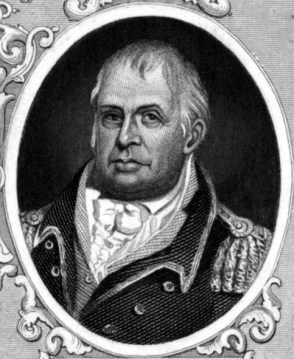
General Artemas Ward

Washington’s previous plan had been to attack across the frozen waters of Back Bay. Holding on to part of that plan, he proposed a backdoor amphibious assault launched from Cambridge. The Americans would cross Back Bay to Boston’s western shores.

General William Heath pointed out that if the enemy did “make a sally” from Boston, British General William Howe would provide for defense of the town. Washington’s plan to expect his soldiers to cross a mile and a half of open water in the face of British artillery “was madness”.

William_E_Heath
General William Heath

It was finally agreed to build fortifications on Dorchester Heights on a single night before the British knew what was happening, just as had been done at Bunker (Breed’s) Hill. The operation would require the procurement, supply, and maintenance of equipment, as well as, movement of troops and hospitalization of the wounded. Those things would prove to be as challenging as the military engagement.

Freezing temperatures meant that building a redoubt atop the bare, rock-hard, wind-swept hills of Dorchester was going to be difficult. The solution came from an unexpected source—Lieutenant Colonel Rufus Putnam, a cousin of General Israel Putnam. Rufus had worked beside a few British engineers during the French and Indian War. Washington asked him to devise a way to quickly build a fortification on the Heights.

Rufus borrowed a book from General William Heath titled Attack and Defense of Fortified Places by the British engineer John Muller. On page 4, he discovered an engineering term he had never heard before: chandelier.

A chandelier was a double-ended wooden scaffold that sat on the ground: when it was placed beside another chandelier, the open space between the two frames was filled with fascines; bundles of tree branches that when covered with dirt formed the basis of a cannon-proof bulwark. With dozens of precut chandeliers and fascines, the Americans could create the beginnings of a redoubt atop Dorchester Heights.

Chandeliers-and-fascines
Two chandeliers, stacked with fascines.

Putnam took his plan to construct chandeliers to colonels Richard Gridley and Henry Knox. In turn, the three went to see George Washington. The solution was a scheme whereby the fortifications would be fabricated elsewhere out of sight, then, with massed manpower and oxen, hauled, along with the heavy cannon, to Dorchester Heights, where all would have to be in place and ready for action before daylight on March 5; the sixth anniversary of the Boston Massacre.

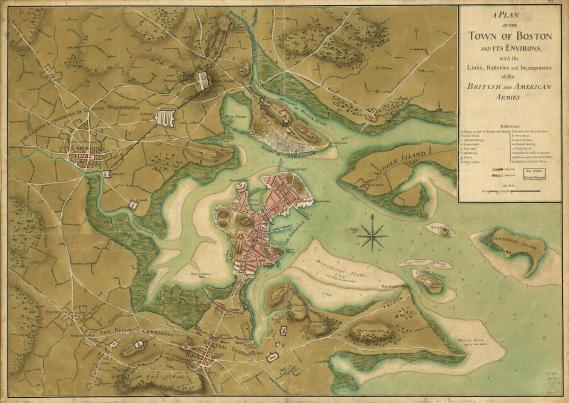
As a diversion, a cannonade and bombardment would begin against the British works on Boston Neck and Bunker Hill from the American works on Cobble Hill and Lechmere’s Point in Cambridge and from Lamb’s Dam on the Roxbury side. This required the placement of some of the heavy cannons from Ticonderoga. The causeway from Roxbury to Dorchester would be lined with a long barrier of hay bales to block the enemy’s view of the Americans moving to the Heights.

Men were dispatched to round up wagons, carts, and 800 oxen. The army’s hospital in Cambridge was readied. Notices in the Boston Gazette, published out of Watertown, called for volunteer nurses. 2000 Massachusetts militia were called out.

Work details, in Roxbury, cut down trees to make chandeliers, barrels, abatis, fascines, and gabions. The barrels would be set in rows in front of the parapets to present the appearance of strengthening the works; but the real design was, in case the British made an attack, to roll them down the hill toward the approaching enemy. Carpenters in Cambridge built 45 flat-bottomed bateaux, each capable of carrying 80 men, along with two floating batteries.

For miles around, everyone was expecting something. Bets were wagered on what would happen and when. Abigail Adams wrote to her husband, John, in Philadelphia:

“The preparations increase and something is daily expected, something terrible it will be. I have been in a continual state of anxiety and expectation . . . it has been said ‘tomorrow’ and ‘tomorrow’ for this past month, but when the dreadful tomorrow will be I know not.”

Washington’s fear that the American operation would be discovered was fueled when a Virginia rifleman deserted to the British. Generals William Heath and John Sullivan personally inspected the lines to ensure that the guards on duty were vigilant on the chance that British got wind of what was happening and moved first to occupy the Heights.

On the night of February 27, Colonel Henry Knox led a group of his artillerymen to install cannon and mortars on Lechmere Point. The cannonade began from there on the night of March 2. Cannons began lobbing shot and shells into Boston to divert the enemy and drown out the noise of the work parties. The British responded with a furious cannonade of their own.

Siege_of_Boston_1776

On the night of March 4, at 7:00 p.m. Henry Knox’s regiments began firing from Roxbury, Lechmere Point, and Cobble Hill at a ferocious rate. The roar of British guns answered.

British captain Charles Stuart described sheets of fire filling the sky, and that “the inhabitants [of Boston] were in a horrid situation, particularly the women…drove from their houses by shot, and, crying for protection.”

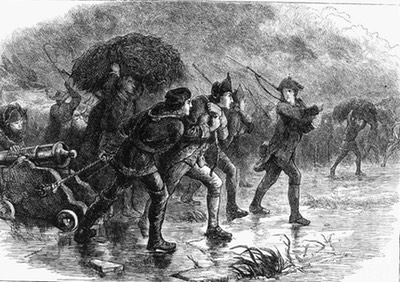
When the cannonading began, General John Thomas, with 2000 men, started across the Dorchester causeway, moving rapidly and silently, shielded from view by the long barrier of hay bales. An advanced guard of 800 men made up largely of riflemen, went first, to fan out along the Dorchester shores. A work party of 1,200 men followed the riflemen. Then came the hundreds of heavy wagons loaded with chandeliers, fascines, hay bales, barrels, and the guns from Ticonderoga. Progress up the steep smooth slopes was extremely difficult, yet some of the ox teams and wagons made several trips.

iu-11-2_med_hr(1)

At Cambridge, generals Nathanael Greene and John Sullivan readied 4000 troops for an amphibious assault in the event of a signal from the Roxbury meetinghouse.

The night proved to be perfect for the work operation to come. The weather was unseasonably mild. A low-lying haze prevented the British from seeing much of anything beyond Boston, and a full moon provided the Americans with the light they needed to see their way. On the Heights, the troops went to work with picks and shovels to arrange the chandeliers and fascines, and dig ditches and build breastworks. By 10:00 pm, the fortifications were sufficiently ready to defend against small arms and grapeshot.

A British lieutenant colonel, Sir John Campbell, reported to British General Francis Smith that the rebels were at work on Dorchester Heights. Smith chose to ignore it. From that point on, the work proceeded unnoticed.

General William Heath wrote, “Perhaps there never was so much work done in so short a space of time.”

At first light, the British were shocked to see two redoubts atop the hills of Dorchester—one facing east toward Castle Island and the other facing north toward Boston, with two smaller works on their flanks and heavy artillery staring down on the town.

WilliamHowe1777ColorMezzotint_(crop)
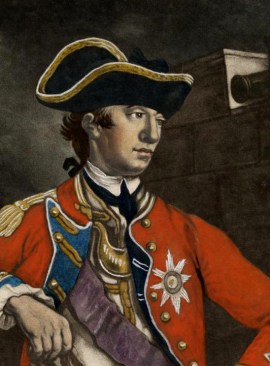
General William Howe

General William Howe was said to have exclaimed, “My God, these fellows have done more work in one night than I could make my army do in three months!”

Howe had been confident that the rebels would never make a move on Boston, and had promised to sally forth if they did so. As a matter of pride, he would have to attack as he vowed. His council of war believed an attack would be a terrible mistake however, despite their objections, Howe ordered 3000 troops to embark down the harbor to Castle Island from where an assault on the Heights would be launched at nightfall.

Among General Howe’s council, Captain Archibald Robertson, Captain John Montresor, and Lord Hugh Percy contended that they “ought to immediately embark” Boston altogether. By nightfall, a storm that some judged to be a hurricane, raged. Howe was glad to accept this interruption as an excuse for not undertaking an attack that would have cost the lives of many of his regulars. The following morning, he called back the detachment and informed his war council of his intentions of evacuating Boston and going to Halifax, Nova Scotia.

On March 17, 1776, General Howe and his army evacuated Boston ending the eleven month long siege. On March 19, the last of the British might in Boston harbor Blew up Castle William and burnt some of the barracks. There was a lazy attempt to cannonade Dorchester Neck. Then, on March 27, they headed for open sea.


Resources:

http://www.processhistory.org/gw-cambridge/

https://en.wiktionary.org/wiki/chandelier

Memoirs of Major-General Heath. Containing Anecdotes, Details of Skirmishes, Battles, and other Military Events, During The American War. Written Br Himself. publithtrt accorying to 3ft of Congrefa. Printed at Boston, Bt I. THOMAS and E. T. ANDREWS, Faust’s Statue, No. 45, Newburt-Street. Sold by them; by I. Thomas, Worcefter; by Thomas, Andrew! Is” Pen- himam, Albany j by Thomas, Andrews (9* Butler, Baltimore; and by the Bookfellers throughout the Continent. MUG. I798.

Philbrick, Nathaniel. Bunker Hill A City, A Siege, A Revolution. 2013Penguin Books, New York, NY.

McCullough, David. 1776. 2005: Simon & Schuster, New York, NY.