The Battle of Hobkirk’s Hill

On August 16, 1780, American General Horatio Gates lost an army to British General Lord Charles Cornwallis just north of Camden, South Carolina. Gates abandoned his vanquished army and rode 180 miles to Hillsboro, North Carolina. Gates was the third major general the civilian governing body, the Continental Congress, sent to command the Continental Army’s Southern Department and the third to fail in the attempt. His predecessors, Robert Howe and Benjamin Lincoln surrendered Savannah, Georgia and Charleston, South Carolina respectively to the British. This time, Congress left the choice to the commander-in-chief of the Continental Army: General George Washington. He chose his most trusted and capable major general, Nathanael Greene, who had been by Washington’s side since 1775 at the Siege of Boston where Patriots were keeping the British locked in Boston after the first shots of the American Revolutionary War were fired in Massachusetts.

Major General Nathanael Greene

Greene took command of the ragged, starving remnants of the Southern Army from Horatio Gates in Charlotte, North Carolina on December 3, 1780. His army, including militia forces, totaled 2,300 but only 800 were properly armed and clothed. Greene, who was from Rhode Island and had spent his entire life in the north, had to adapt quickly to the new environment where the landscape, climate, and rivers were different. A place where the majority of the people were poor and the powerful Rice King’s of the south were cowed. Where civil authority had broken down and a civil war raged between Patriots and Loyalists. General Charles Cornwallis was 70 miles south at Winnsboro, South Carolina with a well-equipped principle force of 4,000 men. What was a Continental general with a new independent command to do? Ignore every military doctrine that warned of dividing an army in the face of a superior foe.

General Lord Charles Cornwallis

Greene executed a strategy that began with sending General Daniel Morgan and a flying detachment to northwest South Carolina to “spirit up the people.” Greene led his wing of the army from Charlotte to Cheraw, South Carolina where food for the army was more plentiful. Cornwallis sent his cavalry colonel Banastre Tarleton to “rid the countryside of Morgan.” On January 17, 1781, Morgan defeated Tarleton at a place called the Cowpens. Cornwallis lost 1,000 men at Cowpens. Furious, he went after Morgan.

General Daniel Morgan

With a small contingent of guard, Greene set out through 300 miles of perilous Loyalist country to support Morgan’s retreat toward Salisbury, North Carolina. Cornwallis burned his baggage train to lighten his army’s pursuit. Greene moved his army’s junction to Guilford Courthouse, North Carolina where he decided that a retreat to the Dan River on the border of North Carolina and Virginia was the only way to preserve his army. On February 15, Cornwallis’s troops marched up to the banks of the Dan River. They saw the American campfires burning on the other side. Greene had taken every boat in the Roanoke Valley and there was nothing Cornwallis could do but stare. Greene moved his army back to Guildford Courthouse where he and Cornwallis clashed on the afternoon of March 15, 1781. It was a pyrrhic British victory that cost Cornwallis more than 500 men. He retreated to Wilmington, North Carolina, a coastal port 200 miles away.
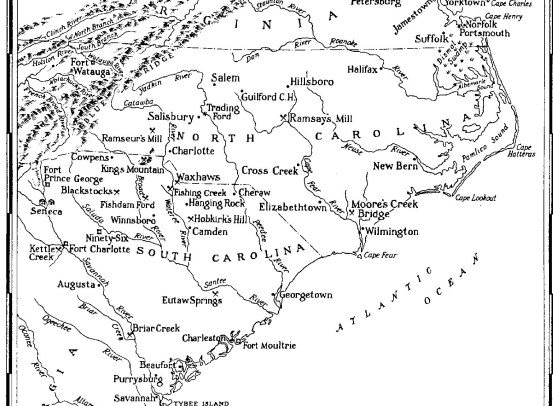
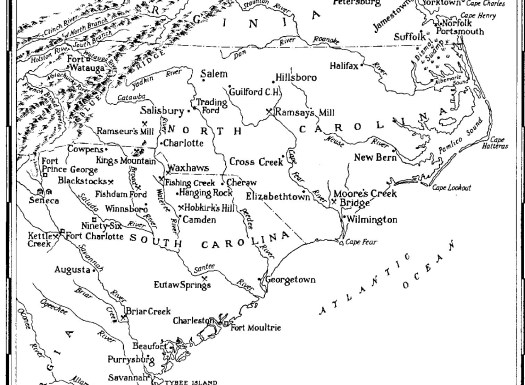
North and South Carolina during the American Revolutionary War

Undaunted by the loss at Guilford Courthouse, Greene turned his attention to the British outposts in the interior of South Carolina. The Southern Army marched through country that was extremely difficult to operate—cut by deep creeks and impassable morasses, heavy timber, and thick underbrush. On April 20, they pulled up to the stockade walls of Camden, South Carolina where Lord Francis Rawdon had 900 Loyalist and British troops garrisoned. Aware that it was too strong to attack, Greene pulled his army back to Hobkirk’s Hill, a sandy ridge two miles north of Camden over which ran the Salisbury Road.
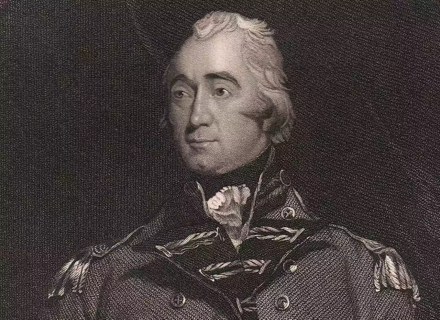
Colonel Lord Francis Rawdon

In the early morning hours of April 25, 1781, a skittish drummer deserted from the Maryland line. He carried word to Rawdon that the American Army was weakened by detachments and lack of food. General Greene had no artillery with him. It was in the rear along with the baggage train and that militia General Thomas Sumter had not come up yet to support the Americans. Rawdon listened to the drummer. He armed the boy along with every man in the garrison, including musicians and drummers.

Nathanael Greene’s troops were camped on Hobkirk’s Hill in order of battle in a wide line across the hill. Colonel Otho Holland Williams had overall command of the Maryland troops to the left of the road, and General Isaac Huger ranked command over the Virginia Continentals to the right. Otho’s two regiments were the 1st Maryland, commanded by Colonel John Gunby and the 2nd Maryland commanded by Colonel Benjamin Ford. Gunby’s deputy was the brilliant Colonel John Eager Howard, who had led the regiment at Cowpens and taken up command at Guilford Courthouse when Gunby was pinned beneath his horse. The 2nd Virginians were under the direct command of Colonel Samuel Hawes with the 1st under Colonel Richard Campbell. Two hundred fifty North Carolina militia were in back of the Continentals. Colonel William Washington’s 3rd Continental Dragoons—only about fifty mounted due to the difficulty of procuring horses—were held in reserve.

Colonel Otho Holland Williams

To protect them from surprise, pickets were stationed 300 yards in front of their lines supported by Maryland, Virginia, and Delaware Continentals. Greene’s men were enjoying the quiet morning buoyed by his orders that every man would receive two days’ worth of food and a gill of spirits as soon as quartermaster Colonel Edward Carrington arrived with the stores. Their arms were stacked. Coats and shoes lay scattered. Washington’s dragoon horses grazed peacefully at their loose tethers. Men were relaxing by a rivulet, soaking their sore feet or cleaning their kettles when they heard the sound of sharp musketry at the base of the hill.

The American drums beat to arms as the pickets clashed with Lord Rawdon’s vanguard. The surprised Americans, many still barefoot and half-dressed, rushed to form their lines. Gun smoke curl up and through the towering pine trees. Otho Holland Williams tried to keep his surprise concealed when he mounted his horse and galloped from the front lines to Greene’s headquarters. When he arrived, General Greene, who had been enjoying the rare luxury of a cup of coffee, was on his feet. Satisfied, Otho returned to the lines before the fighting became widespread.

Greene abandoned his breakfast and jumped into the saddle, followed by his aides majors Lewis Morris and Ichabod Burnett. North Carolina militia officer Guilford Dudley was marching up the back side of the hill with the artillery. Otho ordered Dudley to “March to the right and support Colonel Campbell.”

Greene rode forward with a good view of the hill. Captain Robert Kirkwood’s Delaware pickets were slowly being pushed back by Rawdon’s vanguard. The British commander had arranged his men in a single line with his Corps of Observation in the rear, the right wing supported by 675 provincial regulars and the Volunteers of Ireland on the left. Rawdon’s line was narrow. Greene believed that they could strike their flanks, rear, and front. He quickly ordered Colonel Richard Campbell to wheel left upon the enemy’s right flank. He communicated that he wanted Colonel Benjamin Ford that he was to wheel his men to the right.
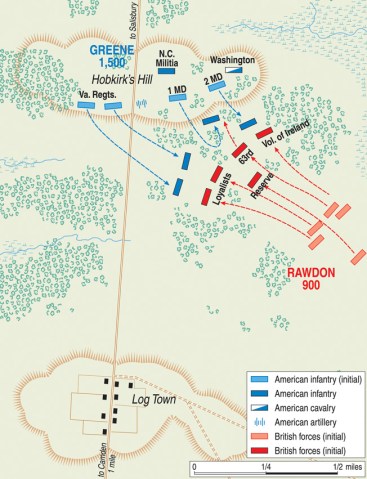
As Rawdon advanced, Greene sent orders to unmask the artillery. The American gunners shredded the tightly packed British columns with volleys of whistling grapeshot. Through the clearing blue smoke, General Greene saw the destruction and was beside himself with satisfaction. “Victory is in reach! Draw forth and send instructions to Colonels Gunby and Hawes to conduct a bayonet charge in the center. Then send Colonel Washington and his dragoons to turn the enemy’s right flank and charge them in the rear.”

Lord Rawdon raged as he saw his men fall and the Continentals charging with bayonets. He took his aggressive anger out on one of his aides, “I was told that Greene had no artillery!” He shouted orders to the Volunteers of Ireland who came up and added their fire against the Maryland ranks. Rawdon continued to disseminate orders to his aides, “Rally, my boys, and bring up all from the rear. Lengthen our lines and avoid the flanking maneuver the American general intends on executing.”

Aside from the 63rd foot, all of Rawdon’s troops were American Tories fighting against American Whigs, and they were quick to take advantage of the thick woods on the hill. The firing was so intense that musket barrels became too hot to hold in their hands.

As Nathanael Greene’s infantry rolled forward so too did William Washington and his dragoons. They swept down around the hill to avoid felled trees and heavy undergrowth, and then rode hard for Major John Coffin’s dragoons on the British right flank. They clashed and swung their short blades from the saddles of their wheeling horses. Coffin’s men scattered. Although deterred by the thick undergrowth, Washington gathered his dragoons under the direct command of captains William Parsons and Walker Baylor and fell upon the rear of the British infantry. They became bogged down in taking prisoners who were, in fact, Lord Rawdon’s desperate attempt to arm as many as he could. The musicians, surgeons, and teamsters had no stomach to stand up against a force of hard galloping dragoons, and they quickly surrendered.

Colonel William Washington

The American infantry continued to push forward. Many of the Marylanders under Colonel Benjamin Ford were new recruits, and some began firing without orders. Ford was shot off his horse and suffered a mortal wound. None of the skittish 2nd Marylanders came to their colonel’s aide. Gunby’s and Hawes’ men continued a steady advance. Some forgot to use their bayonets and fired instead. The trusted captain of the right company, William Beatty, was shot through the heart and dropped dead.

Colonel John Eager Howard

His company, the 1st Marylanders, became deranged and fell out of line. The other companies under Colonel John Eager Howard were still advancing, and instead of pushing them all forward Colonel John Gunby saw they were marching in the form of a bow and ordered them to fall back to the foot of the hill and reform. The consequences were fatal. General Greene had told them not to fire. Now, they were being told to halt in the face of a charging British force. They broke and ran. This left the 2nd Marylanders isolated, and they too fell back followed by the 1st Virginians.

Otho Holland Williams saw the panic and rode toward them, but neither he nor Colonels Howard or Gunby could stop it. Greene was up on the ridge where he had spent most of the battle with Samuel Hawes’ 2nd Virginians. He exposed himself like a captain of grenadiers and attempted to restore order. It became obvious that Lord Rawdon understood that Hawes’ men were alone, and, seeing his advantage, pressed the hill to flank them and silence the American artillery.

Swept up in the tide of retreating troops, the American gunners mishandled their frightened teams and snagged the limbers in heavy brush. The horses panicked and had to be cut from the limbers. Bitterly disappointed, Greene issued the order for his surviving regiments to withdraw, and they formed with the now-rallied Gunby’s men at the foot of the hill.

The troubles the gunners were encountering came to Greene’s attention as they tried to pull the cannon out of the reach of the enemy with drag ropes. He jumped from his saddle, and with the horse’s bridle in one hand and a drag rope in the other, he encouraged the dismayed gunners, “There is not a man here who does not have the courage to take the cannon off.” Seeing that their general was with the artillery, others came to help. Greene wasted no time, and he rode on to see what could be done about bringing the rout to a halt.

Major John Coffin’s British dragoons charged toward the cannon with swords aloft and began to put some of the men dragging the cannon to the sword. The assault gave the others time to get the guns hitched to horses and safely away backed up by Washington’s charging dragoons, each with prisoners in tow. It was a wasted effort. Bogged down by captives and the wooded lay of the land, Washington’s cavalry could not act with effect.

Greene called a retreat. Washington caught up with the main army and delivered the prisoners he probably should not have taken. Greene ordered the prisoners processed. He knew Rawdon was in pursuit. He did not know that Rawdon had left Major John Coffin with his cavalry on Hobkirk’s Hill to claim the ground as a British victory.

Greene ordered Washington to go back and screen their retreat and to take Captain Kirkwood’s Delaware unit with him. He also instructed Washington to take up their stragglers and wounded, and bring them back. If circumstances and time permitted, bury their dead.

Greene led his army three miles north of Hobkirk’s Hill and stopped to camp at Saunders’ Creek in the same sandy Pine Barrens where Horatio Gates had lost an army. Lord Rawdon broke off his pursuit and returned to the walls of Camden. Both commanders lost 200 men—dead, wounded, captured, and missing. Greene was in a vexatious mood after the loss he was certain could have been a victory. He changed his password and countersign to “Persevere” and “Fortitude.” The loss angered him and wounded his pride. He directed his anger at Maryland Colonel John Gunby saying his actions were the cause for the loss and had Gunby court-martialed.

On April 28, he issued orders in the camp at Rugeley’s Mill, “General Huger, Colonel Harrison, and Colonel Washington are to compose a court to inquire into the conduct of Colonel Gunby in the action of the 25th instant.” The testimony found that Gunby was exerting himself in rallying and forming his troops, only committing an error in judgment. Greene could not let it pass. He castigated Gunby publicly in written orders:

Col. Gunby’s Spirit and activity were unexceptional. But his order for the regiment to retire, which broke the line, was extremely improper and unmilitary; and in all probability the only cause why we did not obtain a complete victory.

Despite  Greene’ loss, by April 24 Cornwallis had had enough of Nathanael Greene. He abandoned the Carolinas and marched to Virginia. Greene’s strategy began to strangle the British. He cut off Lord Rawdon’s supply line and forced him to evacuate Camden on May 9. Over that month under Greene’s orders, the British outposts fell at the hands of “Light-Horse” Harry Lee and militia generals Francis Marion and Andrew Pickens. Greene laid siege to the last remaining outpost at the fortified town of Ninety-Six on May 22. The siege ended in bloody, hand to hand combat. Nathanael retreated on June 18. Lord Rawdon marched into Ninety-Six two days later and eventually burned the outpost.

Greene moved his army to the High Hills of Santee near Camden where the air was cooler and the mosquitos were less relentless. Although it was a camp of repose, there was not a moment that allowed him to let his guard down or cease his endless letters of instruction, exhortation, and solicitation regarding the condition of his ragged, malaria-ridden army and their needs. Still, his sense of humor didn’t completely escape him. He wrote to General Henry Knox that no general had run as often or “more lustily” as he had and likened his flight to that of “a Crab, that could run either way.”

Hobkirk’s Hill and the collapse of the British outposts in South Carolina was not be the end of Greene’s strategy. His relentless perseverance to keep the British locked in Savannah and Charleston paid off. On October 19, 1781, Lord Cornwallis surrendered to Franco/American forces at Yorktown, Virginia. If it had not been for General Nathanael Greene, the surrender at Yorktown likely would not have happened.


My biographical novel about General Nathanael Greene title “The Line of Splendor: A Novel of Nathanael Greene and the American Revolution” is available on Amazon. Click the cover to get your copy!

Resources:

Beakes, John H. Jr. Otho Holland Williams in The American Revolution. Charleston, South Carolina: The Nautical and Aviation Publishing Co. of American, 2015

Beakes, John H. Jr. and Piecuch, Jim. Cool Deliberate Courage: John Eager Howard in the American Revolution.  Heritage Books, 2009

Buchannan, John. The Road to Charleston. Charlottesville: University of Virginia Press, 2019

Carbone, Gerald M. Nathanael Greene A Biography of the American Revolution, 2008.

Golway, Terry. Washington’s General Nathanael Greene and the Triumph of the American Revolution. New York: Henry Holt and Company

Greene, George Washington. The Life of Nathanael Greene, Major General in the Army of the Revolution.3 Volumes. New York: Hurd and Houghton. Cambridge: Riverside Press, 1871

Thayer, Theodore. Nathanael Greene Strategist of the American Revolution. New York: Twayne Publishers, 1960

 

General Nathanael Greene and the American Revolution

Before the Revolutionary War

“My Father was a man of great Piety, had an excellent understanding; and was govern’d in his conduct by humanity and kind Benevolence.” ~Nathanael Greene reflecting on his youth.

Nathanael was born in Potowomut, Rhode Island on August 7, 1742; the fourth son of a Quaker preacher and prosperous business man. The brothers’ education was limited to math, reading, and writing. Their father thought book learning beyond that would lead to temptation and sin. Nathanael challenged his father’s “prejudices against Literary Accomplishments.” He later broke with the doctrines of the formal Quaker religion which didn’t condone armed conflict.

He had physical challenges: a limp, asthma, and a small pox scar on his right eyeball that was often infected a result of his 1770 inoculation.

Nathanael was sent to manage and operate the family iron forge in Coventry, Rhode Island. He worked with the men who pounded smelt into anchors sold in Newport. In the house he dubbed Spell Hall he collected and studied works about human theory, civil society, military law and strategy, and poems.

He spent time in East Greenwich with his distant relative, William Greene. Discussions were held about the state of rebellion in America over Parliamentary taxes and control of colonial autonomy. William’s wife was raising her niece, Catharine Littlefield. Caty trapped Nathanael’s heart. They married on July 20, 1774. Caty was 19. Nathanael was nearly 32.

Catharine Littlefield Greene Miller in her mid-fifties circa 1809 attributed to James Frothingham. Image courtesy of General Nathanael Greene Homestead

Nathanael joined the East Greenwich militia company, the Kentish Guards, as a private. He was mortified when he applied for lieutenant and was denied because of his limp. When the first shots of the Revolutionary War were fired on April 19, 1775 in Massachusetts, the Rhode Island General Assembly formed an Army of Observation. Nathanael was plucked from the ranks and promoted to general. On May 8, 1775, he kissed his pregnant wife goodbye and led his new army toward Boston.

The Siege of Boston

“I am determined to defend my rights and maintain my freedom, or sell my life in the attempt.” ~Nathanael to Caty, June 1775

Militia from all over New England responded. Nathanael laid out camp with his army of 1,000 recruits on a hill in Roxbury facing the British army under siege in Boston. He reported to General Artemas Ward. On June 17, while Nathanael was on a recruiting trip in Rhode Island, 1,000 provincial soldiers were defeated by 2,000 British soldiers on the Charlestown peninsula north of Boston on Breed’s Hill.

Two weeks later, the new commander in chief of the recently formed Continental Army arrived—General George Washington. The civilian governing body, the Continental Congress, appointed four major generals and eight brigadier generals. Nathanael was the last brigadier, who at age 32, was the army’s youngest general.

In January 1776, he contracted jaundice. During his illness, Henry Knox, a Boston bookseller, hauled 5o tons of artillery to Framingham, Massachusetts from Fort Ticonderoga in New York. The artillery was mounted on Dorchester Heights overlooking Boston on the night of March 4. General William Howe, the British commander in chief, ordered the city evacuated. Washington placed Boston under Nathanael’s command during which he enforced martial law.

The Battle for New York

“I am confident the force of America, if properly exerted, will prove superior to all her enemies.” ~ Nathanael to John Adams, July 2, 1776

The Continental army moved to New York. Nathanael had command of a string of five strategic forts built on Brooklyn Heights across the East River on Long Island. A British armada began dropping anchor in New York Harbor on June 29, 1776. Over the next few weeks, some 32,000 troops arrived on board 270 ships. In August, with the enemy looming, he was one of four brigadiers promoted to major general.

That month, he succumbed to a critical fever, possibly typhoid. General Israel Putnam assumed his command. On August 22, William Howe invaded Long Island and defeated the Continental Army stationed there. John Adams wrote that Nathanael’s sickness was the cause of the enemy “stealing a march on us.

The army began withdrawing northward from the city as the British invaded New York Island. On September 16, Nathanael experienced his first battle when it erupted at Harlem Heights. Two month later, Forts Lee and Washington perched on the Hudson River across from one another fell to the British under Nathanael’s command. He was devastated and wrote to his friend, Henry Knox, “I am mad, vexed, sick and sorry. Happy I should be to see you.” The ragged Continental Army retreated through New Jersey with British General Charles Cornwallis in pursuit. On December 8, they crossed the Delaware River into Pennsylvania.

During the crucial period when Washington was planning a 1776 Christmas night attack on the Hessian garrison at Trenton, New Jersey, Nathanael did many things of great importance. Two of those were:

  • On December 21, he wrote to Congress to report the state of the army and urged them to give Washington temporary full powers to avoid having to wait for Congressional committees to make decisions. Congress agreed and did so.
  • He was one of two major generals who led divisions to Trenton and Princeton where the Patriots were victorious.

The Philadelphia Campaign

“O my sweet angel how I wish—how I long to return to our soft embrace. The endearing prospect is my greatest comfort amidst all the fatigues of the campaign.” ~Nathanael to Caty after the British defeated the American army at Brandywine, autumn 1777

In 1777, the Continental Army wintered in Morristown, New Jersey. Late in July, William Howe loaded the bulk of his army on his brother’s ships leaving the Continental Army and Congress baffled over his destination.

Howe’s armada sailed up the Chesapeake Bay and disembarked at Head of Elk, Maryland. His target was Philadelphia. In response, Washington positioned his army on Brandywine Creek. On the afternoon of September 11, General Cornwallis turned Washington’s right flank on Birmingham Hill. Nathanael and his 2,400 Virginians marched toward Sandy Hollow where they formed a line that surprised and stopped Cornwallis. The Americans fell back to Chester, Pennsylvania. Two weeks later, the British took Philadelphia.

*Birmingham Hill where the British turned the right flank of Washington’s army during the Battle of Brandywine. Photo circa 2022 by Salina B Baker

On October 17, British General John Burgoyne surrendered to General Horatio Gates in Saratoga, New York where Gates was sent to stop Burgoyne’s march to Albany. Spawned from this victory, a loose plot to overthrow Washington, as well as Nathanael, was executed. Some in Congress believed that Washington was failing and that the victorious Gates was the answer.

General Mifflin, who resigned as Quartermaster General of the Continental Army proclaimed, “The ear of the Commander-in-chief was exclusively possessed by Greene.” The cabal collapsed in early 1778.

Quartermaster General

“They have taken me from the line of splendor.” ~Nathanael to Pennsylvania politician Joseph Reed after he accepted the position of Quartermaster General of the Continental Army, March 1778

The Continental Army wintered at Valley Forge, Pennsylvania in 1778. A committee from Congress arrived to discuss the state of the army and a new quartermaster general. The duties of the quartermaster general encompassed obtaining and transporting supplies, and scouting for new camp sites.

*General Nathanael Greene by Charles Willson Peale 1778. Metropolitan Museum of Art

Washington and the committee pressed Nathanael to take the job that he feared it would confine him “to a series of drudgery” and would remove him from field command. Congress admitted that the next quartermaster general would “face Confusion of the Department.” With a sense of duty he accepted the position, but complained, “No one has ever heard of a quarter Master in History.”

During the summer of 1778, he played a dual role maintaining his excellent quartermaster planning that provided the Continental Army with adequate supplies. He also was given field command during the battles of Monmouth Courthouse and Rhode Island.

The war ground to a stalemate in the north. The value of the Continental dollar plunged. Nathanael made several trips to Philadelphia during the spring of 1779. Congress was questioning the large receipts he and his deputies were receiving from commissions. Compounded by their refusal to provide more money and support, he tendered his resignation in a less than a diplomatic tone to match the insulting letters he received from the Board of Treasury. Congress ignored it.

The Continental Army returned to Morristown, New Jersey in the winter of 1780. Nathanael lamented, “Provisions are scarce indeed…from the want of money to purchase it.” A snowstorm blocked the roads and cut supply lines. When the storm passed, Nathanael relieved the starving soldiers by ordering the roads cleared and pressing farmers to load wagons with provisions.

Caty arrived in camp eight months pregnant. On January 30, she gave birth to their fourth child a son they named Nathanael Ray. Baby Nathanael joined the Greene’s growing family: George 4, Martha 3, and Cornelia 16 months. He and the two youngest were conceived during Caty’s visits to camp.

That spring, the American garrison in Charleston, South Carolina under General Benjamin Lincoln surrendered to Henry Clinton in the worst loss of the Revolutionary War.

Congress adopted its new system for the Quartermaster Department. With the states now responsible for supplies, a decrease in salaries, and the principal men on whom he depended removed, Nathanael believed it was impossible to conduct business. He wrote to Washington outlining his grievances and seeking approval of his intention to quit. But the wording and tone of his resignation letter to Congress dated July 26, 1780 so infuriated members that they threatened to remove him from the army. Washington supported him and put a stop to the threats.

While Nathanael resigned, General Horatio Gates rode into camp in North Carolina and took command of the remnants of the Southern army. On August 16, General Charles Cornwallis, now in command of the British army in the south, defeated Gates near Camden, South Carolina. Gates abandoned his vanquished army and rode 180 miles to Hillsboro, North Carolina. What Washington needed was a good general in the South. Congress’ previous choices had failed. This time they left the choice to him. He chose Nathanael Greene.

The Southern Army

“My Dear Angel, What I have been dreading has come to pass. His Excellency General George Washington by order of Congress has appointed me to command of the Southern Army. God bless you my love and support your spirits. I am yours.”  ~Nathanael to Caty, October 1780

Nathanael and his second in command General Baron von Steuben rode to Virginia and stopped along the way to gather troops and supplies from various states. Their efforts were largely futile. Leaving Steuben in Virginia to continue recruiting efforts with Governor Thomas Jefferson, Nathanael went in search of his army and on December 2, 1780 in Charlotte, North Carolina, he found the starving, ragged survivors of the Southern Army under Horatio Gates. His army numbered 2,300, but less than 800 of his whole force was properly equipped and clothed.


North and South Carolina during the American Revolutionary War and Nathanael Greene’s movements

This was what Nathanael was faced with. His command encompassed, Virginia, North Carolina, South Carolina and Georgia. As a Rhode Islander who had spent his whole life in the north, everything was different. He had to adjust quickly.

  • There was a breakdown in civil authority.
  • A civil war raged between Loyalists and Patriots.
  • A large part of the population was poor. They talked differently.
  • The trees, rivers, landscape, and climate were different.
  • Before taking command from Gates, he studied maps and ordered a survey of the nearby rivers so he could understand the geography.
  • The circumstances forced him to embrace partisan strategy. He reached out to militia generals Francis Marion, Thomas Sumter and Andrew Pickens operating in South Carolina.

What was a Continental general with a new independent command, to do? Ignore every military doctrine that warned of the dangers of dividing an army in the face of a superior foe.

He detached General Daniel Morgan to march to northwest South Carolina. Nathanael led the remainder of his little army to Cheraw. Cornwallis ordered cavalry Colonel Banastre Tarleton to rid the countryside of Morgan. Morgan prepared for the inevitable battle at a place called the Cowpens. On the pastures, he formed his men into three lines. On the morning of January 17, 1781, Morgan shouted “Boys get up, Benny is coming.” They deployed, fired one shot, and then retired so the next line could step up. The British infantry and cavalry broke. Tarleton fled.

Cornwallis lost 1,000 men at Cowpens. Furious, he went after Morgan. Nathanael ordered his wing to march to Salisbury, North Carolina. With a small contingent of guard, he set out through 300 miles of perilous loyalist country to support Morgan where they began a retreat toward Salisbury.

Cornwallis burned his baggage train to lighten his army’s pursuit. The further Cornwallis marched, the more his army succumbed to exhaustion and starvation. Nathanael, also exhausted, shifted his army’s junction to Guilford Courthouse, North Carolina. When the army linked up, he held a rare war council.

Nathanael laid it out. They had 2,400 men, many of whom were badly armed and clothed. Cornwallis was less than twenty miles away. It was agreed that a retreat to the Dan River on the border of North Carolina and Virginia was the only option to avoid annihilation.

Nathanael detached 700 men and formed a light corps, to screen his main army from the British and detract them from the lower fords of the Dan River where he intended to cross. The ailing Daniel Morgan went home to Virginia. Colonel Otho Holland Williams was selected to command and with Colonel “Light-Horse” Harry Lee’s cavalry legion, they kept Cornwallis at bay while Nathanael led the army toward the Dan River at a frantic pace.

On February 15, Cornwallis’ troops marched up to the banks of the Dan where the campfires of the American army burned on the other side. Nathanael had taken every boat in the Roanoke Valley across the river and there was nothing Cornwallis could do but stare.

With thousands of new militia and some Continentals, the Southern Army swelled to 4,500 men. Nathanael moved back to Guilford Courthouse. Cornwallis led his 1,900 men toward a long awaited battle with Nathanael Greene.

Nathanael’s order of battle was a model of Daniel Morgan’s at Cowpens, but the wooded terrain at Guilford Courthouse prevented his three lines from seeing or supporting one another. He rode among the troops to encourage them. Artillery opened up. His lines began to fall apart under advancing British fire. The enemy turned his left flank. After two hours, he prudently called a retreat to preserve his army.

It was a pyrrhic British victory that cost Cornwallis more than 500 men. He retreated to Wilmington, North Carolina, a coastal port 200 miles away.

 Nathanael turned his attention to the British outposts in the interior of South Carolina. He ordered Baron von Steuben and Thomas Jefferson to send militia. The Virginia Assembly blocked his request because Henry Clinton had sent British troops and reinforcements to that state.

Infuriated with Jefferson and frustrated with a lack of support from Washington in New York, he turned his army southward toward the primary outpost at Camden. They arrived at the stockade walls on April 20 where Lord Francis Rawdon had 900 loyalist and British troops garrisoned. Aware that it was too strong to attack, Nathanael pulled his army back to Hobkirk’s Hill, a ridge two miles north.

On the morning of April 25, Lord Rawdon approached. Nathanael’s infantry rolled forward but then the Maryland line bowed causing the Virginia regiments to fall back. Nathanael called a retreat. The loss angered him and wounded his pride. He directed his anger at Maryland Colonel John Gunby saying his actions were the cause for the loss and had Gunby court-martialed.

Despite Nathanael’s loss, by April 24 Cornwallis had had enough of Nathanael Greene. He abandoned the Carolinas and marched to Virginia.

At this time, he wrote to the exiled governor of South Carolina, John Rutledge, stressing the importance of reestablishing government. His concern extended to his command in Virginia where the Marquis de Lafayette arrived to stop the British path of destruction there.

Nathanael’s strategy began to strangle the British. He cut off Lord Rawdon’s supply line and forced him to evacuate Camden on May 9. Over that month under Nathanael’s orders, the British outposts fell at the hands of “Light-Horse” Harry Lee and militia generals Francis Marion and Andrew Pickens. Nathanael laid siege to the last remaining outpost at the fortified town of Ninety-Six on May 22. The siege ended in bloody, hand to hand combat. Nathanael called off the assault and retreated on June 18. Lord Rawdon marched into Ninety-Six two days later and burned the outpost.

Nathanael moved his army to the High Hills of Santee where the air was cooler and the mosquitos were less relentless. Although it was a camp of repose, there was not a moment that allowed him to let his guard down or cease his endless letters of instruction, exhortation, and solicitation regarding the condition of his ragged, malaria-ridden army and their needs. Still, Nathanael’s sense of humor didn’t completely escape him. He wrote to Henry Knox that no general had run as often or “more lustily” as he had and likened his flight to that of “a Crab, that could run either way.”

The Southern Army rested for six weeks in the High Hills of Santee. Lord Rawdon fell ill and Colonel Alexander Stewart replaced him. Stewart pressed his 1,500 men toward Orangeburg, South Carolina. Nathanael called in the militia under Francis Marion and Andrew Pickens. On August 23, his army marched out of the High Hills looking for a fight.

On September 8, at 4:00 a.m., after weeks of mucking through swamps and heavy rain, Nathanael’s army marched toward the enemy at a place called Eutaw Springs. Musket fire and artillery exploded from both sides of the line as they clashed on wooded grounds near a three-story mansion. Some of the British locked themselves in the mansion. Artillery fire proved useless in dislodging them. Nathanael’s cavalry tangled in the bushes near the creek and their commander, Colonel William Washington was bayonetted and captured. After 4 hours of fighting, Nathanael ordered a retreat. Losses that day totaled a staggering 1,400. Both sides claimed victory.

*Eutaw Springs Battlefield in Eutaw Springs, South Carolina. Most of the battlefield has been swallowed by man-made Lake Marion. Photo circa 2021 by Salina B Baker

The Battle of Eutaw Springs was the last significant land battle of the Revolutionary War. The months of sacrifice and perseverance led to the recognition and laurels Nathanael so desperately wanted. He was awarded a Congressional Medal of Honor bearing his likeness.

A few days after the battle, he learned that Cornwallis was entrenched in the village of Yorktown, Virginia. There on October 19, 1781, Lord Charles Cornwallis surrendered following a three-week Franco/American siege under Washington. If Nathanael hadn’t relentlessly persevered and chased British Genera Charles Cornwallis out of the Carolinas, the surrender at Yorktown likely would not have happened. That’s how important his achievements were in the South.

In early April 1782, after nearly two years of separation, Nathanael and Caty were enveloped in each other’s arms when Caty arrived from Rhode Island. He was sunburned and thin. He told her about the tracts of land South Carolina and Georgia gifted him for his service in the south. In addition, he invested in 7,000 acres on Cumberland Island off the coast of Georgia. With the military and government coffers empty, he was forced to buy uniforms for his troops on credit through a Charleston speculator named John Banks.

The British evacuated Charleston on December 14, 1782. There was a peaceful transfer of power between Nathanael and British General Alexander Leslie. The Greenes moved into the residence of former governor John Rutledge. The mansion became army headquarters. Nathanael was hailed as the conquering hero. Caty was referred to as “Lady Greene.”

Nathanael was still faced with clothing and providing for his army. His own financial affairs fell apart. A business he formed in 1779 came to its conclusion and Nathanael garnered only 10% of his original 10,000 pound investment. His clothing supplier, John Banks, entered a moneymaking scheme that went bad. Congress delayed paying Banks’ creditors. Banks in turn refused to deliver the provisions without a guarantee. Nathanael signed a guarantee for 30,000 pounds, money he did not have.

On April 16, 1783, preliminary articles of peace were signed between the United States and Great Britain. He dismissed his soldiers on June 21 saying “We have trod the paths of adversity together, and have felt the sunshine of better fortune.

He left Charleston on August 11. On his journey he was greeted with fanfare. He briefly reunited with Washington. On October 7, he formally requested that Congress accept his resignation as major general and asked that he be allowed to go home to Rhode Island. He didn’t attend Washington’s farewell address delivered on December 4. Nathanael was already home.

Elusive Peace

“My family is in distress and I am overwhelmed with difficulties and God knows when or where they will end. I work hard and live poor but I fear all this will not extricate me.” ~ Nathanael to Henry Knox, March 12, 1786

Pressures and Perplexities

He arrived at the docks of war torn Newport, Rhode Island in late November 1783. He had written to Caty that he trembled to think of the enormous sums of money he owed and that he was doomed to a life of hardship. The Greenes had no home of their own. In the coming year, they decided that Mulberry Grove on the Savannah River in Georgia held fruitful possibilities.

He reunited with his four children, George 7, Martha 6, Cornelia 5, and Nat 3 who looked upon him at first as a stranger, but he was soon their “companion and playfellow.” On April 17, 1784, the Greenes welcomed the arrival of their seventh family member, a baby girl they named Louisa.

He made business plans with his brother, Jacob. On December 17, he was elected the president of the Rhode Island Society of the Cincinnati. But his despondency grew. He received a letter from a firm demanding money for the army clothes they had sold John Banks. On August 1, he sailed to Charleston to look for Banks. He found him dead and buried. He asked his lawyer to file a claim against Bank’s estate.

He returned to Newport, but was soon back on his way south to tend to legal matters and prepare to move his family to Mulberry Grove. His business kept him away until mid-August 1785. When he returned home, Caty had just given birth to their sixth child, a girl named Catharine. The children came down with whooping cough. The older children recovered, but baby Catharine died. The despondent Greenes boarded a ship bound for Savannah, Georgia on October 14, 1785. Nathanael would never see Rhode Island again.

In April 1786, he described his new life at Mulberry Grove as “a busy time” surrounded by gardens and fruit trees. His library was well-stocked with his beloved books. General Anthony Wayne was also awarded land by the State of Georgia and was a close neighbor. Years later Nathanael’s son, Nat, recalled his father holding him on his knee and teaching him “funny songs.” Little George often walked the fields with his father.  

In late April, a very pregnant Caty fell. The accident brought on premature labor and the baby died soon after. One day, seeking the comfort of Nathanael’s arms, she found him by the river weeping. When he looked up at her, she saw the haggard face of a man who had sworn to give everything including his life and his future to the cause of freedom, and had done just that. She, too, had sacrificed. Only as one, could they survive and thrive.

I Have Seen a Great and Good Man Die

“Pardon this scrawl, my feelings are but too much affected, because I have seen a great and good man die.” ~ General Anthony Wayne to Colonel James Jackson, June 19, 1786

Caty and Nathanael drove to Savannah on Monday June 11, 1786 and spent the night with a friend. The next day they stopped at a neighbor’s home. Under the hot sun and without a hat, Nathanael walked the fields with his neighbor. On the way home, he complained of a headache. By Thursday, the pain had intensified over his eyes and his forehead swelled. He became unresponsive. He was suffering from sunstroke and the standard treatments of the day, bleeding and blistering, were useless. The children were sent to a neighbor. Anthony Wayne arrived and for two days he and Caty held vigil. At six o’clock in the morning on June 19, 1786, Nathanael Greene stopped breathing. He was 43.

His body was dressed in the uniform he had worn on formal occasions as a major general of the Continental Army. White silk gloves, a gift from the Marquis de Lafayette, were slipped on his hands. His body was floated down the river to Savannah and carried ashore where Caty and the children waited among silent citizens. A military corps escorted his coffin to Colonial Cemetery. A service was read and then Nathanael’s body was placed in a vault and a 13 gun salute was fired. No one thought to erect a marker.

Alexander Hamilton

On July 4, 1789, Alexander Hamilton delivered a eulogy for Nathanael Greene at the national meeting for the Society of the Cincinnati in New York City. Part of that eulogy reads:

But where alas is now this consummate General, this brave soldier, this discerning statesman, this steady patriot, this virtuous citizen, this amiable man? Why was he not longer spared to a country which he so dearly loved, which he was so well able to serve, which still seems so much to stand in need of his services? Why was he only allowed to assist in laying the foundation and not permitted to aid in rearing the superstructure of American greatness?

Congress passed a resolution to erect a monument to General Nathanael Greene. The statue by Henry Kirke Brown and a gift from Rhode Island was erected in 1877 in Stanton Park, Washington D.C.

Sacred To The Memory of Nathanael Greene, Esquire

A Native Of The State Of Rhode Island

Who Died On The 19th Of June 1786

Late Major General In The Service Of The U.S.

And Commander Of Their Army In The Southern Department

*Equestrian Statue of General Nathanael Greene in Washington D.C., Author image rights ©Alamy Ltd

“I found the South in confusion and distress and restored it to freedom and tranquility.” ~Major General Nathanael Greene


My biographical novel about General Nathanael Greene titled “The Line of Splendor, A Novel of Nathanael Greene and the American Revolution” is available on Amazon. Click on the cover to get your copy.


Resources

Barnwell, Joseph W. “The Evacuation of Charleston by the British in 1782.” The South Carolina Historical and Genealogical Magazine 11, no. 1 (1910): 1–26. http://www.jstor.org/stable/27575255.

Beakes, John H. Jr. Otho Holland Williams in The American Revolution. Charleston, South Carolina: The Nautical and Aviation Publishing Co. of American, 2015

Buchannan, John. The Road to Charleston. Charlottesville: University of Virginia Press, 2019

Carbone, Gerald M. Nathanael Greene A Biography of the American Revolution, 2008.

Gardiner, Asa Bird. The Discovery of the Remains of Major-General Nathanael Greene, First President of the Rhode Island Cincinnati. New York: The Blumberg Press, 1901

Golway, Terry. Washington’s General Nathanael Greene and the Triumph of the American Revolution. New York: Henry Holt and Company

Greene, George Washington. The Life of Nathanael Greene, Major General in the Army of the Revolution.3 Volumes. New York: Hurd and Houghton. Cambridge: Riverside Press, 1871

Greene, Nathanael. “Letter of General Nath’l. Greene to Gen’l. Washington, 1781.” The Pennsylvania Magazine of History and Biography 30, no. 3 (1906): 359–65. http://www.jstor.org/stable/20085346.

Johnson, William. Sketches of the Life and Correspondence of Nathanael Greene Volume 1 and II. Charleston, South Carolina 1822

Reed, William B. Life and Correspondence of Joseph Reed. Philadelphia: Lindsay and Blakiston, 1847

Schecter, Barnet. The Battle for New York. New York: Walker and Company, 2002

Showman, Richard K. Editor. The Papers of Nathanael Greene: Volume V and VII and pages 612-613. Chapel Hill and London: University of North Carolina Press. 1989.

Stegeman, John F. and Janet A. Caty A Biography of Catharine Littlefield Greene Athens, Georgia University of Georgia Press, 1977.

Thayer, Theodore. Nathanael Greene Strategist Of The American Revolution. New York: Twayne Publishers, 1960.

Upham, Charles Wentworth. The Life of General Washington: First President of the United States, Volume I. London: Officer of the National Illustrated Library, 1852

Waters, Andrew. To The End of World. Yardley, PA: Westholme Publishing, LLC, 2020

*https://founders.archives.gov/documents/Washington/03-06-02-0024

To George Washington from Major General Nathanael Greene, 15 August 1776

*https://founders.archives.gov/documents/Washington/03-27-02-0267

To George Washington from Major General Nathanael Greene, 27 July 1780

*https://founders.archives.gov/documents/Washington/03-27-02-0390

To George Washington from Major General Nathanael Greene, 5 August 1780

*https://founders.archives.gov/documents/Jefferson/01-04-02-0222

To Thomas Jefferson from Nathanael Greene, 6 December 1780

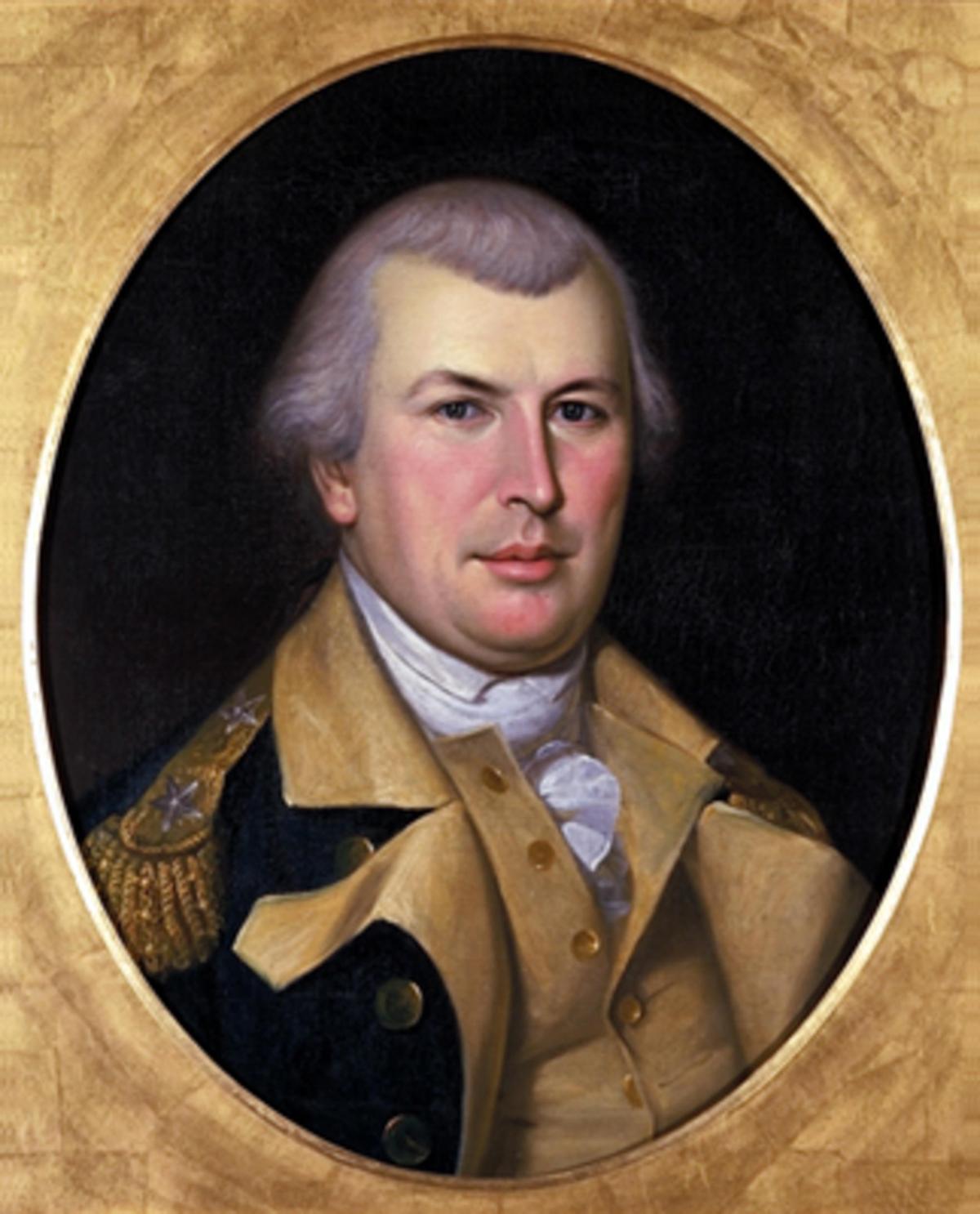
*Featured Image. General Nathanael Greene, painting by Charles Willson Peale from life, 1783. Author image rights ©Alamy Ltd.