At daybreak on March 14, 1781, Major General Nathanael Greene’s army moved out of camp at Speedwell Iron Works in North Carolina and marched the road to Guilford Courthouse to meet his opponent British General Charles, Lord Cornwallis in a long awaited battle. Greene had studied this land well. The choice of position was wholly his decision. The grounds lay in the middle of irregular cultivated fields interspersed with small clearings. The courthouse stood on a hill in one of the clearings. A gentle declivity formed an undulating slope nearly half a mile in length. Greene’s army consisted of 4,243 foot and 160 horse. Fifteen hundred were Continentals, the rest militia. He put his order of battle in place. It was a model of Daniel Morgan’s at Cowpens. The enemy would have to march up New Garden Road where Greene deployed the first of three defensive lines. He positioned one thousand North Carolina militia on the edge of the woods behind a rail fence.
Major General Nathanael Greene instructing the North Carolina Militia in the first line, Battle of Guilford Courthouse.
They would have a good view of the British as they marched out of the woods, through fields and across a small stream. Twelve hundred Virginia militiamen formed the second line. Fourteen hundred experienced Continentals from Virginia, Maryland and Delaware drew up on a brow of the gently rising hill near the courthouse and formed the third line.
Battle of Guilford Court House, a portrait of the battle by H. Charles McBarron Jr.
They were in overall command of General Isaac Huger and Colonel Otho Holland Williams. The army had four 6-pound cannon and one hundred artillerymen. Greene posted two on the road between the militia regiments and the other two between the Virginia and Delaware fronts.
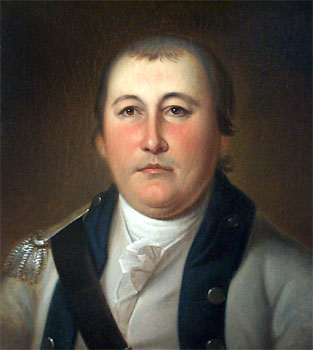
Colonel Otho Holland Williams
Colonel William Washington’s cavalry protected the right flank while Colonel Harry Lee’s horsemen positioned themselves on the left. To the rear, the Reedy Fork Road served as the line of retreat. Like at Cowpens, each line would deliver two or three well-executed volleys and then retire to the second line.
The battlefield at Guilford Courthouse was much larger and Greene was unable to see the entire field. On the morning of March 15, 1781, the wailing pipes of the Scottish Highlanders filtered through the woods. The first British and Hessian troops stepped out on the field and charged the Americans. British Colonel Banastre Tarleton’s cavalry arrived on the main road with instructions not to charge without positive orders. They were followed by a second wave of infantry with Cornwallis leading the 71st Regiment of Highlanders and the German Regiment of Bose under the command of General Alexander Leslie on the right.
Colonel Banastre Tarleton
An ineffective artillery volley ensued then the British moved forward. The North Carolina line fired too early and their center collapsed. Cornwallis pressed Colonel James Webster’s 33rd foot and Jaegers forward from the left. The Virginia militia fired and gave fight. A volley thundered that threw back Webster’s men dropping both British and Americans. A musket ball smashed Virginia militia General Edward Stevens’ thigh. Webster suffered a mortal wound. There was a brief pause as Webster’s men retreated to reform. General Charles O’Hara’s reserves of grenadiers and the 2nd Battalion of Guards united with Alexander Leslie’s troops. They crossed a ravine and emerged from the woods and attacked Greene’s third line, the Maryland and Delaware Continentals. The 1st Marylanders stood their ground. O’Hara was hit in the chest.
General Alexander Leslie
He turned his command over to Colonel James Stewart. Stewart headed for the fleeing 2nd Marylanders and captured two cannon. He turned on the 1st Maryland and they volleyed at the same time. Their colonel, John Gunby lost his mount and was pinned under it. His deputy commander, Colonel John Eager Howard, took over for him. A bugle sounded and William Washington and his dragoons thundered through the 2nd Guards and slaughtered them. John Eager Howard regrouped his Marylanders. The shattered British troops tried to reform.
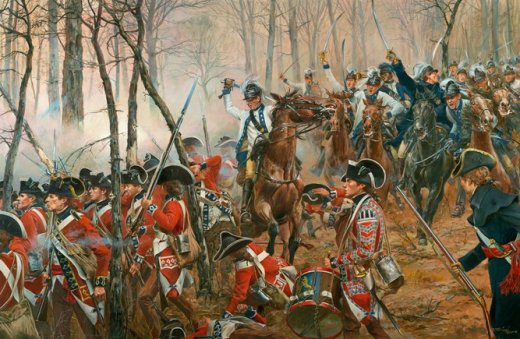
Battle of Guilford Courthouse. Painting by Don Troiani depicting William Washington’s dragoons thundering through the 2nd Guards
Greene pressed forward into the midst of the battle. There was nothing between him and the enemy but woods. His aide saw the danger and warned, “You are riding into the enemy, General Greene!” Greene calmly nodded, turned his horse and rode back to his position. The enemy was gaining ground on his right. At 3:30 pm, two hours after the battle began, he saw that the enemy had turned his left flank. He ordered a retreat before his army could be encircled.
Major General Nathanael Greene
Cornwallis’ lost twenty-five percent of his army in the pyrrhic British victory. The days leading up to Guilford Courthouse overwhelmed Nathanael Greene and he fainted after the battle, but it was the turning point that forced Cornwallis out of the Carolinas and into Virginia where he met his final surrender to Franco/American forces led by George Washington on October 19, 1781.
Resources:
Beakes, John H. Jr. Otho Holland Williams in The American Revolution. Charleston, South Carolina: The Nautical and Aviation Publishing Co. of American, 2015.
Buchannan, John. The Road to Charleston. Charlottesville: University of Virginia Press, 2019.
Buchannan, John. The Road to Guilford Courthouse. Toronto: John Wiley & Sons, Inc., 1997.
Carbone, Gerald M. Nathanael Greene A Biography of the American Revolution, 2008.
Greene, George Washington. The Life of Nathanael Greene, Major General in the Army of the Revolution. 3 Volumes. New York: Hurd and Houghton. Cambridge: Riverside Press, 1871.
Piecusch, Jim, and John H. Beakes, Jr. Cool Deliberate Courage John Eager Howard in the American Revolution. Berwyn Heights, Maryland: Heritage Books, Inc., 2009.
Featured image. The equestrian statue of General Nathanael Greene at Guilford Courthouse Military Park, Greensboro, North Carolina
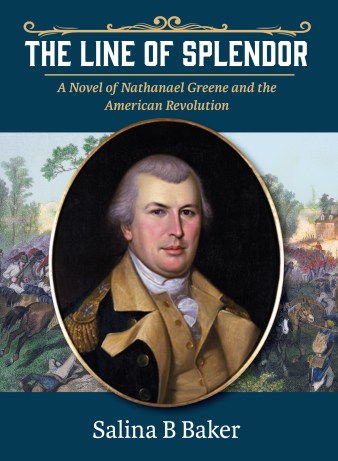
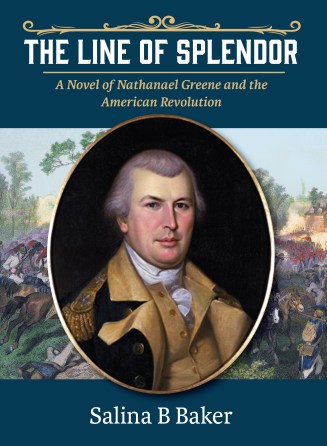
My biographical novel about General Nathanael Greene titled “The Line of Splendor, A Novel of Nathanael Greene and the American Revolution” is available on Amazon. Click on the cover to get your copy.
On August 16, 1780, American General Horatio Gates lost an army to British General Lord Charles Cornwallis just north of Camden, South Carolina. Gates abandoned his vanquished army and rode 180 miles to Hillsboro, North Carolina. Gates was the third major general the civilian governing body, the Continental Congress, sent to command the Continental Army’s Southern Department and the third to fail in the attempt. His predecessors, Robert Howe and Benjamin Lincoln surrendered Savannah, Georgia and Charleston, South Carolina respectively to the British. This time, Congress left the choice to the commander-in-chief of the Continental Army: General George Washington. He chose his most trusted and capable major general, Nathanael Greene, who had been by Washington’s side since 1775 at the Siege of Boston where Patriots were keeping the British locked in Boston after the first shots of the American Revolutionary War were fired in Massachusetts.
Major General Nathanael Greene
Greene took command of the ragged, starving remnants of the Southern Army from Horatio Gates in Charlotte, North Carolina on December 3, 1780. His army, including militia forces, totaled 2,300 but only 800 were properly armed and clothed. Greene, who was from Rhode Island and had spent his entire life in the north, had to adapt quickly to the new environment where the landscape, climate, and rivers were different. A place where the majority of the people were poor and the powerful Rice King’s of the south were cowed. Where civil authority had broken down and a civil war raged between Patriots and Loyalists. General Charles Cornwallis was 70 miles south at Winnsboro, South Carolina with a well-equipped principle force of 4,000 men. What was a Continental general with a new independent command to do? Ignore every military doctrine that warned of dividing an army in the face of a superior foe.
General Lord Charles Cornwallis
Greene executed a strategy that began with sending General Daniel Morgan and a flying detachment to northwest South Carolina to “spirit up the people.” Greene led his wing of the army from Charlotte to Cheraw, South Carolina where food for the army was more plentiful. Cornwallis sent his cavalry colonel Banastre Tarleton to “rid the countryside of Morgan.” On January 17, 1781, Morgan defeated Tarleton at a place called the Cowpens. Cornwallis lost 1,000 men at Cowpens. Furious, he went after Morgan.
General Daniel Morgan
With a small contingent of guard, Greene set out through 300 miles of perilous Loyalist country to support Morgan’s retreat toward Salisbury, North Carolina. Cornwallis burned his baggage train to lighten his army’s pursuit. Greene moved his army’s junction to Guilford Courthouse, North Carolina where he decided that a retreat to the Dan River on the border of North Carolina and Virginia was the only way to preserve his army. On February 15, Cornwallis’s troops marched up to the banks of the Dan River. They saw the American campfires burning on the other side. Greene had taken every boat in the Roanoke Valley and there was nothing Cornwallis could do but stare. Greene moved his army back to Guildford Courthouse where he and Cornwallis clashed on the afternoon of March 15, 1781. It was a pyrrhic British victory that cost Cornwallis more than 500 men. He retreated to Wilmington, North Carolina, a coastal port 200 miles away.
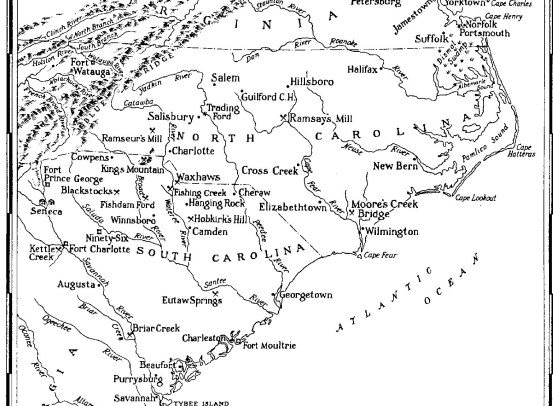
North and South Carolina during the American Revolutionary War
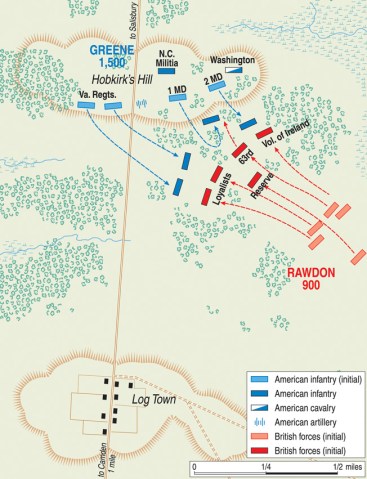
Undaunted by the loss at Guilford Courthouse, Greene turned his attention to the British outposts in the interior of South Carolina. The Southern Army marched through country that was extremely difficult to operate—cut by deep creeks and impassable morasses, heavy timber, and thick underbrush. On April 20, they pulled up to the stockade walls of Camden, South Carolina where Lord Francis Rawdon had 900 Loyalist and British troops garrisoned. Aware that it was too strong to attack, Greene pulled his army back to Hobkirk’s Hill, a sandy ridge two miles north of Camden over which ran the Salisbury Road.
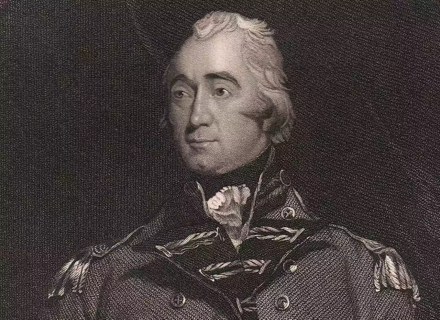
Colonel Lord Francis Rawdon
In the early morning hours of April 25, 1781, a skittish drummer deserted from the Maryland line. He carried word to Rawdon that the American Army was weakened by detachments and lack of food. General Greene had no artillery with him. It was in the rear along with the baggage train and that militia General Thomas Sumter had not come up yet to support the Americans. Rawdon listened to the drummer. He armed the boy along with every man in the garrison, including musicians and drummers.
Nathanael Greene’s troops were camped on Hobkirk’s Hill in order of battle in a wide line across the hill. Colonel Otho Holland Williams had overall command of the Maryland troops to the left of the road, and General Isaac Huger ranked command over the Virginia Continentals to the right. Otho’s two regiments were the 1st Maryland, commanded by Colonel John Gunby and the 2nd Maryland commanded by Colonel Benjamin Ford. Gunby’s deputy was the brilliant Colonel John Eager Howard, who had led the regiment at Cowpens and taken up command at Guilford Courthouse when Gunby was pinned beneath his horse. The 2nd Virginians were under the direct command of Colonel Samuel Hawes with the 1st under Colonel Richard Campbell. Two hundred fifty North Carolina militia were in back of the Continentals. Colonel William Washington’s 3rd Continental Dragoons—only about fifty mounted due to the difficulty of procuring horses—were held in reserve.
Colonel Otho Holland Williams
To protect them from surprise, pickets were stationed 300 yards in front of their lines supported by Maryland, Virginia, and Delaware Continentals. Greene’s men were enjoying the quiet morning buoyed by his orders that every man would receive two days’ worth of food and a gill of spirits as soon as quartermaster Colonel Edward Carrington arrived with the stores. Their arms were stacked. Coats and shoes lay scattered. Washington’s dragoon horses grazed peacefully at their loose tethers. Men were relaxing by a rivulet, soaking their sore feet or cleaning their kettles when they heard the sound of sharp musketry at the base of the hill.
The American drums beat to arms as the pickets clashed with Lord Rawdon’s vanguard. The surprised Americans, many still barefoot and half-dressed, rushed to form their lines. Gun smoke curl up and through the towering pine trees. Otho Holland Williams tried to keep his surprise concealed when he mounted his horse and galloped from the front lines to Greene’s headquarters. When he arrived, General Greene, who had been enjoying the rare luxury of a cup of coffee, was on his feet. Satisfied, Otho returned to the lines before the fighting became widespread.
Greene abandoned his breakfast and jumped into the saddle, followed by his aides majors Lewis Morris and Ichabod Burnett. North Carolina militia officer Guilford Dudley was marching up the back side of the hill with the artillery. Otho ordered Dudley to “March to the right and support Colonel Campbell.”
Greene rode forward with a good view of the hill. Captain Robert Kirkwood’s Delaware pickets were slowly being pushed back by Rawdon’s vanguard. The British commander had arranged his men in a single line with his Corps of Observation in the rear, the right wing supported by 675 provincial regulars and the Volunteers of Ireland on the left. Rawdon’s line was narrow. Greene believed that they could strike their flanks, rear, and front. He quickly ordered Colonel Richard Campbell to wheel left upon the enemy’s right flank. He communicated that he wanted Colonel Benjamin Ford that he was to wheel his men to the right.
As Rawdon advanced, Greene sent orders to unmask the artillery. The American gunners shredded the tightly packed British columns with volleys of whistling grapeshot. Through the clearing blue smoke, General Greene saw the destruction and was beside himself with satisfaction. “Victory is in reach! Draw forth and send instructions to Colonels Gunby and Hawes to conduct a bayonet charge in the center. Then send Colonel Washington and his dragoons to turn the enemy’s right flank and charge them in the rear.”
Lord Rawdon raged as he saw his men fall and the Continentals charging with bayonets. He took his aggressive anger out on one of his aides, “I was told that Greene had no artillery!” He shouted orders to the Volunteers of Ireland who came up and added their fire against the Maryland ranks. Rawdon continued to disseminate orders to his aides, “Rally, my boys, and bring up all from the rear. Lengthen our lines and avoid the flanking maneuver the American general intends on executing.”
Aside from the 63rd foot, all of Rawdon’s troops were American Tories fighting against American Whigs, and they were quick to take advantage of the thick woods on the hill. The firing was so intense that musket barrels became too hot to hold in their hands.
As Nathanael Greene’s infantry rolled forward so too did William Washington and his dragoons. They swept down around the hill to avoid felled trees and heavy undergrowth, and then rode hard for Major John Coffin’s dragoons on the British right flank. They clashed and swung their short blades from the saddles of their wheeling horses. Coffin’s men scattered. Although deterred by the thick undergrowth, Washington gathered his dragoons under the direct command of captains William Parsons and Walker Baylor and fell upon the rear of the British infantry. They became bogged down in taking prisoners who were, in fact, Lord Rawdon’s desperate attempt to arm as many as he could. The musicians, surgeons, and teamsters had no stomach to stand up against a force of hard galloping dragoons, and they quickly surrendered.
Colonel William Washington
The American infantry continued to push forward. Many of the Marylanders under Colonel Benjamin Ford were new recruits, and some began firing without orders. Ford was shot off his horse and suffered a mortal wound. None of the skittish 2nd Marylanders came to their colonel’s aide. Gunby’s and Hawes’ men continued a steady advance. Some forgot to use their bayonets and fired instead. The trusted captain of the right company, William Beatty, was shot through the heart and dropped dead.
Colonel John Eager Howard
His company, the 1st Marylanders, became deranged and fell out of line. The other companies under Colonel John Eager Howard were still advancing, and instead of pushing them all forward Colonel John Gunby saw they were marching in the form of a bow and ordered them to fall back to the foot of the hill and reform. The consequences were fatal. General Greene had told them not to fire. Now, they were being told to halt in the face of a charging British force. They broke and ran. This left the 2nd Marylanders isolated, and they too fell back followed by the 1st Virginians.
Otho Holland Williams saw the panic and rode toward them, but neither he nor Colonels Howard or Gunby could stop it. Greene was up on the ridge where he had spent most of the battle with Samuel Hawes’ 2nd Virginians. He exposed himself like a captain of grenadiers and attempted to restore order. It became obvious that Lord Rawdon understood that Hawes’ men were alone, and, seeing his advantage, pressed the hill to flank them and silence the American artillery.
Swept up in the tide of retreating troops, the American gunners mishandled their frightened teams and snagged the limbers in heavy brush. The horses panicked and had to be cut from the limbers. Bitterly disappointed, Greene issued the order for his surviving regiments to withdraw, and they formed with the now-rallied Gunby’s men at the foot of the hill.
The troubles the gunners were encountering came to Greene’s attention as they tried to pull the cannon out of the reach of the enemy with drag ropes. He jumped from his saddle, and with the horse’s bridle in one hand and a drag rope in the other, he encouraged the dismayed gunners, “There is not a man here who does not have the courage to take the cannon off.” Seeing that their general was with the artillery, others came to help. Greene wasted no time, and he rode on to see what could be done about bringing the rout to a halt.
Major John Coffin’s British dragoons charged toward the cannon with swords aloft and began to put some of the men dragging the cannon to the sword. The assault gave the others time to get the guns hitched to horses and safely away backed up by Washington’s charging dragoons, each with prisoners in tow. It was a wasted effort. Bogged down by captives and the wooded lay of the land, Washington’s cavalry could not act with effect.
Greene called a retreat. Washington caught up with the main army and delivered the prisoners he probably should not have taken. Greene ordered the prisoners processed. He knew Rawdon was in pursuit. He did not know that Rawdon had left Major John Coffin with his cavalry on Hobkirk’s Hill to claim the ground as a British victory.
Greene ordered Washington to go back and screen their retreat and to take Captain Kirkwood’s Delaware unit with him. He also instructed Washington to take up their stragglers and wounded, and bring them back. If circumstances and time permitted, bury their dead.
Greene led his army three miles north of Hobkirk’s Hill and stopped to camp at Saunders’ Creek in the same sandy Pine Barrens where Horatio Gates had lost an army. Lord Rawdon broke off his pursuit and returned to the walls of Camden. Both commanders lost 200 men—dead, wounded, captured, and missing. Greene was in a vexatious mood after the loss he was certain could have been a victory. He changed his password and countersign to “Persevere” and “Fortitude.” The loss angered him and wounded his pride. He directed his anger at Maryland Colonel John Gunby saying his actions were the cause for the loss and had Gunby court-martialed.
On April 28, he issued orders in the camp at Rugeley’s Mill, “General Huger, Colonel Harrison, and Colonel Washington are to compose a court to inquire into the conduct of Colonel Gunby in the action of the 25th instant.” The testimony found that Gunby was exerting himself in rallying and forming his troops, only committing an error in judgment. Greene could not let it pass. He castigated Gunby publicly in written orders:
Col. Gunby’s Spirit and activity were unexceptional. But his order for the regiment to retire, which broke the line, was extremely improper and unmilitary; and in all probability the only cause why we did not obtain a complete victory.
Despite Greene’ loss, by April 24 Cornwallis had had enough of Nathanael Greene. He abandoned the Carolinas and marched to Virginia. Greene’s strategy began to strangle the British. He cut off Lord Rawdon’s supply line and forced him to evacuate Camden on May 9. Over that month under Greene’s orders, the British outposts fell at the hands of “Light-Horse” Harry Lee and militia generals Francis Marion and Andrew Pickens. Greene laid siege to the last remaining outpost at the fortified town of Ninety-Six on May 22. The siege ended in bloody, hand to hand combat. Nathanael retreated on June 18. Lord Rawdon marched into Ninety-Six two days later and eventually burned the outpost.
Greene moved his army to the High Hills of Santee near Camden where the air was cooler and the mosquitos were less relentless. Although it was a camp of repose, there was not a moment that allowed him to let his guard down or cease his endless letters of instruction, exhortation, and solicitation regarding the condition of his ragged, malaria-ridden army and their needs. Still, his sense of humor didn’t completely escape him. He wrote to General Henry Knox that no general had run as often or “more lustily” as he had and likened his flight to that of “a Crab, that could run either way.”
Hobkirk’s Hill and the collapse of the British outposts in South Carolina was not be the end of Greene’s strategy. His relentless perseverance to keep the British locked in Savannah and Charleston paid off. On October 19, 1781, Lord Cornwallis surrendered to Franco/American forces at Yorktown, Virginia. If it had not been for General Nathanael Greene, the surrender at Yorktown likely would not have happened.
My biographical novel about General Nathanael Greene title “The Line of Splendor: A Novel of Nathanael Greene and the American Revolution” is available on Amazon. Click the cover to get your copy!
Resources:
Beakes, John H. Jr. Otho Holland Williams in The American Revolution. Charleston, South Carolina: The Nautical and Aviation Publishing Co. of American, 2015
Beakes, John H. Jr. and Piecuch, Jim. Cool Deliberate Courage: John Eager Howard in the American Revolution. Heritage Books, 2009
Buchannan, John. The Road to Charleston. Charlottesville: University of Virginia Press, 2019
Carbone, Gerald M. Nathanael Greene A Biography of the American Revolution, 2008.
Golway, Terry. Washington’s General Nathanael Greene and the Triumph of the American Revolution. New York: Henry Holt and Company
Greene, George Washington. The Life of Nathanael Greene, Major General in the Army of the Revolution.3 Volumes. New York: Hurd and Houghton. Cambridge: Riverside Press, 1871
Thayer, Theodore. Nathanael Greene Strategist of the American Revolution. New York: Twayne Publishers, 1960
After the Battle of Monmouth on June 28, 1778, the American Revolutionary War lulled in the north where British General Sir Henry Clinton was stationed with a large part of his army in New York. King George III and the British Parliament turned their eyes on the American South and sent their armies where a civil war raged between American Loyalists and Patriots.
In response, the Continental Congress, the Patriot civilian governing body sent Generals Robert Howe, Benjamin Lincoln, and Horatio Gates respectively who from 1778 – 1780 lost Savannah, Georgia; Charleston, South Carolina; and Camden, South Carolina to the British.
Congress’ previous choices to command the Southern Army failed. Now, they left the choice to General George Washington. He chose his ablest major general: Nathanael Greene. Nathanael’s brilliant strategy, wore down the British army in the South commanded by General Lord Charles Cornwallis. After months of chasing Greene’s army, which lost every engagement except the battle at Cowpens, South Carolina, Cornwallis abandoned Georgia and the Carolinas and retreated with his exhausted and starving army into Virginia. Then, Nathanael systematically destroyed the British outposts, supply lines, and communication lines between the British holding Savannah and Charleston, and the rest of South Carolina.
Major General Nathanael Greene
In late August 1781, Nathanael learned that British Colonel Alexander Stewart was moving through central South Carolina and he intended to put a stop to it. On August 23, he marched his army out of the High Hills of Santee looking for a fight.
On September 7, after weeks of mucking through swamps and heavy rains, the Southern Army arrived at Burdell’s Plantation seven miles from Eutaw Springs, South Carolina where Stewart was camped with 1,500 men. During their march, Nathanael’s army picked up militia under Francis Marion, Andrew Pickens and Francois de Malmedy. Cavalry Colonel William Washington also reunited with them swelling the army to nearly 2,400 men. Nathanael ordered his troops to cook one day’s provisions and allowed them a gill of rum. They would attack in the morning.
On September 8, just before dawn, Nathanael’s army marched toward the enemy. At 7:00 a.m., they saw white tents near a brick mansion. Behind the mansion, springs drained into Eutaw Creek which flowed into the Santee River. A British foraging party was rooting for sweet potatoes when the American vanguard spotted them. Stewart sent cavalry Major John Coffin with a forward detachment. They skirmished with Colonel “Light-Horse” Harry Lee’s legion. Colonel Otho Holland Williams ordered “Move in the order of battle and halt.”
Colonel Otho Holland Williams
The order of battle was familiar: militia up front, with orders to fire and fall back. This placed the militiamen from North Carolina and South Carolina in front with Colonel Harry Lee’s legion and reinforcements from Francis Marion and Andrew Pickens. Behind the militia, Continentals, men from Maryland, Virginia and North Carolina formed the line. Nathanael held Washington’s cavalry and Colonel Robert Kirkwood’s Delaware company in reserve. Stewart posted a single main line of defense to the west. His 63rd and 64th Regiments of Foot looked directly across at Francis Marion.
General Francis Marion
Stewart’s 3rd Regiment of Foot held the right of his line. His center was anchored with Loyalist brigades from New York and New Jersey. Musket fire exploded from both sides of the line. Continental 2lb grasshoppers boomed. The Virginia and Maryland regiments drove toward the brick mansion in a race to get inside before the British. The British won shouldering the door closed against the Americans pushing from the other side. American troops surged through the British camp and tripped over tent ropes and stakes. British marksmen opened fire. The Americans tried to dislodge the British with unsuccessful cannon fire.
Major John Marjoribanks tried to hold the British right flank. Nathanael ordered Colonel William Washington to push against Marjoribanks. The British in the mansion raked Washington and his men. Washington’s horse was shot out from underneath him. He was bayonetted and taken prisoner. Colonel John Eager Howard of Maryland was shot in the collar bone. Colonel Richard Campbell of Virginia was mortally shot in the chest. Harry Lee’s deputy executed an unsuccessful charge. Nathanael’s army was suffering debilitating losses and his men were scattered across the field.
Colonel William Washington
After four hours of fighting he called a retreat and rallied his bloodied exhausted forces in the woods. Losses that day totaled 1,400. Both sides claimed victory. After destroying their firearms, Stewart retreated toward Charleston. Nathanael’s army returned to the High Hills of Santee. Nathanael praised his soldiers and the militia to Congress. He was awarded a Congressional Gold Medal of Honor bearing his likeness. Otho Holland Williams was awarded a sword. The Battle of Eutaw Springs was the last significant land battle of the Revolutionary War.
A month after the battle, due to General Nathanael Greene and his army’s perseverance and sacrifice, the British general he had chased out of the Carolinas, Lord Charles Cornwallis, surrendered to Franco/American forces under General George Washington at Yorktown, Virginia on October 19, 1781.
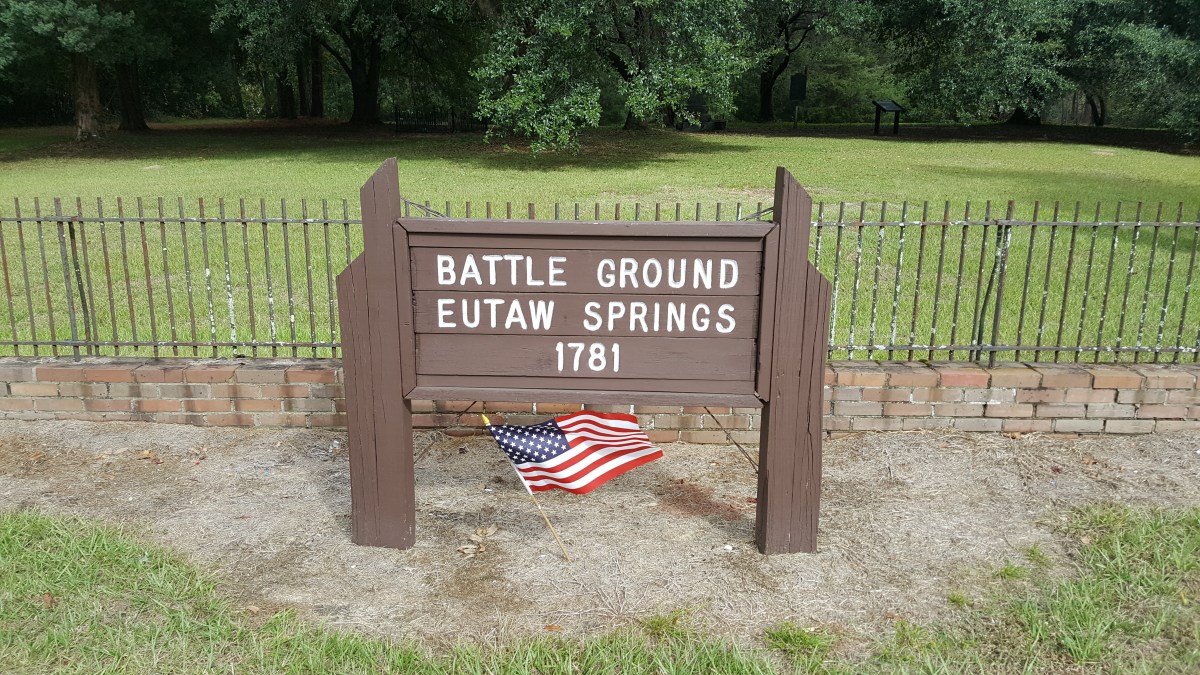
Marker erected by the Daughters of the American Revolution Eutaw Chapter
Eutaw Springs a poem by Philip Freneau (1752–1832) First published in the Freeman’s Journal, November 21, 1781
AT Eutaw Springs the valiant died:
Their limbs with dust are covered o’er—
Weep on, ye springs, your tearful tide;
How many heroes are no more!
Marker depicting the grave of British Major John Marjoribanks who died from wounds received at Eutaw Springs
My biographical novel about General Nathanael Greene title “The Line of Splendor: A Novel of Nathanael Greene and the American Revolution” is available Amazon. Click the cover to get your copy!
Resources:
Beakes, John H. Jr. Otho Holland Williams in The American Revolution. Charleston, South Carolina: The Nautical and Aviation Publishing Co. of American, 2015
Beakes, John H. Jr. and Piecuch, Jim. Cool Deliberate Courage: John Eager Howard in the American Revolution. Heritage Books, 2009
Buchannan, John. The Road to Charleston. Charlottesville: University of Virginia Press, 2019
Carbone, Gerald M. Nathanael Greene A Biography of the American Revolution, 2008.
Golway, Terry. Washington’s General Nathanael Greene and the Triumph of the American Revolution. New York: Henry Holt and Company
Greene, George Washington. The Life of Nathanael Greene, Major General in the Army of the Revolution.3 Volumes. New York: Hurd and Houghton. Cambridge: Riverside Press, 1871
Thayer, Theodore. Nathanael Greene Strategist of the American Revolution. New York: Twayne Publishers, 1960












 Salina B Baker