The Battle of Guilford Courthouse

At daybreak on March 14, 1781, Major General Nathanael Greene’s army moved out of camp at Speedwell Iron Works in North Carolina and marched the road to Guilford Courthouse to meet his opponent British General Charles, Lord Cornwallis in a long awaited battle. Greene had studied this land well. The choice of position was wholly his decision. The grounds lay in the middle of irregular cultivated fields interspersed with small clearings. The courthouse stood on a hill in one of the clearings. A gentle declivity formed an undulating slope nearly half a mile in length. Greene’s army consisted of 4,243 foot and 160 horse. Fifteen hundred were Continentals, the rest militia. He put his order of battle in place. It was a model of Daniel Morgan’s at Cowpens. The enemy would have to march up New Garden Road where Greene deployed the first of three defensive lines. He positioned one thousand North Carolina militia on the edge of the woods behind a rail fence.

Major General Nathanael Greene instructing the North Carolina Militia in the first line, Battle of Guilford Courthouse.

They would have a good view of the British as they marched out of the woods, through fields and across a small stream. Twelve hundred Virginia militiamen formed the second line. Fourteen hundred experienced Continentals from Virginia, Maryland and Delaware drew up on a brow of the gently rising hill near the courthouse and formed the third line.

Battle of Guilford Court House, a portrait of the battle by H. Charles McBarron Jr.

They were in overall command of General Isaac Huger and Colonel Otho Holland Williams. The army had four 6-pound cannon and one hundred artillerymen. Greene posted two on the road between the militia regiments and the other two between the Virginia and Delaware fronts.

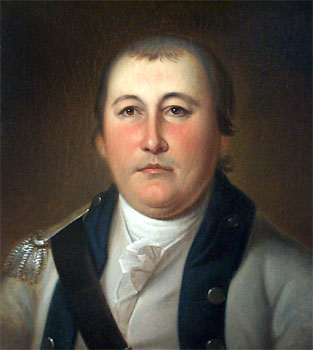
Colonel Otho Holland Williams

Colonel William Washington’s cavalry protected the right flank while Colonel Harry Lee’s horsemen positioned themselves on the left. To the rear, the Reedy Fork Road served as the line of retreat. Like at Cowpens, each line would deliver two or three well-executed volleys and then retire to the second line.

The battlefield at Guilford Courthouse was much larger and Greene was unable to see the entire field. On the morning of March 15, 1781, the wailing pipes of the Scottish Highlanders filtered through the woods. The first British and Hessian troops stepped out on the field and charged the Americans. British Colonel Banastre  Tarleton’s cavalry arrived on the main road with instructions not to charge without positive orders. They were followed by a second wave of infantry with Cornwallis leading the 71st Regiment of Highlanders and the German Regiment of Bose under the command of General Alexander Leslie on the right.

Colonel Banastre Tarleton

An ineffective artillery volley ensued then the British moved forward. The North Carolina line fired too early and their center collapsed. Cornwallis pressed Colonel James Webster’s 33rd foot and Jaegers forward from the left. The Virginia militia fired and gave fight. A volley thundered that threw back Webster’s men dropping both British and Americans. A musket ball smashed Virginia militia General Edward Stevens’ thigh. Webster suffered a mortal wound. There was a brief pause as Webster’s men retreated to reform. General Charles O’Hara’s reserves of grenadiers and the 2nd Battalion of Guards united with Alexander Leslie’s troops. They crossed a ravine and emerged from the woods and attacked Greene’s third line, the Maryland and Delaware Continentals. The 1st Marylanders stood their ground. O’Hara was hit in the chest.

General Alexander Leslie

He turned his command over to Colonel James Stewart. Stewart headed for the fleeing 2nd Marylanders and captured two cannon. He turned on the 1st Maryland and they volleyed at the same time. Their colonel, John Gunby lost his mount and was pinned under it. His deputy commander, Colonel John Eager  Howard, took over for him. A bugle sounded and William Washington and his dragoons thundered through the 2nd Guards and slaughtered them. John Eager Howard regrouped his Marylanders. The shattered British troops tried to reform.
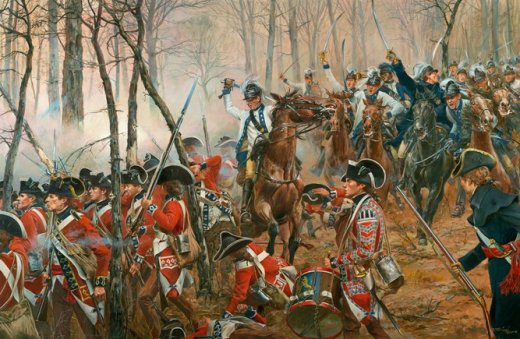
Battle of Guilford Courthouse. Painting by Don Troiani depicting William Washington’s dragoons thundering through the 2nd Guards

Greene pressed forward into the midst of the battle. There was nothing between him and the enemy but woods. His aide saw the danger and warned, “You are riding into the enemy, General Greene!” Greene calmly nodded, turned his horse and rode back to his position. The enemy was gaining ground on his right. At 3:30 pm, two hours after the battle began, he saw that the enemy had turned his left flank. He ordered a retreat before his army could be encircled.

Major General Nathanael Greene

Cornwallis’ lost twenty-five percent of his army in the pyrrhic British victory. The days leading up to Guilford Courthouse overwhelmed Nathanael Greene and he fainted after  the battle, but it was the turning point that forced Cornwallis out of the Carolinas and into Virginia where he met his final surrender to Franco/American forces led by George Washington on October 19, 1781.


Resources:

Beakes, John H. Jr. Otho Holland Williams in The American Revolution. Charleston, South Carolina: The Nautical and Aviation Publishing Co. of American, 2015.

Buchannan, John. The Road to Charleston. Charlottesville: University of Virginia Press, 2019.

Buchannan, John. The Road to Guilford Courthouse. Toronto: John Wiley & Sons, Inc., 1997.

Carbone, Gerald M. Nathanael Greene A Biography of the American Revolution, 2008.

Greene, George Washington. The Life of Nathanael Greene, Major General in the Army of the Revolution. 3 Volumes. New York: Hurd and Houghton. Cambridge: Riverside Press, 1871.

Piecusch, Jim, and John H. Beakes, Jr. Cool Deliberate Courage John Eager Howard in the American Revolution. Berwyn Heights, Maryland: Heritage Books, Inc., 2009.

Featured image. The equestrian statue of General Nathanael Greene at Guilford Courthouse Military Park, Greensboro, North Carolina


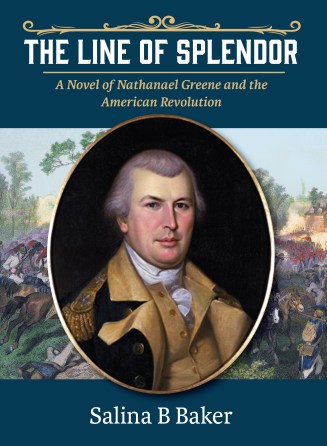
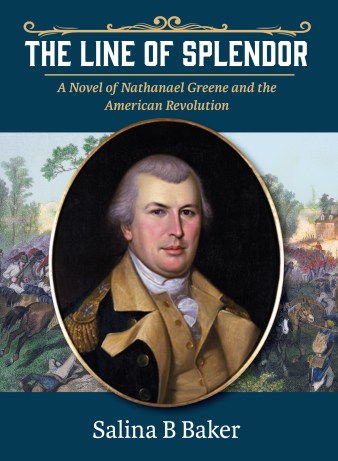
My biographical novel about General Nathanael Greene titled “The Line of Splendor, A Novel of Nathanael Greene and the American Revolution” is available on Amazon. Click on the cover to get your copy.
The Battle of Eutaw Springs

After the Battle of Monmouth on June 28, 1778, the American Revolutionary War lulled in the north where British General Sir Henry Clinton was stationed with a large part of his army in New York. King George III and the British Parliament turned their eyes on the American South and sent their armies where a civil war raged between American Loyalists and Patriots.

In response, the Continental Congress, the Patriot civilian governing body sent Generals Robert Howe, Benjamin Lincoln, and Horatio Gates respectively who from 1778 – 1780 lost Savannah, Georgia; Charleston, South Carolina; and Camden, South Carolina to the British.

Congress’ previous choices to command the Southern Army failed. Now, they left the choice to General George Washington. He chose his ablest major general: Nathanael Greene. Nathanael’s brilliant strategy, wore down the British army in the South commanded by General Lord Charles Cornwallis. After months of chasing Greene’s army, which lost every engagement except the battle at Cowpens, South Carolina, Cornwallis  abandoned Georgia and the Carolinas and retreated with his exhausted and starving army into Virginia. Then, Nathanael systematically destroyed the British outposts, supply lines, and communication lines between the British holding Savannah and Charleston, and the rest of South Carolina.

Major General Nathanael Greene

In late August 1781, Nathanael learned that British Colonel Alexander Stewart was moving through central South Carolina and he intended to put a stop to it. On August 23, he marched his army out of the High Hills of Santee looking for a fight.

On September 7, after weeks of mucking through swamps and heavy rains, the Southern Army arrived at Burdell’s Plantation seven miles from Eutaw Springs, South Carolina where Stewart was camped with 1,500 men. During their march, Nathanael’s army picked up militia under Francis Marion, Andrew Pickens and Francois de Malmedy. Cavalry Colonel William Washington also reunited with them swelling the army to nearly 2,400 men. Nathanael ordered his troops to cook one day’s provisions and allowed them a gill of rum. They would attack in the morning.

On September 8, just before dawn, Nathanael’s army marched toward the enemy. At 7:00 a.m., they saw white tents near a brick mansion. Behind the mansion, springs drained into Eutaw Creek which flowed into the Santee River. A British foraging party was rooting for sweet potatoes when the American vanguard spotted them. Stewart sent cavalry Major John Coffin with a forward detachment. They skirmished with Colonel “Light-Horse” Harry Lee’s legion. Colonel Otho Holland Williams ordered “Move in the order of battle and halt.”

Colonel Otho Holland Williams

The order of battle was familiar: militia up front, with orders to fire and fall back. This placed the militiamen from North Carolina and South Carolina in front with Colonel Harry Lee’s legion and reinforcements from Francis Marion and Andrew Pickens. Behind the militia, Continentals, men from Maryland, Virginia and North Carolina formed the line. Nathanael held Washington’s cavalry and Colonel Robert Kirkwood’s Delaware company in reserve. Stewart posted a single main line of defense to the west. His 63rd and 64th Regiments of Foot looked directly across at Francis Marion.

General Francis Marion

Stewart’s 3rd Regiment of Foot held the right of his line. His center was anchored with Loyalist brigades from New York and New Jersey. Musket fire exploded from both sides of the line. Continental 2lb grasshoppers boomed. The Virginia and Maryland regiments drove toward the brick mansion in a race to get inside before the British. The British won shouldering the door closed against the Americans pushing from the other side. American troops surged through the British camp and tripped over tent ropes and stakes. British marksmen opened fire. The Americans tried to dislodge the British with unsuccessful cannon fire.

Major John Marjoribanks tried to hold the British right flank. Nathanael ordered Colonel William Washington to push against Marjoribanks. The British in the mansion raked Washington and his men. Washington’s horse was shot out from underneath him. He was bayonetted and taken prisoner. Colonel John Eager Howard of Maryland was shot in the collar bone. Colonel Richard Campbell of Virginia was mortally shot in the chest. Harry Lee’s deputy executed an unsuccessful charge. Nathanael’s army was suffering debilitating losses and his men were scattered across the field.

Colonel William Washington

After four hours of fighting he called a retreat and rallied his bloodied exhausted forces in the woods. Losses that day totaled 1,400. Both sides claimed victory. After destroying their firearms, Stewart retreated toward Charleston. Nathanael’s army returned to the High Hills of Santee. Nathanael praised his soldiers and the militia to Congress. He was awarded a Congressional Gold Medal of Honor bearing his likeness. Otho Holland Williams was awarded a sword. The Battle of Eutaw Springs was the last significant land battle of the Revolutionary War.

A month after the battle, due to General Nathanael Greene and his army’s perseverance and sacrifice, the British general he had chased out of the Carolinas, Lord Charles Cornwallis, surrendered to Franco/American forces under General George Washington at Yorktown, Virginia on October 19, 1781.

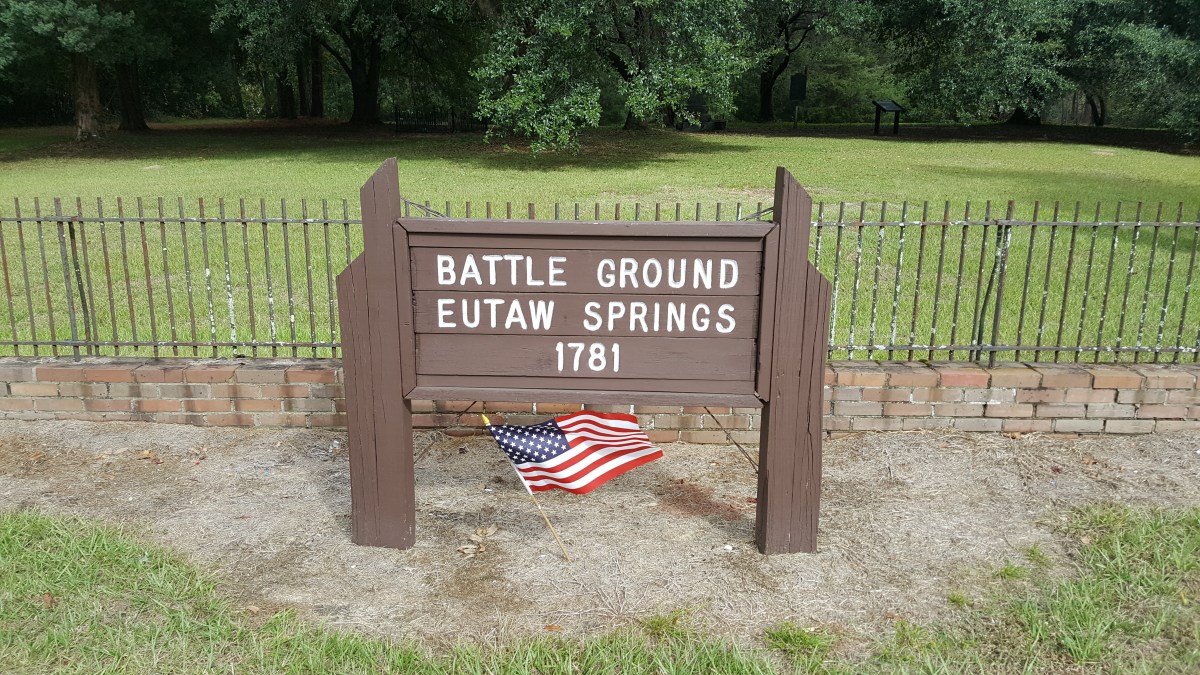
Marker erected by the Daughters of the American Revolution Eutaw Chapter

Eutaw Springs a poem by Philip Freneau (1752–1832) First published in the Freeman’s Journal, November 21, 1781

AT Eutaw Springs the valiant died:

Their limbs with dust are covered o’er—

Weep on, ye springs, your tearful tide;

How many heroes are no more!

Marker depicting the grave of British Major John Marjoribanks who died from wounds received at Eutaw Springs


My biographical novel about General Nathanael Greene title “The Line of Splendor: A Novel of Nathanael Greene and the American Revolution” is available Amazon. Click the cover to get your copy!


Resources:

Beakes, John H. Jr. Otho Holland Williams in The American Revolution. Charleston, South Carolina: The Nautical and Aviation Publishing Co. of American, 2015

Beakes, John H. Jr. and Piecuch, Jim. Cool Deliberate Courage: John Eager Howard in the American Revolution.  Heritage Books, 2009

Buchannan, John. The Road to Charleston. Charlottesville: University of Virginia Press, 2019

Carbone, Gerald M. Nathanael Greene A Biography of the American Revolution, 2008.

Golway, Terry. Washington’s General Nathanael Greene and the Triumph of the American Revolution. New York: Henry Holt and Company

Greene, George Washington. The Life of Nathanael Greene, Major General in the Army of the Revolution.3 Volumes. New York: Hurd and Houghton. Cambridge: Riverside Press, 1871

Thayer, Theodore. Nathanael Greene Strategist of the American Revolution. New York: Twayne Publishers, 1960