At daybreak on March 14, 1781, Major General Nathanael Greene’s army moved out of camp at Speedwell Iron Works in North Carolina and marched the road to Guilford Courthouse to meet his opponent British General Charles, Lord Cornwallis in a long awaited battle. Greene had studied this land well. The choice of position was wholly his decision. The grounds lay in the middle of irregular cultivated fields interspersed with small clearings. The courthouse stood on a hill in one of the clearings. A gentle declivity formed an undulating slope nearly half a mile in length. Greene’s army consisted of 4,243 foot and 160 horse. Fifteen hundred were Continentals, the rest militia. He put his order of battle in place. It was a model of Daniel Morgan’s at Cowpens. The enemy would have to march up New Garden Road where Greene deployed the first of three defensive lines. He positioned one thousand North Carolina militia on the edge of the woods behind a rail fence.
Major General Nathanael Greene instructing the North Carolina Militia in the first line, Battle of Guilford Courthouse.
They would have a good view of the British as they marched out of the woods, through fields and across a small stream. Twelve hundred Virginia militiamen formed the second line. Fourteen hundred experienced Continentals from Virginia, Maryland and Delaware drew up on a brow of the gently rising hill near the courthouse and formed the third line.
Battle of Guilford Court House, a portrait of the battle by H. Charles McBarron Jr.
They were in overall command of General Isaac Huger and Colonel Otho Holland Williams. The army had four 6-pound cannon and one hundred artillerymen. Greene posted two on the road between the militia regiments and the other two between the Virginia and Delaware fronts.
Colonel Otho Holland Williams
Colonel William Washington’s cavalry protected the right flank while Colonel Harry Lee’s horsemen positioned themselves on the left. To the rear, the Reedy Fork Road served as the line of retreat. Like at Cowpens, each line would deliver two or three well-executed volleys and then retire to the second line.
The battlefield at Guilford Courthouse was much larger and Greene was unable to see the entire field. On the morning of March 15, 1781, the wailing pipes of the Scottish Highlanders filtered through the woods. The first British and Hessian troops stepped out on the field and charged the Americans. British Colonel Banastre Tarleton’s cavalry arrived on the main road with instructions not to charge without positive orders. They were followed by a second wave of infantry with Cornwallis leading the 71st Regiment of Highlanders and the German Regiment of Bose under the command of General Alexander Leslie on the right.
Colonel Banastre Tarleton
An ineffective artillery volley ensued then the British moved forward. The North Carolina line fired too early and their center collapsed. Cornwallis pressed Colonel James Webster’s 33rd foot and Jaegers forward from the left. The Virginia militia fired and gave fight. A volley thundered that threw back Webster’s men dropping both British and Americans. A musket ball smashed Virginia militia General Edward Stevens’ thigh. Webster suffered a mortal wound. There was a brief pause as Webster’s men retreated to reform. General Charles O’Hara’s reserves of grenadiers and the 2nd Battalion of Guards united with Alexander Leslie’s troops. They crossed a ravine and emerged from the woods and attacked Greene’s third line, the Maryland and Delaware Continentals. The 1st Marylanders stood their ground. O’Hara was hit in the chest.
General Alexander Leslie
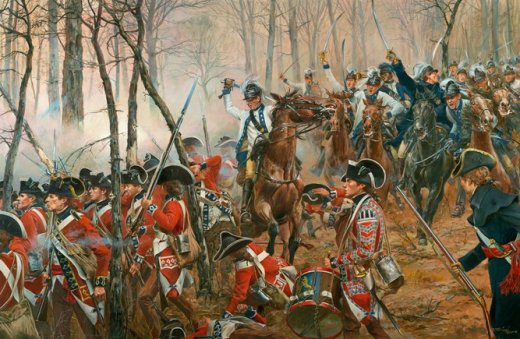
He turned his command over to Colonel James Stewart. Stewart headed for the fleeing 2nd Marylanders and captured two cannon. He turned on the 1st Maryland and they volleyed at the same time. Their colonel, John Gunby lost his mount and was pinned under it. His deputy commander, Colonel John Eager Howard, took over for him. A bugle sounded and William Washington and his dragoons thundered through the 2nd Guards and slaughtered them. John Eager Howard regrouped his Marylanders. The shattered British troops tried to reform.
Battle of Guilford Courthouse. Painting by Don Troiani depicting William Washington’s dragoons thundering through the 2nd Guards
Greene pressed forward into the midst of the battle. There was nothing between him and the enemy but woods. His aide saw the danger and warned, “You are riding into the enemy, General Greene!” Greene calmly nodded, turned his horse and rode back to his position. The enemy was gaining ground on his right. At 3:30 pm, two hours after the battle began, he saw that the enemy had turned his left flank. He ordered a retreat before his army could be encircled.
Major General Nathanael Greene
Cornwallis’ lost twenty-five percent of his army in the pyrrhic British victory. The days leading up to Guilford Courthouse overwhelmed Nathanael Greene and he fainted after the battle, but it was the turning point that forced Cornwallis out of the Carolinas and into Virginia where he met his final surrender to Franco/American forces led by George Washington on October 19, 1781.
Resources:
Beakes, John H. Jr. Otho Holland Williams in The American Revolution. Charleston, South Carolina: The Nautical and Aviation Publishing Co. of American, 2015.
Buchannan, John. The Road to Charleston. Charlottesville: University of Virginia Press, 2019.
Buchannan, John. The Road to Guilford Courthouse. Toronto: John Wiley & Sons, Inc., 1997.
Carbone, Gerald M. Nathanael Greene A Biography of the American Revolution, 2008.
Greene, George Washington. The Life of Nathanael Greene, Major General in the Army of the Revolution. 3 Volumes. New York: Hurd and Houghton. Cambridge: Riverside Press, 1871.
Piecusch, Jim, and John H. Beakes, Jr. Cool Deliberate Courage John Eager Howard in the American Revolution. Berwyn Heights, Maryland: Heritage Books, Inc., 2009.
Featured image. The equestrian statue of General Nathanael Greene at Guilford Courthouse Military Park, Greensboro, North Carolina
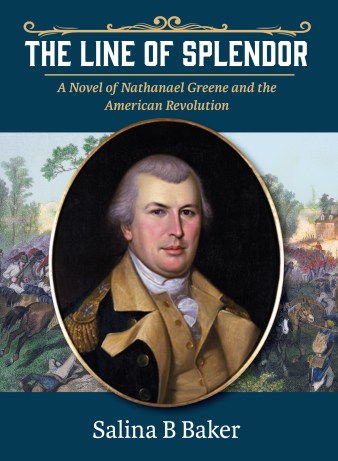
My biographical novel about General Nathanael Greene titled “The Line of Splendor, A Novel of Nathanael Greene and the American Revolution” is available on Amazon. Click on the cover to get your copy.
While many people today view their pets as close members of their family, even with human-like thoughts and feelings, this phenomenon was not as common in the eighteenth century. By 1775 at the start of the American Revolutionary War, dogs were well established and part of the culture, although they were not always welcome and ownership was restricted. Horses have been useful animals since the dawn of history, whether they’re used for a sport, work, or war. This attachment endured and directly contributed to the well-being, success and sometimes distress of many people whether they were American, British, French, or German.
Dogs
Spado
Continental Army Major General Charles Lee, a native of England, fought for the British army in the French and Indian War. When the war was over, he returned home and became a soldier of fortune. When he moved to North America in 1773, the Patriots hailed him as a military expert. Lee was slovenly, used foul language, sarcasm, and insults, and criticized his superiors. On the other hand, he was a composed, brilliant and courageous leader in battle.
Engraved caricature of Charles Lee with his dog, Spado
Charles Lee was often accompanied by at least one or two of his canine companions that only added to his eccentric perception for he proclaimed, “If you love me, you must love my dogs.” His favorite was Spado, which a guest at a dinner party described as “a native of Pomerania, which I should have taken for a bear had I seen him in the woods.” On another occasion in late 1775, Lee had Abigail Adams shake Spado’s paw. Comparing their trustworthiness with his fellow humans, Lee wrote to Abigail’s husband, John Adams, “Once I can be convinced that men are as worth objects as dogs, I shall transfer my benevolence.”
Lee’s dogs provided him with a sense of comfort. About a year later, Lee was captured in New Jersey. Either Spado wasn’t with the general or if he was, the British raiders didn’t bring Spado along. Lee wrote to George Washington from British-held New York asking that his dogs be brought to him as “I never stood in greater need of their Company than at present.”
Evidently Lee’s friends undertook to send Spado to the estate that the general had purchased in Virginia, but the dog was lost and an advertisement appeared Dunlap’s Maryland Gazette, published in Baltimore with a reward. Some of those Maryland newspapers made their way north because on March 9, 1777 Abigail Adams wrote to her husband, “I see by the news papers you sent me that Spado is lost. I mourn for him. If you know any thing of His Master pray Let me hear, what treatment he meets with, where he is confined &c.”
But evidently Spado was gone for good. When General Lee was finally released from captivity in the spring of 1778, his best companion was not there to greet him. He was never as cheerful afterward.
Lila
George Washington was an avid dog lover and fox hunter, Greyhounds, spaniels, terriers, newfoundlands, briards, and many toy breeds could be found in Washington’s extensive Mount Vernon kennel. Before and after the war, he visited his kennels daily and provided his pups with creative names, such as Madame Moose, Drunkard, Vulcan, Taster, Duchess, and Truelove.
George Washington and his Dogs
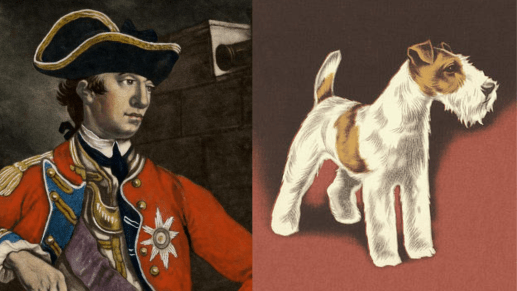
Washington’s love for his four-legged friends carried over to the Revolutionary War. At the Battle of Germantown on October 4, 1777, fog blanketed the fighting troops, causing mass confusion and many accidental misfires. British General William Howe’s pet fox terrier, Lila, was one of the many lost in the confusion. Disoriented, Lila followed Washington and the Continental Army home from the battle. After Washington identified Howe as Lila’s owner from her collar he felt it was his duty to return her, opposed to keeping her as a trophy of war.
General William Howe and a Fox Terrier similar to Lila
He delivered the dog back to Howe along with the following note, likely written by aide-de-camp, Alexander Hamilton, “General Washington’s compliments to General Howe. He does himself the pleasure to return him a dog, which accidentally fell into his hands, and by the inscription on the Collar appears to belong to General Howe.”
Azor
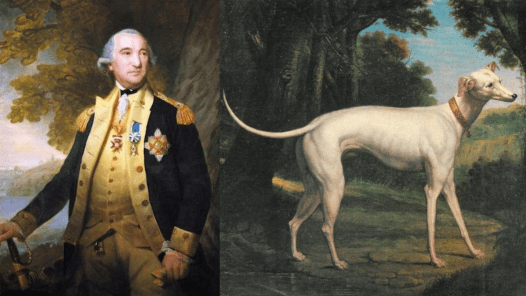
Baron Von Steuben of Prussia landed at Portsmouth, New Hampshire on December 1, 1777 with French aides and a large dog. Throughout the entire Revolutionary War, Steuben was accompanied by his beloved and much indulged Italian Greyhound, Azor. Even before Steuben’s party landed on American soil, Azor’s “discerning ear for music” put him in good stead with the crew of the ship which took them to New Hampshire. Azor howled pitifully every time the captain of the ship attempted to sing.
Baron von Steuben and an Italian Greyhound similar to Azor
Steuben’s aide, Pierre-Étienne du Ponceau, wrote: “We travelled on horseback. I must not forget the Baron’s dog Azor, the only pedestrian among us. He was a beautiful Italian grey hound who had an excellent ear for music.”
Baron von Steuben was promoted to major general and inspector general of the Continental Army. He proved to be a godsend to the fledging American army encamped for the winter at Valley Forge. He had a few idiosyncrasies that endeared him to the American troops: He wore enormous pistols in his uniform sash; he cursed in a multitude of foreign languages, and he was constantly followed by Azor. Ultimately, Steuben went down in history for the bravery, discipline, and grit he brought to the American troops and a dog that was there to provide him companionship and comfort. I found no record of what happened to Azor, but the dog was still with Steuben as late as 1786.
Horses
The American Revolution’s armies got their horsepower from horses. These animals carried cavalrymen into battle, pulled cannons, carts and wagons of all description, hauled baggage on their backs, moved messengers swiftly over countless miles, and brought officers and gentlemen to wherever they needed to be. The rebel colonists used their own horses in the war, but the British and Hessians often had to take theirs since it was difficult to ship horses across the Atlantic from England. Taking horses was not unknown among the Patriots, especially cavalry units who wore out their horses and horse furniture quickly, however they were supposed to pay the owner or provide a promissory note for the animal.
Cavalry
Without the cavalry troops used in the American Revolution, the Americans would not have stood a chance against the massive British Army. These horses provided them with faster feet to travel farther in a shorter time.
The Continental mounted forces rendered valuable service during the latter stages of the war, specifically in the Southern Theater of the American Revolution. William Washington’s 3rd Continental Light Dragoons played an instrumental role in the in the battles of Cowpens and Guilford Court House. Henry “Light Horse Harry” Lee’s Legion, as well as militia units led by generals Andrew Pickens, Thomas Sumter and Francis Marion, saw extensive action in American Major General Nathanael Greene’s operations in the southern colonies.
The Battle of Guildford Courthouse depicting Colonel William Washington’s dragoons
The hated and feared British cavalry officer, Colonel Banastre Tarleton often clashed with these legions and dragoon companies, one of the most famous being the Battle of Cowpens on January 17, 1781 when Tarleton and Washington dueled for a moment at the end of the battle.
The Battle of Cowpens by William Ranney 1845. Banastre Tarleton and William Washington at the end of the battle.
The British Army sent two regiments of light dragoons to serve in North America during the Revolutionary War. The first to arrive was the 17th Light Dragoons, who landed in Boston in 1775, while the city was still under siege by the Continental Army. They remained in America for the next eight years, serving in nearly every major campaign up through the end of hostilities.
Nelson and Blueskin
During the American Revolution, Washington was gifted two horses, Nelson and Blueskin who returned with Washington to Mount Vernon after the war.
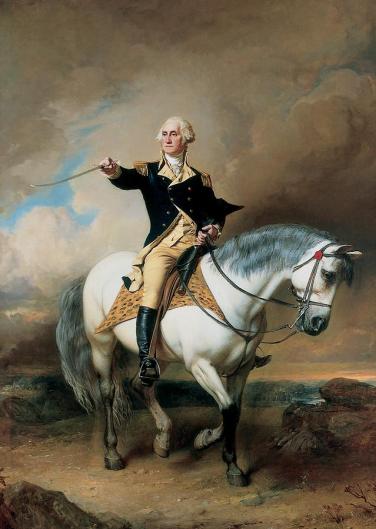
Blueskin was a half-Arabian blue roan – meaning that he had darker skin and lighter colored hair, so during the summer months when his hair was short, he looked bluish in color. When the weather turned colder and his coat thickened, he appeared to be white. Washington rode Blueskin in some battles during the war. However, Blueskin didn’t tolerate the sounds, smells and sights of battle as steadily as Washington would have liked. Many portraits of Washington depict him atop Blueskin, possibly due to the horse’s greyish-white color.
Washington depicted at Trenton riding Blueskin
In fact Washington often rode his other favorite horse, Nelson, to battle instead. Washington did use Blueskin for ceremonial events, which may also have contributed to Blueskin getting more “portrait time” than Nelson. Nelson was said to have “carried the General almost always during the war.” Described as a “splendid charger,” the animal was chestnut, with white face and legs. Nelson was less skittish during cannon fire and the startling sounds of battle. Washington chose to ride Nelson on the day the British army under the direction of Lord Cornwallis surrendered at Yorktown, Virginia in 1781.
Washington depicted at the Battle of Monmouth riding Nelson.
Nelson died at Mount Vernon “many years after the Revolution, at a very advanced age.” His death was reported to George Washington during the Christmas season of 1790, when the old horse would have been twenty-seven years old.
Britain
Britain was the name of the horse that Major General Nathanael Greene owned before the American Revolutionary War ignited on April 19, 1775. Nathanael often rode Britain into Boston and to visit friends and family in Rhode Island. The horse’s name could lead us to understand that before the first shots of the war were fired even men who became officers in the Continental Army still had a mental connection to the American Colonies’ mother country, Britain. There is no depiction of Britain so instead I present the equestrian statue of Nathanael Greene at Guilford Courthouse.
Equestrian statue of General Nathanael Greene at Guilford Courthouse
Warren
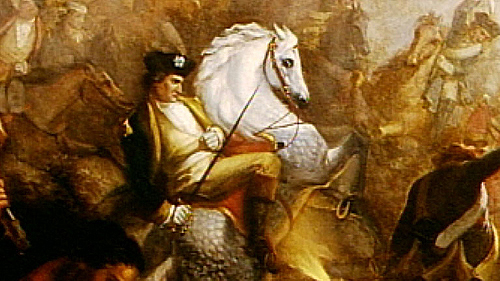
When General Benedict Arnold stormed Breymann’s Redoubt during the Battle of Bemis Heights near Saratoga, New York on October 7, 1777, he was riding a horse that he borrowed from a friend. “On he rushed through deepening twilight on a horse named for the dead hero [Joseph Warren] who had given him the commission with which his military career had begun.” [1] Arnold was shot in the thigh. The horse was shot in the heart and fell on Arnold pinning him beneath it, but it was this heroic action that won the pivotal battle that brought on an American alliance with France that aided in the Siege of Yorktown and the final British surrender in October 1781.
General Benedict Arnold depicted storming Breymann’s Redoubt
Paul Revere’s Horse
On the night of April 18, 1775, Dr. Joseph Warren sent Paul Revere and William Dawes to alert the countryside from Boston to Concord that the British regulars were out of Boston and on the march.
What was the name of the horse Revere rode? There is no evidence that Revere owned a horse at the time he made his famous ride. He likely owned a horse or he certainly had ready access to horses at some point in order to become the experienced rider that he was. If he had owned a horse in April 1775, it is unlikely he would have tried to bring it with him when he was rowed across the Charles River to Charlestown.
Paul Revere’s Ride
Revere left several accounts of his “Midnight Ride,” and although he states that he borrowed the horse from John Larkin, neither he nor anyone else takes much notice of the horse, or refers to it by name. Revere calls it simply “a very good horse.” In the years since 1775 many names have been attached to the animal, the most exotic probably being Scheherazade. The only name for which there is any evidence, however, is Brown Beauty. The following excerpt is taken from a genealogy of the Larkin family, published in 1930.
Samuel (Larkin) … born Oct. 22, 1701; died Oct. 8, 1784, aged 83; he was a chairmaker, then a fisherman and had horses and a stable. He was the owner of “Brown Beauty,” the mare of Paul Revere’s Ride made famous by the Longfellow poem. The mare was loaned at the request of Samuel’s son, deacon John Larkin, and was never returned to Larkin.










 Salina B Baker